Supreme Court Waqf Amendment Order: Key Provisions Stayed, Debate Intensifies
The Landmark Interim Order
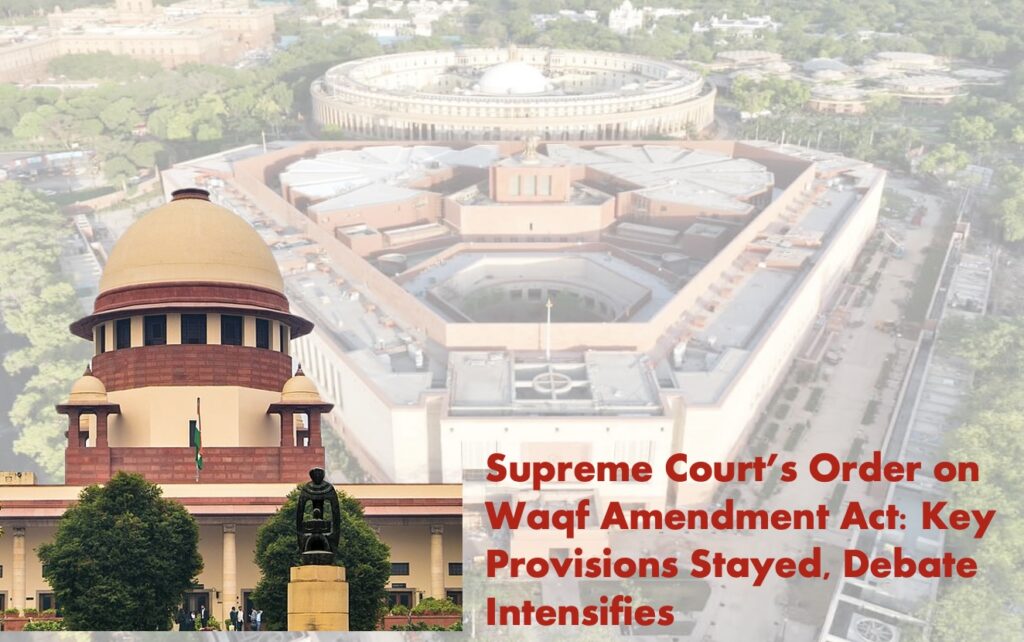
On September 15, 2025, the Supreme Court pronounced an interim order on the Waqf Amendment Act, sending ripples through India’s legal, political, and minority-rights landscape. The apex court refused to stay the entire waqf law but paused specific contentious provisions, igniting widespread debate among policymakers, legal experts, and community stakeholders. This editorial examines what has been stayed, the judicial rationale behind the move, and the implications for the government’s legislative intentions.
Key Provisions Stayed by Supreme Court
Five-Year Practice Clause Put on Hold
One of the most debated features of the amendment was the clause requiring individuals to be practicing Islam for five years to create a waqf. The Supreme Court, in its interim order, stayed this provision, observing its arbitrary character. The Court underscored that such a requirement may unlawfully exclude certain individuals, including recent converts or those with genuinely devout intentions, and could foster unnecessary religious gatekeeping. Therefore, the key-phrase “Supreme Court Waqf Amendment order” holds significant relevance for religious rights and equal protection under law.
Government Officer’s Power to Decide Property Disputes
Another provision—empowering a government Collector to decide if property is waqf or government land—was also halted. The bench held that property disputes should be adjudicated by a competent court or tribunal, protecting both transparency and the separation of powers. This stay is particularly important for historical waqf properties and landowners seeking fair judicial redress.
Non-Muslim Membership Capped
While the law had begun allowing non-Muslims as members or CEO of state waqf boards, the Court directed a cap: not more than three non-Muslims on state boards and four on the central council. It further recommended, as far as possible, that the CEO of the Waqf Board be a Muslim. This action aims to balance inclusive administration with the community’s right to religious management.
What Was Not Stayed
Some provisions remain in force. The registration of waqf properties and mixed board membership are untouched by the interim stay. The Court cited the presumption of constitutionality and left those aspects of the law largely undisturbed, pending final judgment.
Rationale Behind the Supreme Court’s Stay
The bench, led by Chief Justice B R Gavai, explained that “presumption of constitutionality” is always in favour of statutes enacted by Parliament. Stays are granted rarely—especially when the challenge affects core rights, potential for arbitrary exclusion, or overreach by the executive branch. By choosing an intermediate approach rather than a blanket stay, the Court signals respect for legislative processes while honouring constitutional safeguards.
In Summary:
The Supreme Court of India has actually not stayed the Amendment Act 2025 (as it was demanded in the petitions) and has stated that the Act is constitutional, applying the legal principle that laws passed by Parliament are presumed valid unless proven to violate the Constitution’s core pillars. The Court refused to interfere by way of stay or striking down the Act, despite multiple petitions claiming violations of Muslim constitutional rights.
Key points decided by the Supreme Court are:
- Petitioners asked for exemption from compulsory registration of Waqf and related properties; the Supreme Court ruled that registration will remain mandatory.
- The practice of the District Magistrate adjudicating government vs. Waqf property disputes was challenged; the Court stayed this, saying a party cannot act as judge in its own case, so disputes must go to a tribunal instead.
- Petitioners sought only revision as a remedy in property disputes; the Court allowed appeals with a wider scope instead, enabling fuller judicial review.
- It was contested whether non-Muslims can be members of Waqf Boards; the Court permitted non-Muslim members within specified limits for both Central and State Boards.
- The government’s condition requiring Muslims to have a five-year declared status to exercise certain rights was challenged; the Court stayed this condition for the time being.
Legal and Political Impact
Objectives of the Amendment: Checks and Balances
The Waqf Amendment sought greater transparency in waqf administration, tighter registration requirements, and broader government oversight. By staying contentious provisions such as the five-year clause and executive dispute resolution, the Supreme Court partially limits the government’s drive for regulatory reform, emphasizing minority autonomy and judicial due process.
Interim, Not Final—What’s Next?
Importantly, this order is temporary. The case remains under constitutional scrutiny, and the final judgment could affirm, expand, or reverse the changes. The government retains the right to appeal aspects of this interim order if warranted. It may also revisit the stayed provisions legislatively, drafting new rules or clarifications to pass constitutional muster.
Broader Implications for Minority and Secular Rights
The Supreme Court Waqf Amendment order has reignited debates about minority rights, secular governance, and communal inclusivity. Muslim organizations stress the need for autonomy and religious protection, while Hindu associations call for limits to historical waqf privileges. Legal circles praise the Court’s measured restraint but caution that foundational principles—especially regarding state intervention in religious property—are still at stake.
Conclusion: Awaiting Final Judgment
As stakeholders await the full, reasoned order, the Supreme Court’s interim stay on key waqf amendment provisions sets a balanced precedent in the intersection of religious freedom and regulatory reform. The law remains dynamic: advocacy groups, legal experts, and government ministries are all prepared for debate and future developments.