Supreme Court Rejects Union’s Challenge in NGO FCRA Renewal Case
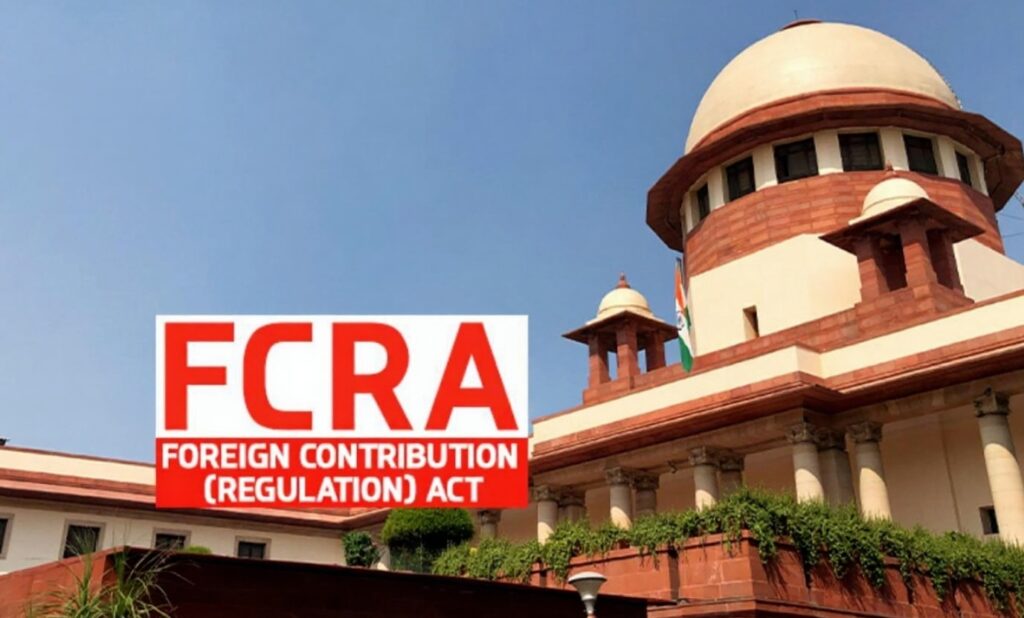
The Supreme Court of India has dismissed the Union government’s challenge to a Madras High Court ruling that directed renewal of an NGO’s Foreign Contribution (Regulation) Act (FCRA) registration. The Court held that there was no evidence of misuse of foreign funds and cautioned the government against obstructing voluntary organisations working for social welfare.
This ruling is significant for India’s civil society sector, where many NGOs depend on foreign contributions to run education, welfare, and heritage projects.
Background: The NGO and Its FCRA Dispute
The case concerns M/s Sharma Centre for Heritage Education, linked to the Ellen Sharma Memorial Trust, founded in 1982 for child welfare and education. The NGO has relied on foreign contributions for nearly three-quarters of its funding.
In 2016, its FCRA certificate was renewed for five years.
In 2021, the Ministry of Home Affairs (MHA) refused renewal under Section 16(1) read with Section 12(4)(a)(vii).
The refusal was based on alleged breaches of Section 7, which prohibits transfer of foreign contributions without approval.
The NGO argued that these were technical issues arising from the 2020 amendments and that no funds had been misused.
Madras High Court’s Relief to the NGO
In 2023, the Madras High Court (Justice N. Anand Venkatesh) ruled in favour of the NGO. The Court held that:
No evidence proved diversion of funds.
The MHA’s refusal order did not provide valid reasons.
A mere technical breach under the amended Section 7 could not justify denial of renewal.
The Court directed that renewal be granted within four weeks. The Union then appealed to the Supreme Court.
Supreme Court’s Observations
A bench of Justices Vikram Nath and Sandeep Mehta rejected the Union’s appeal. Justice Nath asked:
“Have they misappropriated? Is there any abuse of these funds received by them?”
When the government’s counsel could not provide proof, the bench said:
“If they are doing social service for society, what is your problem? You monitor, keep a check, let them file their accounts annually — that’s all. Don’t complicate things, don’t harass them.”
The Court’s remarks reinforced that regulatory powers must be exercised with fairness and transparency.
Legal Context: Key FCRA Provisions
Section 7: Restricts transfer of foreign contributions; tightened by the 2020 amendment.
Section 12(4)(a)(vii): Grounds for refusal of registration or renewal.
Section 16(1): Procedure for renewal.
The Court clarified that retrospective application of amendments cannot be used to deny renewal without evidence of financial misuse.
Implications for NGOs and Civil Society
The verdict has broad implications:
NGOs: Renewal cannot be denied for minor technical breaches unless misuse is proven.
Government: Must issue clear, reasoned orders when refusing renewals.
Civil Society: The judgment provides relief to organisations dependent on foreign funding for welfare and educational projects.
Conclusion
The Supreme Court’s decision upholding the Madras High Court’s order on NGO FCRA renewal ensures that NGOs engaged in genuine social service are not penalised for procedural issues. By dismissing the Union’s challenge, the Court has reinforced the need for accountability, fairness, and non-harassment in regulating foreign contributions.