Supreme Court Signals That Defamation Law Shall be Considered for Decriminalisation Now
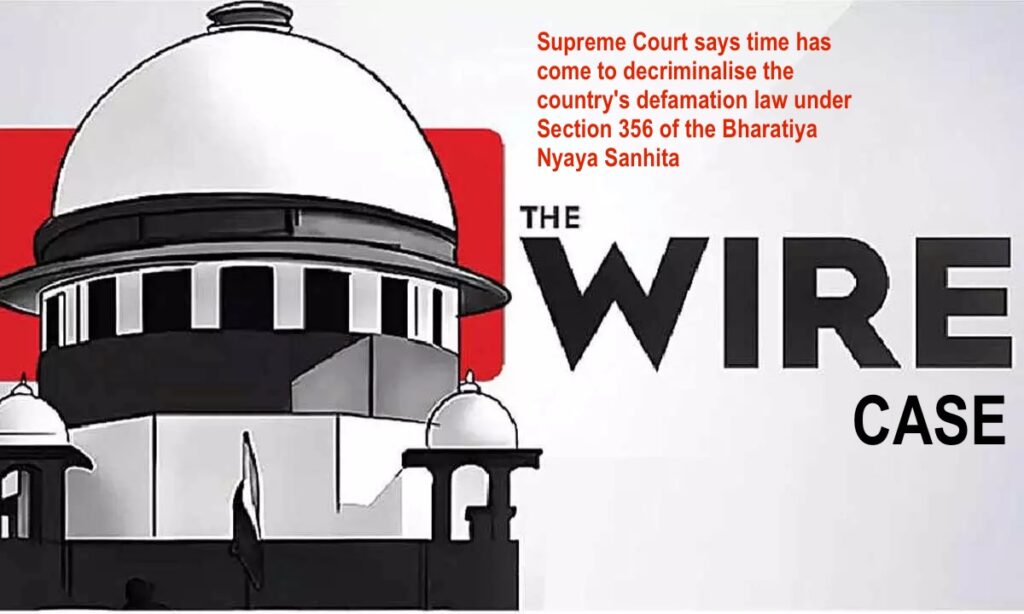
New Delhi, September 23, 2025 — The Supreme Court of India has made an important observation that the time has come to decriminalise the country’s defamation law, hinting at a possible shift in the legal landscape surrounding free speech and reputation protection. The apex court made this comment while hearing a crucial plea filed by the Foundation for Independent Journalism, the organization behind the prominent news portal The Wire, challenging a criminal defamation summons issued against it.
Defamation Law Under Supreme Court’s Spotlight
A bench of Justices M. M. Sundresh and Satish Chandra Sharma issued a notice to former Jawaharlal Nehru University (JNU) professor Amita Singh, the complainant in the defamation case. This case stems from a controversial 2016 news report published by The Wire, which alleged Professor Singh’s involvement in compiling a dossier that accused the university of harboring unlawful activities. Professor Singh has denied these allegations and filed the defamation complaint.
During proceedings, Justice Sundresh remarked, “I think time has come to decriminalise all this,”highlighting the Court’s readiness to reevaluate the criminal defamation provisions, currently codified under Section 356 of the Bharatiya Nyaya Sanhita, which replaced the older Indian Penal Code Section 499.
A Shift from 2016 Ruling on Criminal Defamation
This judicial suggestion marks a notable shift from the Supreme Court’s 2016 ruling where it upheld the constitutional validity of criminal defamation, emphasizing the right to reputation as part of the fundamental right to life and dignity under Article 21 of the Constitution. Since then, the criminal defamation law has faced growing criticism for being used as a tool for harassment, especially against journalists and political dissenters.
Senior Advocate Kapil Sibal, appearing for The Wire and its political affairs editor Ajoy Ashirwad Mahaprashasta, supported the Court’s observation, pushing for reform and citing multiple ongoing petitions, including one filed by opposition leader Rahul Gandhi, challenging the criminal defamation framework.
Legal Proceedings and Public Debate
The current case has seen several twists: The Delhi High Court in 2023 had quashed the summons against The Wire, but the Supreme Court reversed this decision and directed a fresh examination by the trial court. The summons were reissued and upheld by the High Court, leading to this renewed Supreme Court hearing.
The debate over criminal defamation pits the need to protect individual reputations against the imperative to uphold freedom of expression and press freedom. India remains one of the few democracies where defamation is punishable as a criminal offense, unlike most countries that treat it as a civil matter.
What This Means for Media and Free Speech
If the Supreme Court proceeds with decriminalising defamation, it would mark a significant victory for media organizations, activists, and free speech advocates who argue that criminal penalties have a chilling effect on investigative journalism and open discourse.
The Court’s remarks underscore a growing awareness that defamation laws should not be weaponized for oppression or harassment. As the legal fraternity and media watchers await further hearings, India’s defamation law remains under intense scrutiny, signaling the dawn of a possible era of greater freedom balanced with accountability.