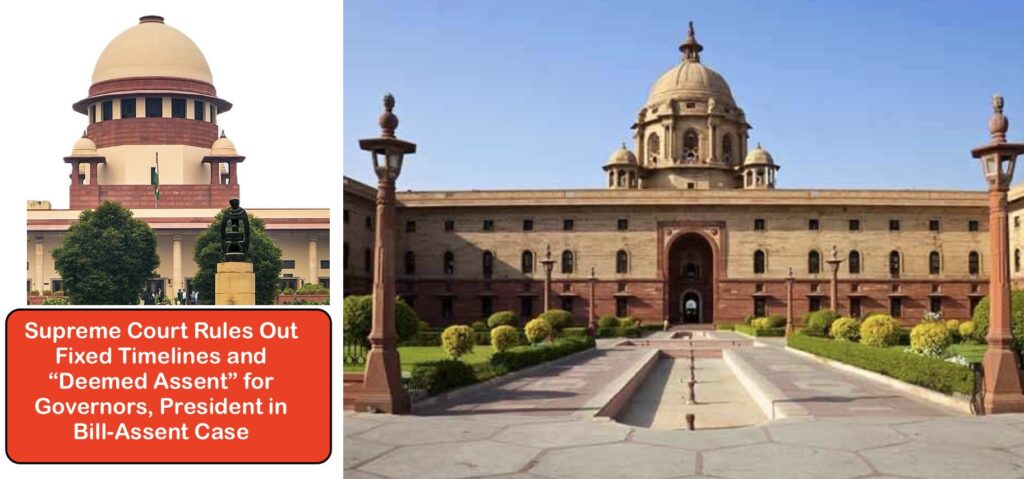
SC Rejects Fixed Timelines, “Deemed Assent” for Bill Assent
A Landmark Judgment on Assent Powers
On 20 November 2025, the Supreme Court of India delivered a landmark advisory opinion in the Presidential Reference case, ruling that neither the President nor State Governors may be constrained by fixed judicial timelines for giving assent to Bills under Articles 200 and 201 of the Constitution. The Court also rejected the concept of “deemed assent”, stressing that automatic approval in the absence of action would violate the doctrine of separation of powers.
While safeguarding the discretionary authority of Governors and the President, the Court made it clear that this does not give them licence to indefinitely withhold Bills. In extreme cases of unexplained delay that frustrate the legislative process, the judiciary may intervene—but only through limited review, without passing judgment on the contents of the Bill itself.
What the Court Actually Decided
No Fixed Judicial Deadlines for Assent
The five-judge Constitution bench, led by Chief Justice B. R. Gavai, held unanimously that the Constitution does not permit courts to impose rigid, judicially enforceable timelines for the President and Governors to grant or withhold assent. The Court pointed to the “elasticity” built into Articles 200 and 201, designed for flexibility rather than mechanistic deadlines.
Rejection of “Deemed Assent”
Equally significant, the Court struck down the idea that a Bill should be automatically deemed to have been assented to if no decision is made within a prescribed period. Such a doctrine, the Court said, would amount to the judiciary taking over functions reserved constitutionally for the Governor or President — a gross violation of the separation of powers.
Limited Judicial Review for Excess Delay
However, the Court refused to allow absolute inaction. If a Governor delays a Bill unreasonably — in a way that stymies the legislative process — courts may issue limited directions to force a decision within a reasonable time. Importantly, they may do so without examining the Bill’s substance.
Governor’s Discretion under Article 200
Answering constitutional questions raised in the Presidential Reference, the Court clarified that under Article 200, a Governor has three options: (1) grant assent, (2) withhold assent and return the Bill to the Legislature, or (3) reserve the Bill for the President’s consideration. If a Governor withholds assent, the Bill must be returned to the Assembly, and cannot simply be stalled indefinitely.
While Governors typically act on the aid and advice of the Council of Ministers, the Court reaffirmed that they hold constitutional discretion in certain cases, particularly under the second proviso of Article 200.
Justiciability and Immunity
The Court held that the Governor’s exercise of discretion under Article 200 does not invite “merit review” by courts. However, in extraordinary cases of prolonged inaction, courts may issue a mandamus (a limited directive), without commenting on the merits.
On the question of immunity under Article 361, the Court observed that while a Governor enjoys personal immunity, his or her office is still subject to the Court’s jurisdiction in cases of inaction.
No Need for Supreme Court Reference Every Time
One of the 14 questions raised by the President was whether she must refer every reserved Bill to the Supreme Court under Article 143 for its opinion. The Court answered in the negative: the President does not have to seek the Court’s advice each time; her “subjective satisfaction” is sufficient unless she chooses to refer.
Limits on Article 142 Power
The Court firmly stated that its extraordinary powers under Article 142 cannot be used to impose “deemed assent” or substitute the functions of the President or Governor.
Why This Case Came to the Supreme Court
The reference was triggered by tensions between elected Governments, Governors, and the President — particularly after a two-judge bench’s April 2025 judgment in the Tamil Nadu Governor case. In that earlier ruling, the Court had set specific time limits: Governors and the President were to act on Bills within defined periods.
President Droupadi Murmu, objecting to judicially mandated deadlines and the concept of deemed assent, invoked her rare power under Article 143 (President’s reference) in May 2025, asking the Court to clarify whether such time-bound directives are constitutionally valid.
Several states and constitutional authorities participated in the hearings, raising fundamental questions about federalism, separation of powers, and the limits of judicial overreach.
Legal Arguments on Both Sides
Union’s Case: The Attorney General and Solicitor General strongly opposed fixed timelines and “deemed assent,” arguing that these would undermine the constitutional discretion of Governors and the President and amount to judicial usurpation.
State Governments’ Arguments: Several states (including Tamil Nadu, West Bengal, Punjab, Kerala) pushed for binding timelines and criticized inaction by Governors as subverting the popular mandate. Senior advocates argued that judicial intervention was needed to protect democratic governance.
Significance and Implications
1. Reinforcing Separation of Powers
By rejecting stringent deadlines and deemed assent, the Court has drawn a clear boundary: the judiciary cannot assume executive functions assigned to Governors or the President.
2. Preserving Discretion
The judgment safeguards the “elasticity” in Articles 200 and 201, affirming that Governors and the President retain meaningful space to act on Bills without being micro-managed by courts.
3. Preventing Legislative Paralysis
At the same time, the Court has not allowed unchecked delay. Its limited review powers provide a constitutional backstop against inaction that frustrates lawmaking.
4. Federal Harmony Through Dialogue
The Court underscored the importance of a dialogue-based approach: Governors should not act obstructively but engage with state legislatures responsibly.
5. Avoiding Judicial Overreach
By refusing to mandate deemed assent or to substitute its judgment on Bills through Article 142, the Court has ensured that it does not become a permanent arbiter of what should be executive discretion.
Expert Views and Reactions
Legal experts say the decision strikes a careful balance: it respects the autonomy of constitutional heads while upholding the need for accountability.
Some constitutional scholars argue that this opinion may limit the potential for future judicial encroachment in legislative-executive disputes.
Others note that while the Court has granted itself a limited role, it has also opened a door for future oversight in cases of “unexplained or prolonged” delays.
A Defining Moment for Constitutional Governance
The Supreme Court’s advisory opinion on 20 November 2025 represents more than a legal resolution. It is a defining moment in the evolution of India’s constitutional architecture, reaffirming both the importance of executive discretion and the necessity of judicial restraint. By rejecting rigid timelines and the concept of “deemed assent,” the Court has preserved the balance between the legislature, the executive, and the judiciary — while ensuring that legislative processes are not stifled by inaction.
This judgment will likely shape how future Bills are navigated between Assemblies, Governors, and the President, and will influence the delicate interplay of power in India’s federal democracy.