Space-Based Data Centres and the Global Race for Orbital AI Infrastructure
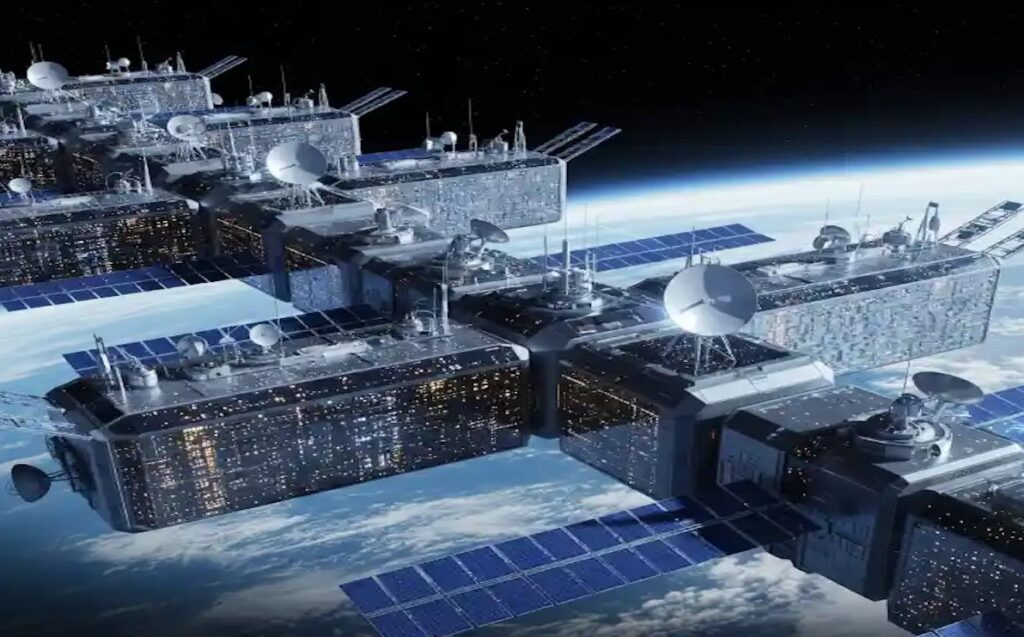
The global technology sector is witnessing a fundamental shift as space-based data centres emerge as a new frontier in digital infrastructure. On January 30, 2026, SpaceX submitted a major application to the US Federal Communications Commission, seeking approval for nearly one million satellites to create an orbital data processing network. This ambitious proposal aims to integrate computing, storage, and artificial intelligence systems directly in space. As terrestrial data centres struggle with energy shortages and environmental constraints, space-based data centres are increasingly viewed as a long-term solution for supporting the rapid expansion of AI-driven technologies.
This development reflects a wider transformation in how governments and private companies perceive space. It is no longer limited to communication or exploration. Instead, it is becoming a critical platform for economic, technological, and strategic dominance.
SpaceX’s Vision for Orbital Computing Infrastructure
SpaceX plans to deploy its proposed satellite constellation in low Earth orbit, ranging between 500 and 2,000 kilometres. These satellites would operate on 30-degree inclined and sun-synchronous trajectories to maximise solar exposure. As a result, the system would benefit from near-continuous access to solar energy.
The network would rely on optical inter-satellite links to enable seamless data transfer. These laser-based systems would integrate with existing Starlink generations. Therefore, SpaceX intends to create a unified space-based computing ecosystem.
According to the company, orbital systems can generate nearly five times more usable energy than ground-based facilities. This advantage could ease the pressure on national power grids that are currently strained by data centre expansion. However, experts remain cautious. Dylan Taylor of Voyager Technologies has described Elon Musk’s proposed two-year rollout as highly aggressive. He has pointed out that large-scale thermal management in space remains unresolved.
In addition, this initiative follows SpaceX’s reported $1.25 trillion merger with xAI. This move highlights the company’s growing focus on AI-driven orbital computing. A proposed $25 billion public offering may provide early funding for solar-powered satellite clusters.
China’s Space Cloud Strategy Under the Five-Year Plan
China has adopted a state-driven approach to space-based data centres through its 15th Five-Year Plan covering 2026 to 2030. The China Aerospace Science and Technology Corporation is leading efforts to build gigawatt-scale “Space Cloud” infrastructure. These systems are designed for in-orbit artificial intelligence processing, storage, and transmission.
The objective is to integrate cloud, edge, and terminal technologies into a unified framework. As a result, China aims to reduce its dependence on terrestrial computing facilities. This strategy builds on research into space solar power that began in 2008.
China’s programme supports bidirectional computing between space and ground systems. Therefore, data can be processed in orbit and transmitted back with minimal delay.
Commercial Chinese Initiatives in Orbital Computing
Several private and semi-private enterprises are contributing to China’s orbital data ambitions.
ADA Space has launched the first phase of its Three-Body Computing Constellation. In May 2025, it placed twelve satellites into orbit. These form part of a planned 2,800-satellite network. The system uses 100-gigabit laser links for high-speed communication. In January 2025, Alibaba Cloud’s Qwen3 AI model successfully completed in-orbit tasks within two minutes, demonstrating operational feasibility.
Meanwhile, the Beijing Astro-Future Institute of Space Technology plans to launch a demonstration satellite at 800 kilometres. The project has received funding of 140 million Yuan from Lenovo and local authorities. The institute aims to achieve commercial viability by 2030. It also envisions a sixteen-satellite gigawatt constellation in the early 2030s.
These efforts complement China’s record of ninety-three launches in 2025 and its ambition to become a leading space power by 2045.
Other International Efforts in Space-Based Data Centres
Outside the United States and China, several organisations are exploring orbital data systems.
France’s Thales Alenia Space led the European Union-funded ASCEND project. The study concluded that space-based facilities could significantly reduce carbon emissions if low-emission launch vehicles become available.
In Abu Dhabi, Madari Space plans to deploy a small experimental payload in 2026 under the United Nations Office for Outer Space Affairs framework. The company intends to build a constellation that reduces latency for Earth observation services.
Florida-based Lonestar Data Holdings tested a lunar data centre in March 2025. It now plans to deploy six satellites near the Earth-Moon L1 point by 2027. Each unit will offer fifteen petabytes of storage.
Starcloud, based in Washington State, is preparing to launch a satellite equipped with Nvidia H100 GPUs. This mission, scheduled for November 2025, claims to provide record in-orbit computing power.
Strategic Advantages of Orbital Data Infrastructure
Space-based data centres offer several structural advantages over terrestrial facilities. First, they benefit from uninterrupted solar energy. Therefore, they can operate without relying on fossil fuels or large land areas.
Second, orbital systems provide natural disaster resilience. Earthquakes, floods, and power failures cannot directly disrupt operations in space. As a result, data security and continuity improve.
Third, proximity to Earth observation satellites enables faster processing of imagery and sensor data. This capability benefits climate monitoring, defence applications, and disaster response.
Market analysts estimate that global data centre demand will rise by 165 per cent by 2030. In this context, orbital systems represent a strategic response to capacity constraints.
Technical and Environmental Challenges
Despite their potential, space-based data centres face serious obstacles.
Thermal management remains the most critical issue. In a vacuum, heat can dissipate only through radiation. Traditional cooling methods do not work. Therefore, large radiators are required. Scaling this system for AI workloads remains extremely difficult.
Radiation poses another major threat. High-energy particles damage semiconductor components. Solar storms can disrupt satellite networks. Although radiation-hardened chips offer partial protection, they increase costs.
Orbital debris also raises concerns. Large constellations increase the risk of collisions and the Kessler syndrome. Furthermore, rocket launches release persistent pollutants into the upper atmosphere.
Maintenance represents another limitation. Repairs in orbit are impractical and costly. Consequently, system failures can result in permanent losses.
Economic Viability and Long-Term Outlook
The cost of deploying and maintaining orbital data centres remains high. Although ride-sharing launches have reduced expenses, large-scale networks still require massive capital investment.
Supporters argue that technological advances will gradually lower costs. They also emphasise partnerships such as Voyager’s collaboration with Palantir for the Starlab project in 2029.
Philip Johnston of Starcloud believes that space-based computing will dominate within a decade. In contrast, astrophysicist Quentin Parker maintains that terrestrial facilities remain more economical and reliable.
This debate reflects broader uncertainty. However, successful trials by ADA Space and Lonestar indicate that operational models are emerging.
Space-Based Data Centres in the Global Technology Power Balance
The scale of SpaceX’s proposed constellation far exceeds China’s planned 2,800 satellites and other smaller projects. Nevertheless, China’s strong state backing provides strategic stability. The United States relies more on private entrepreneurship and venture capital. Europe and the Gulf states focus on experimental deployments.
These differing approaches highlight contrasting governance models. However, all participants recognise that control over orbital computing infrastructure will shape future economic and security frameworks.
For India and other emerging economies, this trend carries major implications. Investment in domestic AI and digital infrastructure, as discussed in India’s AI Infrastructure Strategy, will become increasingly important.
The race to build space-based data centres reflects a broader shift in how nations and corporations view technological sovereignty. While physics, costs, and regulation continue to impose constraints, orbital computing is steadily moving from concept to reality. As AI workloads expand and terrestrial systems reach their limits, space is becoming the next critical battleground for digital dominance.