Sonam Wangchuk Story: From Ladakhi Innovator to National Spotlight
Sonam Wangchuk’s story is one of innovation, education reform, and recent controversies that have made headlines across India. This Ladakhi engineer and activist rose to national attention when the iconic Bollywood film 3 Idiots drew inspiration from his life and work. Born in a remote Himalayan village, he overcame many challenges to become a prominent education reformer, yet his recent activism has sparked intense debate. This article explores his background, influence, and the controversies surrounding his name.
Early Life and Education: Roots in Ladakh
Born on September 1, 1966, in the tiny village of Uleytokpo in Ladakh, Sonam Wangchuk grew up in a region where formal education was limited. His mother, Tsering Wangmo, was instrumental in teaching him basic literacy at home. At nine, he moved to Srinagar to pursue formal schooling, facing linguistic and cultural barriers. He struggled initially and fled to Delhi at age 11 seeking better education, where he gained admission to Vishesh Kendriya Vidyalaya. Eventually, soon he returned to Srinagar to complete his schooling and graduated in 1987 with a degree in Mechanical Engineering from the Regional Engineering College (now NIT Srinagar).
Family Background and Influence
Wangchuk’s family has political ties that have shaped his outlook. His father, Sonam Wangyal, was a Congress politician and a minister in the Jammu and Kashmir government beginning in 1975, after which the family moved to Srinagar. This political heritage complemented Wangchuk’s passion for regional development and educational reform.
Educational Reforms and Innovative Vision
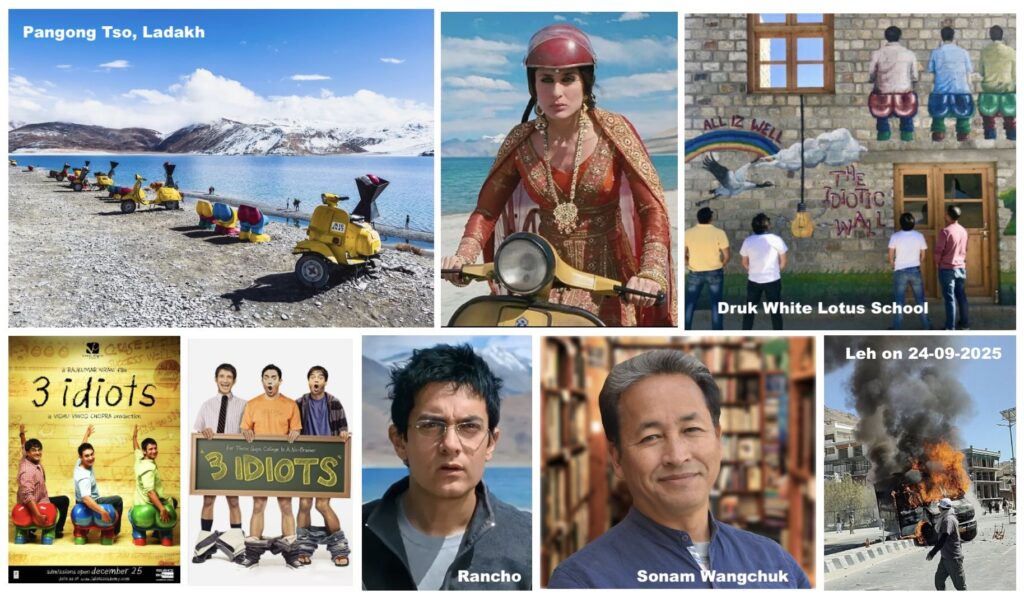
Sonam Wangchuk is widely credited with pioneering alternative education methods in Ladakh. In 1988, shortly after graduating, he co-founded the Students Educational and Cultural Movement of Ladakh (SECMOL), focusing on hands-on, activity-based learning tailored to local needs. His efforts extended to eco-friendly architecture and sustainable development, including the design of the Druk White Lotus School in Shey, near Leh. This school, often called “Rancho’s School” after the 3 Idiots character inspired by Wangchuk, has become an educational landmark and tourist attraction.
His innovations include the Ice Stupa artificial glacier project, helping Ladakhi farmers with water scarcity. SECMOL’s initiative to introduce English-medium education while preserving Ladakhi culture earned international recognition such as the International Terra Award in 2016.
Connection to ‘3 Idiots’ and National Recognition
The 2009 Bollywood blockbuster 3 Idiots, starring Aamir Khan as Phunsukh Wangdu (popularly known as Rancho), drew notable inspiration from Wangchuk’s life and work. While based on Chetan Bhagat’s novel Five Point Someone, the filmmaker openly credited Wangchuk’s pioneering educational philosophy and innovations in Ladakh as key influences shaping the character.
Iconic scenes were shot in Ladakh, including at the Druk White Lotus School and scenic Pangong Lake. This association elevated Ladakh’s profile both as an educational hub and tourist destination which, still matters for the tourists and the local guides/tour operators.
Timeline of Activism and Protests
Following Ladakh’s reorganisation into a Union Territory in 2019 after the revocation of Article 370, Wangchuk began agitating for greater autonomy and constitutional safeguards.
June 2020: Wangchuk called for boycotting Chinese products in response to border skirmishes.
January 2023: Attempted a fast at Khardungla Pass to highlight climate change effects and demand Sixth Schedule protections; was placed under house arrest.
March 2024: Began a 21-day hunger strike pressing for constitutional safeguards and protection from industrial exploitation.
September 2024: Marched from Ladakh to Delhi to press demands but was detained; resumed hunger strike pending government talks.
September 10, 2025: Launched a 35-day hunger strike demanding statehood and Sixth Schedule protections.
September 24, 2025: Protests escalated violently causing deaths and injuries; Wangchuk called off hunger strike, citing failure of peaceful methods.
Rising Controversy: Activism and Political Turmoil
While initially celebrated for reforms, Wangchuk’s recent activism has drawn sharp criticism. Allegations include provoking youth unrest and polarising a strategically crucial border region. His 2024 remarks questioning morale of Indian troops raised national security concerns.
The cancellation in 2025 of a land lease related to the Himalayan Institute of Alternatives (HIAL), co-founded by Wangchuk, amid claims of non-development and political pressure, added to controversies.
Government officials blamed provocative speeches for inciting September 2025 violence. Critics argue his activism blurs lines between public cause and personal ambition. Despite legitimate grievances, escalation risks undermining dialogue and stability.
The Road Ahead: Nurturing Aspirations and National Unity in Ladakh
Ladakh stands at a pivotal moment in its governance and development journey, with aspirations for greater autonomy balanced against the region’s vital importance to India’s national integrity. Sonam Wangchuk’s evolution from visionary educator to key political actor reflects the complex dynamics of regional identity and governance in this strategically sensitive borderland.
It is essential for all voices engaged in Ladakh’s future to pursue dialogue grounded in responsibility and unity. While legitimate regional aspirations must be acknowledged and addressed, care must be taken to avoid statements or actions that could unintentionally disrupt communal harmony or national security. Maintaining peace and cooperation is paramount for safeguarding Ladakh’s unique cultural heritage and strategic interests.
The government remains committed to working collaboratively with Ladakhi stakeholders to explore constitutional safeguards and sustainable development frameworks. At the same time, there is a clear expectation that activism must be conducted in a manner consistent with broader national interests and public order. The stability and prosperity of Ladakh depend on constructive engagement, mutual respect, and a shared commitment to India’s sovereignty.
This balanced approach aims to ensure that Ladakh’s aspirations are realised through dialogue and inclusive governance, preserving both regional identity and national unity for generations to come.