February 2026 Six-Planet Parade Lights Up the Sky in a Rare Planetary Alignment
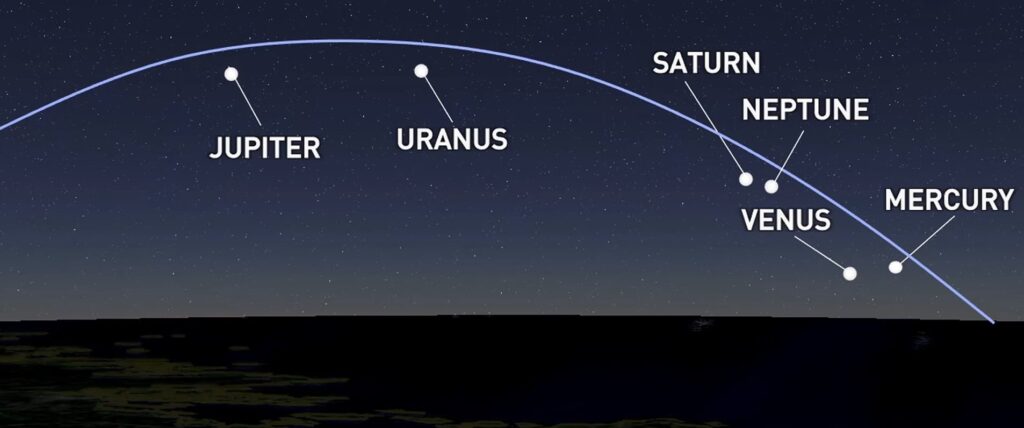
As February 2026 enters its final weeks, skywatchers across the world are preparing for one of the year’s most visually striking astronomical events: a rare six-planet parade visible in the evening sky. Around February 28, 2026, Mercury, Venus, Jupiter, Saturn, Uranus, and Neptune will appear to line up along a graceful arc stretching from the western to southeastern horizon shortly after sunset.
This phenomenon, often referred to as a planetary alignment, is not a physical gathering of worlds in space. The planets remain separated by millions and billions of kilometres. Instead, the display is an optical effect produced by their shared orbital plane, known as the ecliptic. When several planets occupy the same region of this plane from Earth’s perspective, they trace a visible pathway across the sky.
While alignments involving three to five planets occur regularly, a six-planet parade is far less common. Its relative rarity and accessibility make it one of the most anticipated celestial events of 2026.
Understanding the February 2026 Planetary Alignment
The six participating planets include four that are easily visible to the naked eye and two that require optical assistance under most conditions.
Venus will dominate the scene as the brightest object after sunset, shining prominently as the “evening star.” Jupiter will appear higher and equally unmistakable, while Saturn will glow steadily with a subtle golden hue. Mercury, although visible, will be the most challenging target, remaining low on the horizon and setting quickly after dusk.
Uranus and Neptune complete the lineup. Uranus may be visible with binoculars from dark-sky locations, while Neptune will require binoculars or a small telescope. Despite occasional online claims, Mars is not part of this February 2026 alignment.
Together, these planets will form a gentle curved pattern rather than a straight line, following the natural arc of the ecliptic.
Best Time and Conditions for Viewing
The optimal time to observe the six-planet parade is between 30 and 60 minutes after local sunset, when the sky is sufficiently dark but the lower planets have not yet disappeared below the horizon. The display will be most compact around February 28, though it will remain visible for several days before and after this date.
Observers in major cities such as New York, Tokyo, Athens, Mexico City, Mumbai, and Beijing are expected to experience peak conditions around late February and early March. The alignment will be visible from both hemispheres, with slight variations in orientation.
Clear skies, minimal light pollution, and an unobstructed western horizon are essential for the best experience. Atmospheric haze and urban lighting can significantly reduce the visibility of Mercury and Saturn. A bright Moon near Jupiter on February 28 may further affect faint objects.
Using Venus as a reference point is recommended, as it is the easiest planet to locate. Mobile applications with augmented reality features can assist viewers in identifying all six planets accurately.
Scientific Perspective and Historical Context
NASA has highlighted the February 2026 planetary parade as one of the year’s major skywatching events, alongside a total lunar eclipse and prominent meteor showers. Astronomers emphasize that such alignments have no measurable gravitational or environmental impact on Earth. Their significance lies purely in their visual appeal.
Similar multi-planet groupings occurred in 2025, including a seven-planet alignment, but visibility conditions varied. Projections suggest that equally favourable six- or seven-planet displays will remain relatively infrequent over the next decade.
Throughout history, planetary alignments have fascinated civilizations and inspired scientific inquiry, mythological interpretations, and artistic expression. In the modern era, they serve as powerful tools for public engagement with astronomy.
Why the Six-Planet Parade Matters
Beyond its aesthetic appeal, the February 2026 alignment offers an accessible entry point into planetary science. It provides a real-world demonstration of orbital mechanics and celestial geometry, reinforcing how predictable physical laws govern our solar system.
At a time of renewed global interest in space exploration through programs such as NASA’s Artemis missions and private-sector initiatives, events like this help bridge professional science and public curiosity. They encourage observational learning and foster appreciation for humanity’s place in the cosmos.
For many observers, tracing the path of Venus, Jupiter, and their companions across the twilight sky offers a moment of reflection and connection with natural rhythms that have guided humanity for millennia.
Practical Viewing Guidance
Prospective viewers are advised to consult local sunset times and weather forecasts in advance. Travelling to a dark-sky location will greatly enhance visibility. Binoculars or a small telescope will improve the experience, particularly for Uranus and Neptune.
Observers should avoid looking toward the Sun and begin viewing only after it has fully set. Photography enthusiasts are encouraged to share images with astronomy communities to promote wider participation and documentation.
A Celestial Event Not to Miss
Whether viewers manage to identify all six planets or simply enjoy the brilliance of Venus and Jupiter, the February 2026 planetary parade promises a memorable encounter with the solar system. It is a rare opportunity to witness multiple worlds aligned in a single sweeping view, visible without specialised equipment.
As winter transitions toward spring in many parts of the world, this natural spectacle invites people outdoors to reconnect with the night sky. In an age of digital saturation, few experiences remain as universally accessible and awe-inspiring as watching the planets trace their ancient paths across the heavens.
The universe is offering a free performance. All that is required is clear skies, patience, and the willingness to look up.