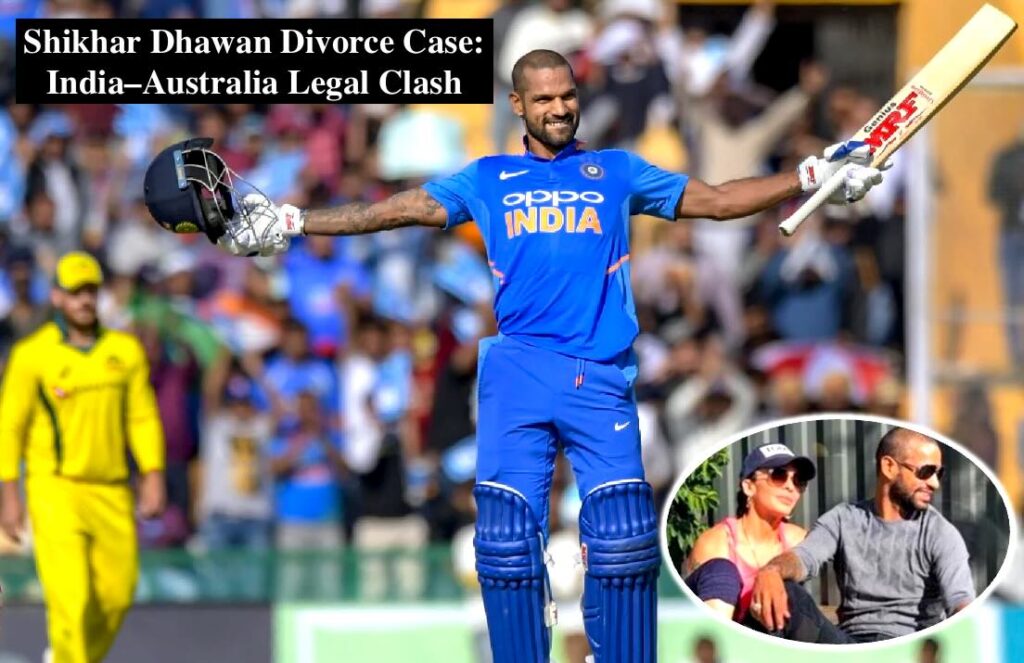
Shikhar Dhawan Divorce Case: When Two Legal Systems Collided Over Marriage, Money, and a Child
The Shikhar Dhawan divorce case has gradually evolved from a private marital dispute into one of India’s most closely watched cross-border legal battles. What began as a troubled relationship between a celebrated sportsperson and his spouse has now exposed deep fault lines between Indian and Australian family law systems.
Former India opener Shikhar Dhawan and his former wife Aesha Mukerji found themselves fighting parallel cases in two countries. Over time, these proceedings produced conflicting judgments, competing financial claims, and unresolved questions about parental access. The result has been a legal maze that continues to test the limits of international judicial cooperation.
A Marriage Rooted in India, a Life Divided by Distance
Shikhar Dhawan, born in 1985, and Aesha Mukerji, born in 1974, have an age gap of nearly ten years. When they met, Dhawan was in his early twenties, while Mukerji was already in her thirties and a mother.
Dhawan and Mukerji married in 2012 in New Delhi, following traditional Indian rituals. At that time, Dhawan’s cricketing career was at its peak, while Mukerji, an Australian citizen of Indian origin, balanced family life between two continents.
For several years, the marriage appeared stable. However, professional travel, cultural differences, and long periods of physical separation gradually strained the relationship. By 2021, the couple had effectively separated. Mukerji returned to Australia with their ~7 years young son – Zoravar Dhawan, while Dhawan continued to live and work in India.
This geographical division later became the foundation of the legal conflict, as both sides began invoking the laws of their respective countries.
Divorce in Delhi and the Court’s Findings
In 2023, the marriage formally ended in India when the Delhi High Court granted divorce on the ground of mental cruelty. The court accepted Dhawan’s plea that he had suffered emotional distress, isolation, and restricted access to his child.
The judgment made it clear that the marriage was governed by Indian personal law. No Australian court dissolved the marriage. Legally, therefore, the marital relationship ended only under Indian jurisdiction.
This ruling later became crucial when questions arose about which country had the primary authority to decide financial and parental matters.
Custody of Zoravar and a Father’s Limited Access
Perhaps the most emotionally charged aspect of the Shikhar Dhawan divorce case relates to their son, Zoravar. During custody proceedings, the Indian court granted primary custody to Mukerji, who was already residing in Australia.
The court reasoned that uprooting the child would disrupt his education and stability. Consequently, Zoravar continued to live with his mother overseas.
Dhawan was granted visitation rights, mainly in the form of scheduled video calls and limited physical meetings during approved visits. Overnight custody or extended stays were not guaranteed. Over time, these restrictions significantly reduced father-son interaction. Dhawan has publicly acknowledged that he went for long periods without meeting his child in person.
This arrangement continues to shape much of the emotional narrative surrounding the dispute.
The Australian Property Settlement and Financial Transfer
Between 2020 and 2022, while divorce proceedings were underway in India, Mukerji pursued financial claims in Australia under family law provisions. After their separation in 2021, she formally sought property settlement before the Federal Circuit and Family Court of Australia.
During this period, Dhawan owned residential property in Australia acquired during the marriage. As part of the proceedings, the property was sold, and the proceeds formed the basis of the settlement.
Rather than contest jurisdiction at that stage, Dhawan chose to comply with the court’s directions. Between late 2021 and mid-2022, he transferred funds from the property sale and related settlements to Mukerji. The total amount reportedly came to around ₹5.7–6 crore.
Following the settlement, Dhawan no longer retained property in Australia. His compliance, intended to avoid prolonged litigation, later became the basis of his challenge in India. Indian courts subsequently held that the agreement had been executed under pressure and lacked free consent, leading to the refund order.
Alimony, Maintenance, and the Reality Behind the Numbers
Public speculation frequently suggested that Mukerji received massive alimony under Indian law. Court records, however, do not support this perception.
Indian courts did not award any confirmed permanent alimony or publicly disclosed monthly maintenance. The focus of Indian proceedings remained on divorce and custody, not long-term spousal support.
Most substantial financial transfers arose from Australian property settlement orders rather than Indian maintenance provisions. This distinction later allowed Indian courts to question the legal validity of those payments.
India Pushes Back and Orders a Refund
In subsequent years, Dhawan challenged the Australian settlement before Indian courts. He argued that the agreement had been signed under emotional pressure and without free consent.
The Indian family court accepted his contention. It ruled that “property settlement” has no direct equivalent in Indian matrimonial law. It further observed that the financial agreement appeared to have been executed under psychological distress.
On this basis, the court declared the arrangement void in India and directed Mukerji to refund around ₹5.72 crore with interest.
This judgment effectively reversed the financial consequences of the Australian order within Indian territory.
Jurisdiction, Reciprocity, and the Question of Authority
At the heart of the case lies a complex jurisdictional question. Marriage, divorce, and domicile were primarily linked to India. Mukerji’s citizenship and residence connected the matter to Australia.
From an international law perspective, India held primary matrimonial jurisdiction. Australia exercised derivative jurisdiction through residence and asset location.
This overlap created scope for forum shopping, where litigants seek favourable legal environments. Courts generally discourage this practice because it undermines judicial consistency.
At the same time, modern legal systems rely on reciprocity. If one country routinely ignores another’s judgments, mutual enforcement collapses. This concern influences how courts handle sensitive cross-border disputes.
Can Australian Courts Revisit Their Earlier Decision?
Australian courts are unlikely to formally cancel their earlier order, as doing so would undermine institutional authority. However, they retain the power to reconsider outcomes in light of new findings.
If Dhawan seeks enforcement of the Indian decree in Australia, the court may examine whether the original settlement suffered from jurisdictional weakness or coercion. It may then reopen financial terms, modify obligations, or encourage compromise.
Such a middle path allows correction without public admission of error. In transnational disputes, this approach has become increasingly common.
What Are Dhawan’s Legal Options Now?
Following the Indian refund order, Dhawan has several strategic paths available.
He can initiate execution proceedings in India to attach any assets or accounts held by Mukerji within the country. If recoverable property exists, this route may yield results.
If assets are located abroad, he can seek recognition of the Indian judgment in Australian courts. This would allow him to request enforcement under Australian civil law. Success here depends on how Australian judges interpret jurisdiction and fairness.
Dhawan may also apply for modification of custody and visitation arrangements, especially if circumstances change. Indian courts retain jurisdiction over parental rights arising from the original marriage.
Another realistic option is negotiated settlement. Cross-border enforcement is expensive, slow, and unpredictable. Many similar disputes ultimately end through mediated compromise.
Finally, Dhawan may pursue diplomatic and legal remedies through bilateral judicial cooperation mechanisms, although such processes are typically slow.
Why This Case Resonates Beyond Celebrity Headlines
The Shikhar Dhawan divorce case reflects a broader trend in an increasingly globalised society. International marriages are rising. So are transnational disputes involving children, property, and citizenship.
This case highlights how inconsistent legal standards can trap families in prolonged litigation. It also shows how emotional vulnerability can intersect with jurisdictional complexity.
For lawmakers, it underscores the need for clearer bilateral frameworks. For families, it serves as a cautionary tale about legal planning in cross-border relationships.
As matters stand, Dhawan has secured a strong legal victory in India. However, full financial recovery and improved parental access depend on developments in Australia and the willingness of both sides to compromise.
The final chapter of this dispute will not be written by one court alone. It will emerge from the uneasy balance between sovereignty, reciprocity, and human consequence in an interconnected legal world.