Sheikh Hasina Sentenced to Death in Absentia: Her First Reaction
By Special Correspondent
Dhaka/Delhi | November 17, 2025
The Sheikh Hasina verdict delivered today by Bangladesh’s own International Crimes Tribunal (ICT) has sent tremors through South Asia. In a historic ruling, the tribunal sentenced former Prime Minister Sheikh Hasina to death in absentia for crimes against humanity linked to the 2024 student uprising. The decision marks the first time a former South Asian head of government has been handed capital punishment by a domestic war-crimes court, igniting sharp political, legal and diplomatic reverberations across the region.
Hasina Found Guilty on Three Grave Counts
The tribunal’s three-judge bench, headed by Justice Golam Mortuza Mozumder, held the 78-year-old leader responsible for inciting killings, directly ordering lethal force — including the alleged deployment of helicopters and drones against unarmed demonstrators — and failing to prevent mass atrocities during the July–August 2024 protests. A United Nations fact-finding mission estimated that at least 1,400 protesters, mostly students, were killed and more than 25,000 injured during the crackdown.
Hasina watched the proceedings from exile in New Delhi, where she has lived since fleeing Bangladesh on 5 August 2024 via a military helicopter as enraged Bangladesh Gen-Z protesters stormed her residence. Former Home Minister Asaduzzaman Khan Kamal was also sentenced to death in absentia, while former police chief Chowdhury Abdullah Al-Mamun received a five-year term after cooperating with investigators.
Sheikh Hasina’s First Reaction to the Verdict
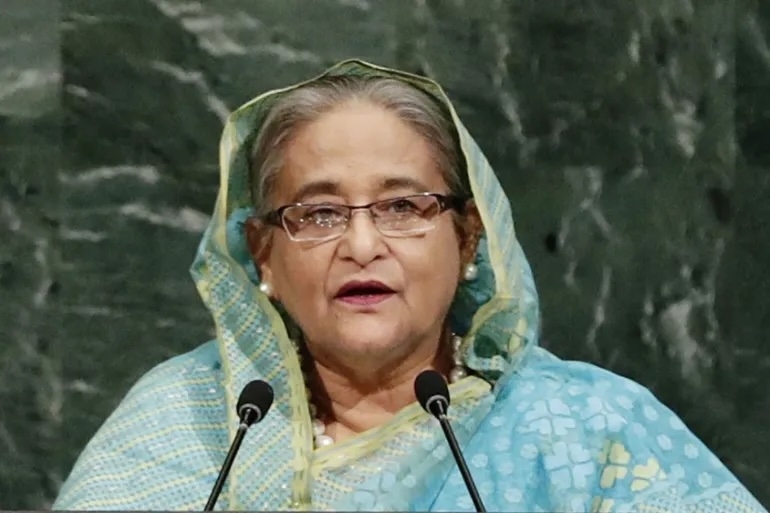
Shortly after the Sheikh Hasina verdict was pronounced, her first official reaction came via a message released from New Delhi and quoted in reports. She reportedly described the judgment as “a political assassination carried out through a courtroom,” asserting that the tribunal had been “commandeered by those desperate to rewrite history.” According to media reporting, Hasina expressed shock at the speed of the trial and insisted she would “fight this injustice through every legal and political forum available.” Her response underscored her claim that the current interim government aims to erase her legacy through judicial means rather than democratic accountability.
Her son Sajeeb Wazed, speaking from the United States, reiterated earlier claims that the trial was “a complete farce orchestrated by an unelected regime.” Meanwhile, what remains of the Awami League — pushed underground after its collapse in 2024 — condemned the tribunal as a platform for political vengeance.
The Tribunal That Turned on Its Architect
The ICT is not an international court like the ICC; it is a domestic tribunal created under Bangladesh’s 1973 International Crimes (Tribunals) Act. It was originally established to prosecute Pakistani officers and their collaborators for the 1971 genocide. Sheikh Hasina revived and expanded the tribunal during her long tenure to prosecute Islamist political opponents, a move that drew criticism from rights groups but enjoyed support from her domestic base.
Today, many observers note the extraordinary irony: the very tribunal she revived now stands against her, delivering the harshest legal outcome possible. Human Rights Watch, the International Commission of Jurists and several Western diplomats have raised concerns over trials in absentia, limitations on defence rights and evidentiary standards. Supporters in Dhaka argue, however, that the tribunal is the only available mechanism to deliver justice to families devastated by the 2024 bloodshed.
Will India Extradite Hasina?
With the Sheikh Hasina verdict now official, the central diplomatic question is whether India will extradite her. Bangladesh submitted a formal extradition request in December 2024 under the bilateral treaty signed in 2013. Since then, New Delhi has maintained strategic ambiguity. Indian officials describe Hasina’s presence as “temporary” and “humanitarian,” yet her visa has been extended repeatedly and she is under discreet but significant state-level protection.
Legal experts argue that India has multiple grounds to refuse extradition: the political-offence exemption in the treaty, concerns about trial fairness, and fears that Hasina could face mob reprisals if returned. Moreover, India’s strategic calculus is complex. Hasina was a steadfast ally who countered Chinese influence, strengthened cross-border security cooperation, and stabilised long-sensitive frontiers. Extraditing her could send unsettling signals to other friendly regimes in the region.
If India Grants Asylum Permanently
If India ultimately grants Hasina asylum and refuses extradition, Dhaka–Delhi relations may enter a prolonged period of strategic friction. Analysts note that such a scenario would effectively freeze the execution of the Sheikh Hasina verdictfor the foreseeable future. It would also turn Hasina into a politically symbolic figure operating from the safety of Indian soil. For India, offering long-term protection could help maintain regional leverage, but it may also invite criticism from Dhaka’s interim administration and domestic political actors who view justice as incomplete without her return. The move could widen existing geopolitical fault lines, with China and Western governments assessing India’s role in shielding a convicted former prime minister.
A Mixed Moment for the Interim Government
For the Muhammad Yunus-led interim administration, the verdict strengthens its narrative of accountability after decades of political impunity. Yet the government faces a practical challenge: enforcing a death sentence on a leader shielded by India is nearly impossible in the short term. Sources in Dhaka suggest that officials are quietly exploring whether aspects of the case could be referred to the International Criminal Court. However, the domestic character of the ICT and Bangladesh’s continued use of the death penalty complicate this option.
A Tense Nation at a Familiar Crossroads
As darkness fell over Dhaka, thousands of students gathered silently outside the tribunal, many holding photographs of friends lost in 2024. They viewed the Sheikh Hasina verdict as a step toward justice. Elsewhere, Awami League loyalists burned tyres and denounced the ruling as “victor’s justice.” With parts of the capital under shoot-on-sight orders and the army on high alert, Bangladesh appears once again at the intersection of justice and instability.
For now, Sheikh Hasina remains beyond the reach of Bangladeshi law, living under Indian protection while her country debates whether the long arc of justice has finally bent—or dangerously splintered.
Other Relevant Readings:
Bangladesh’s Political Crisis: Unpacking the Conspiracy Theories and Seeking Reality
Bangladesh 1975 Coup: The Legacy That Refuses to Die
Bangladesh Gen Z Revolution: From Quota Rage to Political Disillusion