Saudi Arabia’s Dual Strategy in Managing US‑Iran Tensions
Public Restraint, Private Pressure: Two Faces of Saudi Policy
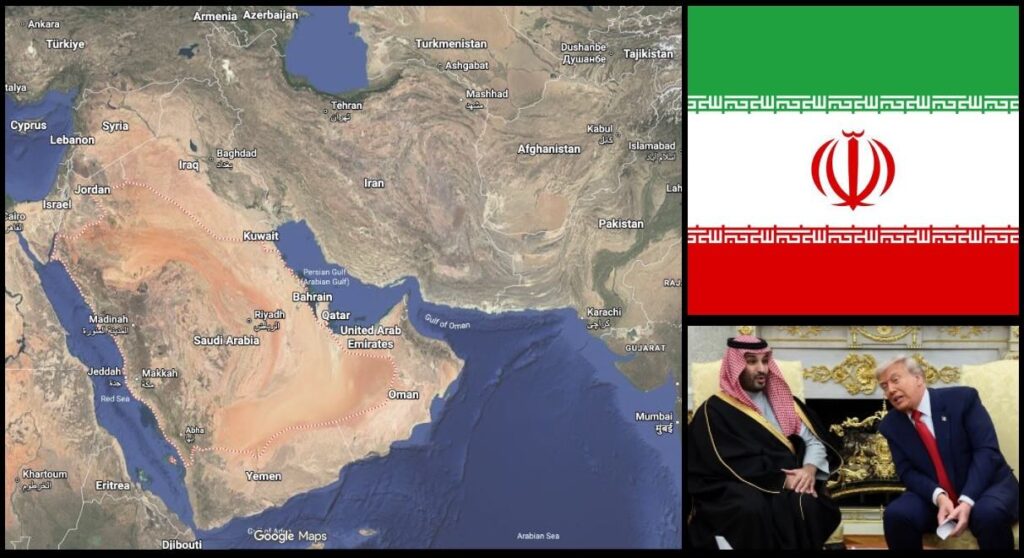
As tensions between the United States and Iran escalated in early 2026, Saudi Arabia adopted a posture that appeared cautious, responsible, and peace-oriented. Riyadh publicly denied allowing its airspace or bases to be used for any American military operation against Iran. Crown Prince Mohammed bin Salman personally conveyed this position to Iranian President Masoud Pezeshkian, while Saudi state media reinforced the message of restraint.
On the surface, this reflected a mature and stabilising regional role.
Behind the scenes, however, a very different narrative emerged. Reports from Washington indicated that Saudi defence officials privately urged the Trump administration to consider military action against Tehran, warning that restraint would only strengthen Iran’s regional position. These discussions were followed by major US arms approvals, including advanced missile defence systems.
This contradiction is not accidental. It represents a deliberate strategy: publicly distancing itself from conflict while privately encouraging pressure on Iran. Saudi Arabia is attempting to influence outcomes without owning the consequences.
Why Riyadh Is Playing Both Sides
Saudi Arabia’s double-track diplomacy is rooted in insecurity, not confidence.
The Kingdom remains acutely vulnerable to Iranian retaliation. The 2019 attack on Saudi oil facilities demonstrated how easily Iran or its proxies can disrupt critical infrastructure. Despite massive defence spending, Saudi Arabia cannot guarantee protection against missile and drone strikes.
At the same time, Riyadh fears a strategically empowered Iran more than temporary instability. Tehran’s expanding influence in Iraq, Syria, Lebanon, and Yemen continues to encircle Saudi interests. Allowing Iran to consolidate regional dominance without resistance is viewed in Riyadh as a long-term existential risk.
Caught between these realities, Saudi leadership has chosen hedging over clarity.
If the US acts, Saudi Arabia can claim neutrality.
If the US refrains, Riyadh presents itself as a responsible regional stabiliser.
In either case, it avoids direct accountability.
This is not statesmanship. It is risk avoidance elevated to policy.
The Illusion of Control in a Fragmenting Middle East
Saudi Arabia’s strategy reflects a broader regional trend: declining confidence in American security guarantees.
Gulf states no longer assume that Washington will decisively intervene in every crisis. US domestic politics, strategic competition with China, and war fatigue have reduced American appetite for Middle Eastern entanglements.
As a result, Saudi Arabia now pursues “strategic optionality” — maintaining working relations with Iran, China, Russia, and the US simultaneously, without committing fully to any.
This creates short-term flexibility but long-term fragility.
Ambiguous alliances dilute deterrence. Adversaries test boundaries. Partners hesitate to rely on you. Over time, strategic ambiguity becomes strategic weakness.
Riyadh’s attempt to manage all sides reflects not regional leadership, but uncertainty about where power truly lies.
Energy, Economics, and the Fear of Escalation
Saudi caution is also driven by economic vulnerability.
The Kingdom exports over 10 million barrels of oil per day. Any sustained conflict in the Gulf could disrupt supply chains, spike global prices, and destabilise domestic revenue planning under Vision 2030.
A war with Iran — even indirectly — would threaten:
- Energy exports
- Investor confidence
- Mega-project financing
- Tourism ambitions
- Currency stability
For a leadership trying to transform Saudi Arabia into a diversified economic hub, regional war is a strategic nightmare.
Public pacifism therefore serves an economic purpose: protecting markets and reassuring investors.
But private hawkishness undermines this credibility.
Trust Deficit: Alienating Both Washington and Tehran
By playing both sides, Saudi Arabia risks alienating both.
From Tehran’s perspective, Riyadh’s private encouragement of US pressure confirms suspicions that Saudi reconciliation is superficial. Any future attack will be interpreted as Saudi-enabled, regardless of official denials.
From Washington’s perspective, Saudi reluctance to provide operational support limits military options. Allies who urge action but refuse cooperation appear unreliable.
This dual distrust weakens Saudi leverage in both capitals.
Strategic partnerships require consistency. Ambiguity erodes influence.
Implications for India and Asia
For countries like India, Saudi ambiguity carries serious consequences.
India imports more than 60% of its crude oil from the Gulf. Any escalation could sharply raise inflation, worsen the current account deficit, and disrupt logistics.
Asian economies depend on Gulf stability far more than Western powers do. Saudi hedging may protect Riyadh temporarily, but prolonged uncertainty increases systemic risk for energy-importing nations.
Regional instability is not cost-free for Asia.
A Policy Built on Avoidance, Not Vision
Saudi Arabia’s current approach reflects tactical skill but strategic hollowness.
It avoids immediate risk.
It postpones hard choices.
It preserves room for manoeuvre.
But it offers no long-term solution.
True regional leadership requires shaping outcomes, not merely surviving them. Riyadh is reacting to events, not directing them.
The Kingdom has resources, influence, and diplomatic capital. Yet it uses them defensively, not constructively.
Instead of building a credible regional security architecture, Saudi Arabia relies on ambiguity and bilateral bargaining.
That is not leadership. It is containment of decline.
Strategic Insecurity Disguised as Diplomacy
Saudi Arabia’s behaviour in the US-Iran standoff exposes a deeper truth: the Kingdom is no longer confident about its security environment or its alliances.
Public restraint and private pressure are symptoms of the same problem — fear of being caught on the wrong side of history.
Riyadh wants Iran contained, America engaged, markets calm, and retaliation avoided — all at once. These goals are incompatible.
Eventually, ambiguity will fail.
When the next major crisis erupts, Saudi Arabia will be forced to choose. Until then, its diplomacy will remain reactive, cautious, and internally contradictory.
In today’s Middle East, clarity is power.
Saudi Arabia is choosing uncertainty instead.
Lorem ipsum dolor sit amet, consectetur adipiscing elit. Ut elit tellus, luctus nec ullamcorper mattis, pulvinar dapibus leo.