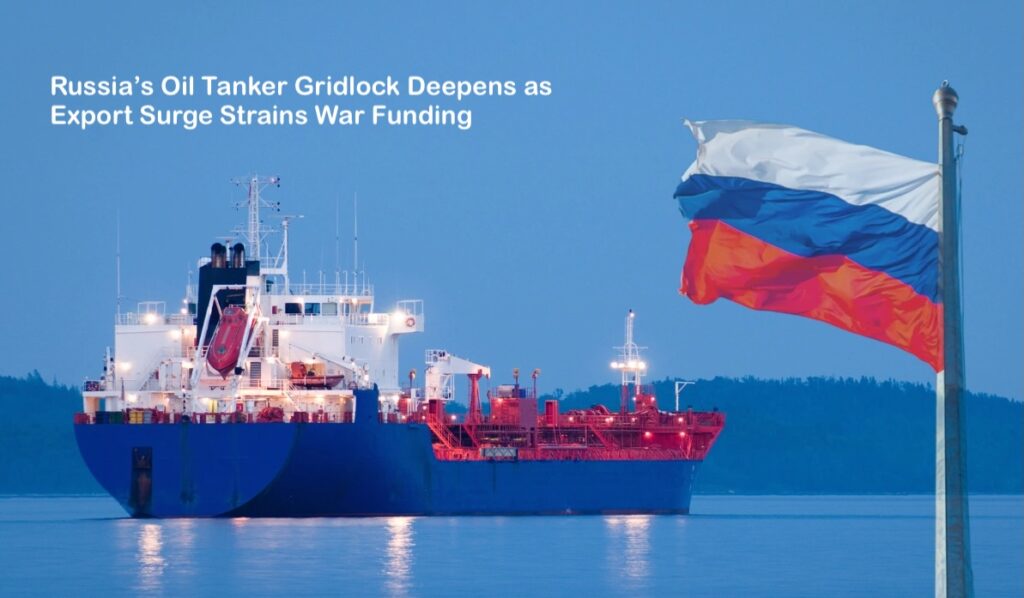
Russia’s Oil Tanker Gridlock Threatens War Financing Amid Surging Oil Exports
Russia’s crude exports have climbed to multi-year highs, yet a growing fleet of stranded tankers is tightening pressure on Moscow’s wartime finances. In the four weeks ending 7 December 2025, seaborne shipments rose to 3.68 million barrels per day, an increase of 220,000 barrels from late November. One week alone saw 38 tankers load 29.65 million barrels, marking one of the largest single-week volumes this year.
Despite the surge, the volume of Russian crude stuck at sea has reached its highest point in two and a half years. Between 175 and 200 million barrels now float without final destinations, a 28% jump since late August. Longer voyages to Asian buyers and mounting offloading delays have created a bottleneck that is now reshaping global energy flows.
Shadow Fleet Strains Under Sanctions and Enforced Limits
Western sanctions continue to squeeze Russia’s shadow fleet, the network of older and opaque tankers that moves discounted crude outside mainstream maritime channels. The G7 price cap, combined with new U.S. measures targeting Rosneft and Lukoil affiliates, has crippled the fleet’s ability to operate at scale.
In October 2025, U.S. Treasury designations blocked dozens of shipping and trading entities. By mid-November, nearly one-third of Russia’s potential seaborne exports—roughly 1.4 million barrels per day—remained stuck in logistical limbo. As a result, shadow fleet capacity has shrunk by 46% since early 2025.
The impact is visible in the Baltic region. Shipments once dominated by shadow vessels at over 60% now rely on them for less than 40%. Meanwhile, storms, Ukrainian drone strikes on Black Sea ports such as Novorossiysk, and diversions via the Suez Canal have intensified delays. These disruptions reduced November Black Sea exports by almost one million tonnes.
The shrinking fleet, combined with longer routes to China and India, has created the Russia’s oil tanker gridlock that Moscow can no longer ignore.
Revenue Squeeze Hits Putin’s War Chest
Even with higher export volumes, Russia is earning far less from each barrel. Tanker congestion and heavy discounts have dragged down export prices for Urals crude. Early December shipments averaged $1.27 billion weekly—an increase from November but still far below pre-sanctions levels.
Russian crude now trades at $19–35 per barrel below Brent, erasing much of the wartime premium Moscow enjoyed in earlier phases of the conflict. Goldman Sachs estimates that Russia’s ruble-denominated oil revenues have plunged by about 50% this year.
Flows to Asia, led by China and India, remain strong at 3.46 million barrels per day. Exports to Europe and the Mediterranean remain negligible. The revenue drop is hitting Moscow’s budget hard. Oil once funded 30–35% of federal spending. Today, it contributes far less while the deficit widens. The International Energy Agency has also raised concerns about Russia’s long-term production sustainability.
Geopolitical Ripple Effects and the Road Ahead
The building up Russia’s oil tanker gridlock underscores the growing pressure on Russia’s economy nearly three years into the Ukraine conflict. The G7 price cap continues to constrain revenue while keeping global supply stable. Buyers in Asia now leverage the cap to demand deeper discounts, giving emerging markets an economic edge at Moscow’s expense.
President Putin faces a difficult choice. He can comply with the cap to access cheaper Western insurance and shipping services, or he can expand shadow operations at higher risk and cost. Both paths carry strategic and financial consequences.
The geopolitical landscape adds further uncertainty. U.S. President Donald Trump’s re-election has injected unpredictability into sanctions enforcement. While some analysts expect a shift in tone, early signals suggest that maritime sanctions will continue, especially where they intersect with national-security interests.
Ukraine’s continued strikes on Russian refineries and port infrastructure complicate the outlook. Long-term output may face structural risks if these assaults persist.
For now, the Russia tanker Gridlock remains a critical pressure point—one that threatens revenues, stretches logistics and undermines the Kremlin’s ability to sustain its war effort.