Moscow’s Rejection of European Peace Plan Deepens Rifts in High-Stakes US-Led Ukraine Negotiations
A Deepening Diplomatic Rift as Peace Efforts Intensify
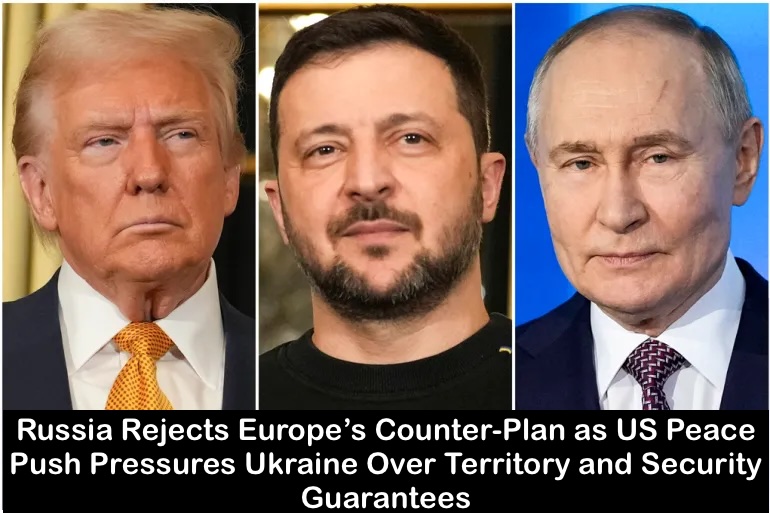
As global pressure mounts to find a diplomatic off-ramp from the war in Ukraine, Russia has sharply dismissed a new European counter-proposal meant to moderate the controversial, US peace plan (28-point plan) that surfaced last week. The Kremlin’s outright rejection has now widened the already stark divide between Western capitals and Moscow, complicating efforts to secure even a temporary stabilization of the conflict.
The original US proposal ignited immediate concern across Kyiv and Europe for appearing to incorporate several of Russia’s long-standing demands, including the cession of Crimea and parts of the Donbas region, a reduction of Ukrainian military capability, and a permanent renunciation of NATO ambitions. President Volodymyr Zelensky swiftly identified the question of territorial compromise as the “main problem,” warning that any forced concessions would undermine Ukraine’s dignity and reward aggression.
Trump Signals “Big Progress,” Yet Kyiv Warns of Major Risks
Former US President Donald Trump, whose administration crafted the peace framework, has suggested that “big progress” may have been made during the Geneva talks. However, he also cautioned that “you shouldn’t believe it until you see it,” leaving open the possibility of forward movement while acknowledging that the process remains fraught with uncertainty.
Zelensky, speaking to a Swedish conference, reiterated that Ukraine will not legalize Russia’s territorial seizures. He stressed that President Vladimir Putin seeks “legal recognition” of what he has “stolen,” adding that borders “cannot be changed by force,” a reference that has become foundational to Kyiv’s negotiating position.
Europe Tries to Recalibrate the US Proposal
Widespread criticism across Europe prompted diplomats to craft an alternative peace plan, developed after intensive consultations in Geneva. Unlike the original proposal, the European counter-framework seeks to soften the stark concessions demanded of Ukraine.
Although far from a final settlement, the European plan suggests pausing hostilities along current front lines, pushing territorial decisions to a later, more stable phase of negotiation. It introduces a U.S.–Ukraine bilateral security guarantee modeled loosely on NATO principles, intended to reassure Kyiv that it would not face further Russian aggression without immediate American support. The plan reduces the pressure on Ukraine to make irreversible territorial concessions upfront, a point European leaders argue is necessary to preserve Kyiv’s sovereignty and public legitimacy.
Russia Rejects the European Plan, Calls It “Unconstructive”
Moscow, however, has rejected the European proposal in uncompromising terms. Kremlin aide Yuri Ushakov declared the new plan “completely unconstructive,” insisting it offers no viable path toward what Russia calls a “just and lasting peace.” President Vladimir Putin, for his part, signaled that some elements of the original U.S. proposal could serve as a “starting point” for negotiations, but warned that if Russia’s conditions are ultimately refused, its forces will “advance further” into Ukrainian territory.
This response underscores a widening strategic gap: Moscow sees value only in the harsher U.S. terms, while Kyiv and Europe view those same terms as dangerously aligned with Russian maximalist objectives.
Frontline Anxiety as Soldiers React to Shifting Diplomatic Ground
On Ukraine’s front lines, the evolving diplomatic landscape has produced frustration, anger, and fatigue. Soldiers interviewed in recent days describe some elements of the original U.S. proposal as “disgraceful,” particularly provisions that would legitimize Russian gains after years of intense fighting. Others, exhausted by ongoing combat, admit that even a deeply imperfect deal may be tolerable if it ends the war. These competing sentiments reflect the broader uncertainty engulfing Ukrainian society as it watches global powers negotiate the future of its territory and autonomy.
Inside the U.S. Plan: Sovereignty and Security at Risk
The U.S. proposal, described by Trump’s team as a flexible “framework,” includes several provisions that would reshape Ukraine’s future. Beyond territorial concessions and military limits, the document calls for Ukraine to abolish what it describes as “discriminatory measures” and to guarantee rights for Russian-language media and education. It also mandates a formal condemnation of “Nazi ideology,” language critics argue mirrors Kremlin propaganda and risks entrenching Russian narratives inside Ukrainian political debate.
Historians and analysts contend that such provisions could erode Ukraine’s sovereignty by embedding Russian influence within domestic legal structures, raising fears that even a temporary peace could set the stage for future subversion.
Zelensky has expressed gratitude for continued American support but has publicly distanced himself from the specifics of the U.S. plan, emphasizing the need for a “dignified peace” that protects Ukraine’s independence and limits the chance of renewed aggression.
Allies Divided as Europe Seeks a Cohesive Position
European governments remain divided over how far to push Kyiv toward compromise. While some support revising the U.S. plan to align more closely with Ukrainian red lines, others caution that rejecting outright negotiation risks prolonging the war indefinitely. Leaders are expected to intensify discussions at an upcoming summit in Angola, where the U.S. plan, the European counter-proposal, and Kyiv’s security concerns will all be debated.
Although Zelensky has indicated that Trump’s team appears receptive to some Ukrainian objections, it remains unclear whether the United States is willing to alter the core components Russia views as non-negotiable.
A Dangerous Crossroads for the West
The diplomatic standoff exposes deep fractures within the Western alliance. The United States is pushing for a framework that many European leaders believe grants Russia too much, too early. Europe is attempting to moderate the approach, but Russia has already rejected the compromise. Meanwhile, Ukraine sits at the center of competing pressures, fearing both abandonment and forced capitulation.
Trump has warned that if Zelensky ultimately refuses the deal, Ukraine may need to “fight his little heart out,” a remark interpreted in Kyiv as a sign that American support could diminish. Ukrainian officials have quietly acknowledged that signing the original U.S. terms could cause the government to collapse, but rejecting them may risk losing vital military assistance.
A Conflict Poised to Escalate or Stabilize—Depending on What Happens Next
With Moscow threatening further advances if its conditions are not met, and with Western capitals divided over the best path forward, the next phase of negotiations will shape not only the war’s trajectory but also Europe’s long-term security architecture.
For now, the peace process remains caught between irreconcilable demands and geopolitical brinkmanship. Ukraine stands at a pivotal moment between defending its sovereignty and managing the expectations of its most powerful allies, while Russia signals that the cost of refusal may be measured in further territorial losses.