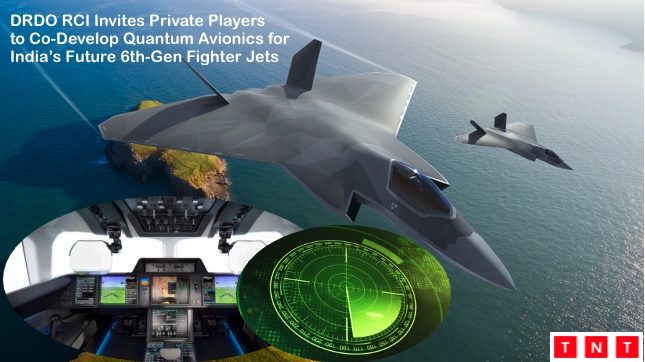
RCI DRDO To Partner With Private Firms for Quantum Avionics in Future 6th-Gen Jets
Research Centre Imarat (RCI), a key DRDO laboratory, actively invites Indian private companies and startups to co-develop quantum avionics for India’s sixth-generation fighter aircraft. This initiative shifts from traditional in-house efforts. Therefore, it harnesses private sector strengths in critical areas like silicon photonics and cryogenic cooling. RCI supports this through Technology Development Fund (TDF) and Innovations for Defence Excellence (iDEX) schemes. In addition, Director B.H.V.S. Narayana Murthy stresses the need for rugged, flight-ready modules.
The move accelerates India’s push towards self-reliant defence tech. Private firms now lead miniaturisation of lab prototypes. These prototypes must withstand Mach 2+ speeds and 9g forces. As a result, quantum avionics promises superior performance in GPS-denied zones. RCI offers up to 90% funding, complete technology transfer, and clear production pathways. However, partners must ensure full indigenisation, from chips to final integration.
Quantum Technologies Targeted by RCI
RCI prioritises three core quantum domains for avionics. First, quantum inertial navigation delivers centimetre-level precision without GPS reliance. This technology uses atom interferometry for unmatched accuracy in jammed environments. Therefore, pilots gain reliable positioning during deep-strike missions.
Second, quantum magnetometry detects magnetic anomalies with extreme sensitivity. It spots submarines, buried IEDs, or metallic objects underwater and underground. In addition, this aids unmanned systems in littoral operations. Third, quantum radar and lidar employ entangled photons. These counter stealth aircraft by enhancing detection through quantum illumination. As a result, India’s fighters outmatch regional threats.
Inertial Navigation Breakthroughs
Quantum inertial systems surpass classical gyroscopes. They maintain coherence over long flights. RCI prototypes already show promise in ground tests. However, flight hardening remains key. Private expertise in photonics speeds this up. Therefore, integration into AMCA Mk2 looks feasible soon.
Private Sector’s Pivotal Role
Director Narayana Murthy calls for industry agility. Private firms excel in scaling prototypes to aviation standards. RCI provides labs, expertise, and IP rights post-development. In return, companies handle certification and mass production. This model mirrors global trends in the US and China. As a result, timelines shrink dramatically.
Funding covers 90% of costs for qualified projects. iDEX nurtures startups, while TDF backs established players. Partners gain export potential after IAF induction. However, full buy-in demands commitment to indigenisation. Therefore, this fosters a vibrant quantum defence ecosystem.
Funding and Transfer Details
RCI streamlines approvals for swift starts. Technology transfer includes design files and test data. Private entities produce at scale for DRDO and Services. In addition, joint teams validate in wind tunnels and flights. This ensures combat readiness.
Strategic Fit for Indian Air Force
Quantum avionics targets Advanced Medium Combat Aircraft (AMCA) Mk2 and beyond. It aligns with National Quantum Mission’s ₹6,000 crore outlay. Prototypes may enter flight trials within 18-24 months. Therefore, IAF gains edge in contested airspace along borders with China and Pakistan.
These sensors boost situational awareness. Quantum radar penetrates stealth coatings. Magnetometers enhance anti-submarine warfare. In addition, inertial units enable autonomous ops. As a result, sixth-gen fighters dominate high-threat scenarios.
AMCA Mk2 Integration Plans
AMCA Mk2 features adaptive wings and nano-stealth too. Quantum suite complements these. RCI coordinates with HAL and private OEMs. Flight tests on scaled platforms precede full embedment. However, challenges like vibration control persist.
Technical Challenges Ahead
Miniaturisation poses the biggest hurdle. Quantum systems need cryogenic cooling below 4 Kelvin. Yet, they must fit compact avionics bays. Maintaining coherence amid vibrations and EMPs demands innovation. Private firms bring nano-fabrication skills here. Therefore, breakthroughs seem likely.
Power efficiency also matters. Quantum tech guzzles energy initially. However, silicon photonics cuts this down. RCI labs simulate extreme conditions. As a result, ruggedised versions emerge faster.
Cryogenic and Photonics Solutions
Cryo-coolers shrink via private R&D. Entangled photon sources stabilise at room temperature partially. In addition, hybrid classical-quantum backups add reliability. These steps make tech deployable now.
Broader Implications for Defence
This collaboration extends to UAVs and missiles. Quantum sensors upgrade BrahMos and Rudram too. India eyes exports post-maturity. It counters F-35 and J-20 stealth. Therefore, regional balance tilts favourably.
National Quantum Mission fuels this. ₹6,000 crore spurs ecosystem growth. RCI leads avionics thrust. Private participation multiplies outcomes. As a result, India joins quantum warfare elite.
Export and Regional Edge
Mature tech draws global buyers. IAF inducts first, others follow. However, ITAR-like controls safeguard IP. This positions India as tech exporter.
RCI’s call galvanises industry. Responses pour in already. Joint ventures form rapidly. Therefore, sixth-gen quantum avionics nears reality, strengthening India’s aerial supremacy.