Reflections on “The Himalayan Blunder” by Brigadier J.P. Dalvi: A Soldier’s Candid Memoir
About the Author
Brigadier John Parashuram Dalvi was a prominent Indian Army officer who commanded the 7th Infantry Brigade during the 1962 Sino-Indian War, a conflict that significantly shaped India’s post-independence military history. Born on 3 July 1920, Dalvi had an illustrious military career, including service during World War II as part of the British Indian Army. In 1962, he was tasked with leading the Indian 7th Infantry Brigade in the North East Frontier Agency (NEFA), confronting Chinese forces under extremely challenging mountainous conditions. The campaign culminated in his capture on 22 October 1962, by the Chinese People’s Liberation Army. He was held as a prisoner of war for seven months before being repatriated in May 1963. Despite facing suspicion and political interrogation at home, Dalvi went on to document his wartime experiences in his seminal book, The Himalayan Blunder. He retired from service in 1967 and passed away in October 1974 from cancer. Dalvi’s memoir remains a cornerstone of Indian military literature, recognized for its candid, frontline perspective and critical analysis of the factors that led to India’s defeat.
About the Book
Publishing History and Editions
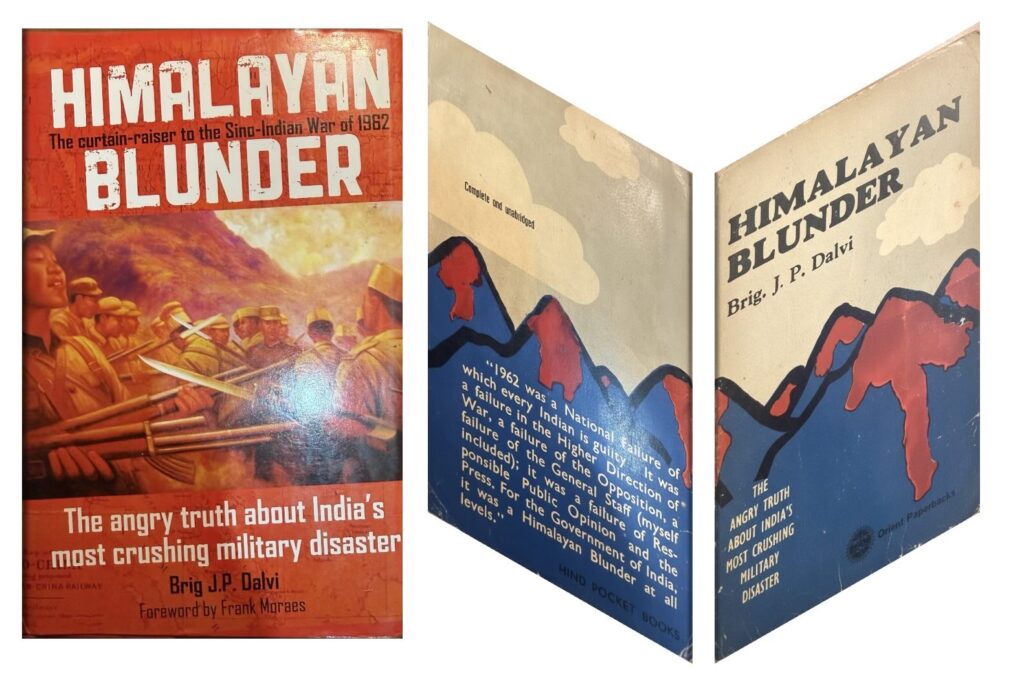
The Himalayan Blunder was originally published in 1969 by Thacker & Company Limited, Bombay. This detailed, hardbound volume soon earned the status of a classic military memoir. Subsequent paperback editions were released by Hind Pocket Books in the early 1970s, broadening its accessibility to a wider readership. More recently, the book saw reprints by Natraj Publishers in 1997 and again in 2010, emphasising the continued relevance of Dalvi’s narrative across generations. This layered publication timeline highlights the enduring importance of the memoir and the critical lessons it imparts.
The Ban on the Book
Shortly after its initial publication, The Himalayan Blunder faced a ban in India. Its uncompromising critique of India’s political and military leadership — notably Prime Minister Jawaharlal Nehru and Defence Minister Krishna Menon — rendered it politically sensitive. Indeed, the book was reportedly first published abroad, arranged by Dalvi’s sister, after Indian publishers hesitated. The ban, imposed under Indira Gandhi’s government, lasted several years due to the book’s harsh portrayal of leadership failures and the mishandling of the 1962 conflict. Dalvi’s candid labeling of India’s defeat as a “Himalayan Blunder” at all levels of government and military command made it controversial. The ban was eventually lifted in the early to mid-1970, after which the book became widely available and recognized as a key historical and military document.
About the Content
Background and Context
Dalvi’s memoir begins by laying out the geopolitical tensions preceding the war, focusing on China’s annexation of Tibet in 1950 and the disputed territorial claims along the McMahon Line. The narrative critiques the neglect and unpreparedness of Indian political and military leadership, pointing out a fraught civil-military relationship. He exposes strategic misjudgements and a lack of readiness that paved the way for the Indian Army’s disastrous campaign in the hostile Himalayan frontier.
Chapter Overview
Dalvi structures the memoir to blend personal battlefield experience with reflective analysis:
The Himalayan Scene – The Years of Credulity and Negligence: This opening chapter discusses the geopolitical landscape shaped by China’s annexation of Tibet and the simmering tensions over the McMahon Line. Dalvi highlights the political neglect that enabled future conflict.
The Fateful Year – 1962: Dalvi chronicles the failure of political and military leadership, emphasizing their inability to foresee Chinese aggression or prepare adequately. Diplomatic complacency and misjudgements are underscored here.
On to the Namka Chu: This section describes initial skirmishes along the Namka Chu River, detailing the harsh terrain and the Indian Army’s tactical challenges as Chinese forces advanced aggressively.
The End of Make-Believe: Dalvi reflects on the widening disconnect between India’s political leadership and the realities on the battlefield. He criticizes the denial and ineffective responses from the hierarchy as the situation worsened.
Battle at Namka Chu River: The book vividly recounts the brutal combat between Dalvi’s 7th Infantry Brigade and the superior Chinese force, covering the intense fight, setbacks, strategic retreat, and Dalvi’s eventual capture.
The Reason Why: The concluding chapter delivers a forthright post-war analysis. Dalvi assigns responsibility for the defeat across the political leadership—including Nehru and Krishna Menon—the senior military command, and systemic failings within the Indian establishment.
Overview and Analysis
Brigadier Dalvi approaches the 1962 Sino-Indian War with unparalleled honesty and clarity. His dual perspective as a frontline commander and prisoner provides an authenticity infrequently seen in war memoirs. He systematically exposes the systemic failures behind India’s defeat, highlighting Prime Minister Nehru’s diplomatic complacency and Defence Minister Krishna Menon’s ineffective leadership, which left the armed forces critically under-equipped and unprepared to defend the country’s borders. Dalvi’s narrative avoids bitterness; instead, it seeks to illuminate past errors to prevent their repetition. The memoir is a compelling call for accountability, foresight, and greater respect for the soldiers who pay the ultimate price in conflict.
Dalvi notably stated that the failure in 1962 was comprehensive, involving not just the political leaders, but also the opposition, the General Staff (including himself), public opinion, and even the press. His condemnation of the Indian government’s systemic lapses as the “Himalayan Blunder at all levels” underscores his belief in collective responsibility for the military humiliation. This powerful assessment has been frequently cited in articles, reviews, and tributes honoring Dalvi’s insights into the 1962 war.
Impact and Legacy
The Himalayan Blunder remains a crucial resource for understanding the failures and lessons of the 1962 conflict. It serves as a stern warning to policymakers and military strategists regarding the dangers of political interference, complacency, and lack of preparedness. At the same time, it pays tribute to the bravery and sacrifice of frontline soldiers. After decades of censorship, its restored availability is a testament to its historical significance and the importance of transparent, honest military historiography in India. The memoir is regularly referenced in scholarly studies of Indian military history and civil-military relations.
Conclusion
The Himalayan Blunder is an indispensable work for anyone interested in Indian military history, defence strategy, or civil-military relations. Beyond narrating battlefield valor and tragedy, Brigadier Dalvi’s memoir functions as a cautionary tale for policymakers and military leaders alike. The book’s journey—from its original 1969 publication by Thacker & Company, through subsequent accessible editions by Hind Pocket Books and Natraj Publishers—reinforces its lasting prominence in Indian military literature. For readers seeking a deeply insightful and sobering examination of India’s most significant military setback, The Himalayan Blunder stands as a vital and engrossing volume that resonates to this day.