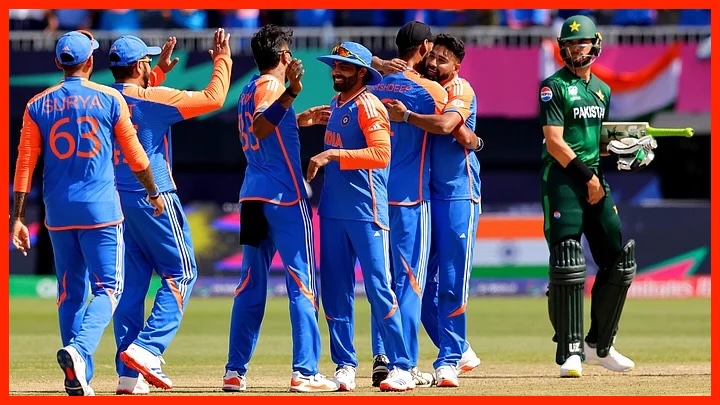
Pakistan’s Boycott Threat Crumbles as ICC’s $144M Axe Looms Over India Showdown
February 8, 2026 | New Delhi | What began as a loud political statement has ended in quiet negotiations and reluctant retreat. Pakistan’s dramatic threat to boycott its marquee T20 World Cup 2026 clash against India is now on the verge of collapse, undone not by diplomacy or public opinion, but by the cold arithmetic of global cricket economics.
Behind closed doors in Lahore, frantic discussions are underway between the Pakistan Cricket Board, ICC officials, and representatives from Bangladesh. The mood, according to multiple sources, is no longer defiant. It is cautious, defensive, and increasingly resigned to reality. The prospect of losing over $144 million in guaranteed ICC revenue has proved far more persuasive than any political slogan.
As the February 15 showdown in Colombo approaches, Pakistan appears poised for yet another high-profile U-turn, reinforcing a familiar pattern in subcontinental cricket diplomacy: rhetoric first, retreat later.
From Diplomatic Tension to Cricketing Crisis
The 2026 ICC Men’s T20 World Cup, jointly hosted by India and Sri Lanka, was conceived as a commercial and sporting spectacle. With twenty teams, a revamped group format, and month-long coverage, the tournament represents one of the most lucrative events in cricket history.
However, long before the first ball was bowled, geopolitics began shaping the narrative.
Bangladesh’s withdrawal from matches scheduled in India, citing security concerns and diplomatic strains, triggered the first major disruption. The ICC’s decision to replace Bangladesh with Scotland was viewed in Dhaka as unfair and hasty. In Islamabad, it was seen as an opportunity.
Pakistan, already playing its entire tournament in Sri Lanka due to its refusal to tour India, seized the moment. The government publicly framed the issue as one of “solidarity” with Bangladesh and “fairness” in international sport. Prime Minister Shehbaz Sharif announced that Pakistan would not face India until the Bangladesh issue was addressed.
What followed was predictable. A sporting tournament was transformed into a geopolitical flashpoint.
The Politics Behind the Protest
Pakistan’s boycott call was presented as a principled stand. Official statements accused the ICC of bias and procedural injustice. Bangladesh’s security concerns were cited repeatedly, and the boycott was marketed domestically as a matter of national dignity.
Yet critics quickly pointed out the contradictions.
Pakistan has participated in multiple ICC events in India in recent years despite similar security narratives. It played in the 2023 ODI World Cup and engaged in Champions Trophy planning in 2025. Each time, strong rhetoric was followed by compliance.
For many observers, this episode appeared less about Bangladesh and more about domestic optics. Cricket remains deeply entwined with national identity in Pakistan, and posturing against India carries political value at home. The boycott threat, therefore, served as a symbolic gesture rather than a sustainable policy.
Social media reflected this cynicism, with many fans describing the episode as another chapter in the familiar “boycott, bargain, backtrack” cycle.
ICC Steps In: Law, Contracts, and Consequences
The International Cricket Council responded swiftly and firmly. Officials made it clear that unilateral withdrawal from scheduled fixtures constitutes a breach of participation agreements.
Private communications to the PCB outlined potential consequences: financial penalties, forfeiture of points, suspension of development funding, and legal exposure to broadcasters and sponsors.
Deputy Chairman Imran Khwaja and senior ICC executives travelled to Lahore for emergency consultations. Their message was direct. Political grievances do not override contractual obligations.
The ICC also rejected any attempt to invoke force majeure. Without concrete evidence of imminent security threats in Sri Lanka, Pakistan’s legal position was weak.
Meanwhile, Sri Lanka Cricket warned that cancellation of the India-Pakistan fixture could cost the host nation up to $70 million in tourism and hospitality revenue. Broadcasters and advertisers raised parallel concerns.
The ecosystem of international cricket, built on predictability and marquee events, was under threat. The ICC moved quickly to protect it.
The Financial Reality: Why the Boycott Was Unsustainable
At the heart of Pakistan’s retreat lies a simple truth: modern cricket runs on money, and India-Pakistan matches are its financial engine.
An India-Pakistan clash generates between $240 million and $500 million in combined value through broadcasting rights, advertising, sponsorships, and digital engagement. Even conservative estimates place its worth near $250 million.
The ICC’s $3 billion media rights deal with Disney Star is structured around such blockbusters. A boycott would have triggered rebate clauses, legal claims, and commercial renegotiations.
For the PCB, the consequences would have been devastating.
Under the 2024–2027 revenue cycle, Pakistan is entitled to approximately $144 million in ICC distributions, translating to $35–38 million annually. This money funds domestic cricket, player contracts, infrastructure, and grassroots development.
Losing it would have crippled the board.
In addition, broadcasters stood to lose $24–35 million in advertising revenue. Sponsors were prepared to seek compensation. Host revenues were at risk. Legal costs loomed.
In short, a boycott would not have punished the ICC or India. It would have punished Pakistan.
Internal Pressure and Strategic Retreat
As financial projections circulated within the PCB, resistance softened. Senior administrators reportedly warned that defaulting on ICC obligations could set Pakistan back a decade.
Players, too, were uneasy. Missing the India match would mean lost exposure, reduced commercial opportunities, and potential exclusion from future leagues.
Privately, many within the board acknowledged that the boycott had been announced without a clear exit strategy.
Negotiations in Lahore now focus on face-saving mechanisms rather than confrontation. Minor concessions, symbolic acknowledgements of Bangladesh’s concerns, and diplomatic language are being explored to justify a reversal.
The goal is no longer to resist. It is to retreat without appearing to surrender.
What Happens Next: Almost Certain Compliance
As of the evening of February 8, informed sources indicate that Pakistan is preparing to confirm its participation.
The overwhelming consensus within cricketing circles is that the match will proceed.
Financial pressure, legal vulnerability, historical precedent, and commercial dependencies all point in the same direction. Pakistan has backed down in similar situations before, and there is little reason to expect a different outcome now.
Only an extraordinary breakdown in talks could derail the fixture. Even then, the costs would be so severe that reversal would remain likely.
Colombo is preparing for a full house. Broadcasters are maintaining schedules. Advertisers are holding their slots.
The machinery of global cricket is already moving forward.
Beyond This Episode: The Larger Pattern
This controversy exposes a deeper structural reality.
International cricket, particularly in the subcontinent, is no longer governed primarily by sporting ideals. It is governed by broadcast contracts, sponsorship portfolios, and audience metrics.
India sits at the center of this system. Its market power shapes schedules, revenues, and governance. Pakistan, despite its rich cricketing heritage, operates within this ecosystem as a dependent stakeholder.
Political gestures may generate headlines, but they rarely survive contact with balance sheets.
Until Pakistan develops financial autonomy within global cricket, such episodes will continue. Public defiance will be followed by private compromise.
When Economics Defeat Rhetoric
Pakistan’s boycott threat was never truly about principle. It was about posture.
Once the numbers were laid bare, posture became unaffordable.
The looming loss of $144 million, the risk of isolation, and the threat of legal action proved more decisive than any political narrative. The ICC did not need to shout. It simply needed to remind all parties where the money flows.
As the India-Pakistan clash approaches, the episode stands as another reminder that in modern cricket, sovereignty ends where broadcast revenue begins.
Colombo will witness the match. The world will watch. The drama will fade.
And the balance sheet will, once again, have the final word.