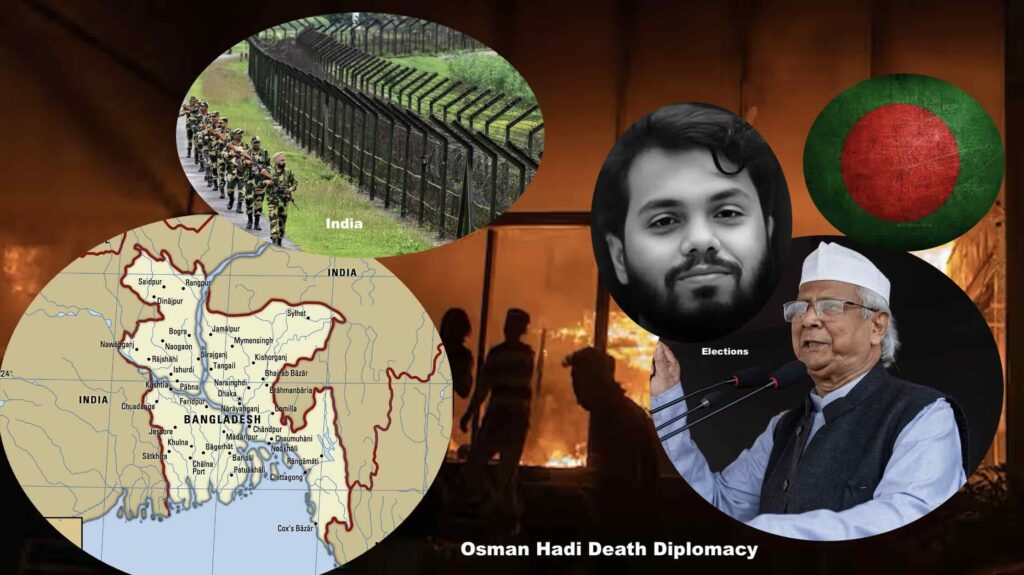
Osman Hadi’s Death and the Double Standards of Global Diplomacy
Western and International Diplomatic Spotlight on Osman Hadi’s Death
The death of Sharif Osman Hadi on 18 December 2025 has drawn an ‘unusually’ wide international response. Diplomatic missions from Western capitals, multilateral institutions, and several non-Western states issued swift condolences. This collective reaction elevated the killing of a Bangladeshi youth leader into a matter of global attention.
Hadi, aged 32, succumbed to gunshot injuries sustained during an attack in Dhaka on 12 December. He died while undergoing treatment in Singapore. His death triggered violent protests, vandalism, and an intensification of anti-India sentiment across Bangladesh. Against this backdrop, the scale and tone of international mourning merit serious scrutiny.
This editorial examines Osman Hadi death diplomacy, not as an expression of sympathy alone, but as a political signal. It raises uncomfortable questions about selective moral standards, strategic silence, and the risks of legitimising radical narratives under the banner of democratic concern.
Who Was Sharif Osman Hadi? Revisiting a Polarising Figure
Sharif Osman Hadi rose to prominence during Bangladesh’s July–August 2024 so-called “Gen Z” uprising, which culminated in the removal of Prime Minister Sheikh Hasina. As a spokesperson of Inquilab Mancha, he projected himself as a youth leader demanding democratic reform and later announced plans to contest elections as an “independent” candidate. However, several other figures played more prominent and sustained roles in the Gen Z movement. Hadi’s national stature was limited during his lifetime, making the scale of attention accorded to him after his death both unusual and disproportionate.
This inflated posthumous projection contrasts sharply with his actual political footprint. His prominence appears to have expanded more through narrative amplification after his killing than through demonstrable leadership or mass acceptance during the protests themselves.
Moreover, this cultivated public image coexisted with deeply divisive positions. Hadi openly called for a ban on the Awami League, a party rooted in Bangladesh’s independence struggle and led by Sheikh Mujibur Rahman, the country’s founding leader. He repeatedly accused India of regional “hegemony” and made inflammatory claims involving India’s North-Eastern states, at times depicting them as part of a greater Bangladeshi map. These assertions further strained already fragile India–Bangladesh relations and fuelled cross-border hostility.
Inquilab Mancha itself faces serious allegations of Islamist alignment. Critics accuse the platform of advocating Sharia-based governance in a constitutionally secular republic. Following Hadi’s death, the group declared him a martyr against what it described as “Indian domination”. Protests that followed saw the vandalism of 1971 Liberation War memorials and targeted attacks on media institutions, acts that struck at the very foundations of Bangladesh’s secular and liberationist identity.
Former Indian diplomat Kanwal Sibal, writing on X, highlighted these contradictions. He questioned why Western governments chose to mourn a figure linked to radical politics while remaining conspicuously silent on violence against minorities, including reported lynchings of Hindus over blasphemy allegations. Online discourse echoed these concerns, particularly after attacks on Indian diplomatic premises compelled India to shut several of its consulates in Bangladesh.
Taken together, these realities complicate the carefully constructed narrative of Sharif Osman Hadi as a benign pro-democracy icon. They raise legitimate questions about how, and why, certain figures are selectively elevated in international discourse—often divorced from their ideological positions and the consequences they leave behind.
Diplomatic Responses: An Expanding Chorus of Condolences
Western diplomatic reactions arrived swiftly and prominently. The United States Embassy expressed “deepest condolences” to Hadi’s family, friends, and supporters. This message appeared alongside American security advisories warning of unrest, yet avoided any reference to the violent aftermath.
The United Kingdom High Commission followed with a similar statement. It described itself as “deeply saddened” and praised Hadi’s democratic activism. His radical positions went unmentioned. EU, Germany and France joined the chorus as their flags in Dhaka were lowered, and statements framed Hadi as a symbol of justice and reform.
The European Union Delegation expressed sorrow, while the European Parliament’s Subcommittee on Human Rights called for action against electoral violence. The United Nations Human Rights Council urged an impartial investigation. The UN Secretary-General condemned the killing but avoided contextual engagement with Hadi’s ideology or its consequences.
More striking were responses from non-Western states. Pakistan’s High Commission offered prayers for Hadi’s soul. Iran’s Embassy expressed solidarity with Bangladesh over his “tragic passing”. Singapore, where Hadi received treatment, conveyed condolences as well.
Collectively, these reactions internationalised Hadi’s death. Yet none addressed attacks on minorities, destruction of liberation symbols, or anti-India violence that followed. This silence is as significant as the statements themselves.
Why the Global Amplification Appears Unusual
Kanwal Sibal described the diplomatic prominence accorded to Hadi as “unusual”. Historically, local political activists without international portfolios do not receive such coordinated global attention. The explanation lies less in humanitarian concern and more in geopolitical signalling.
Western capitals have long criticised Sheikh Hasina for authoritarian tendencies. In this context, Hadi’s 2024 activism fitted a convenient pro-democracy frame. However, diplomacy that ignores ideological extremism while amplifying selective narratives risks distorting reality.
Online analysts argue that these condolences indirectly legitimised Islamist-leaning forces during Bangladesh’s fragile transition. Pakistan and Iran’s involvement further complicates the picture. Both have strategic interests in counterbalancing India’s regional influence. Their expressions of sympathy aligned neatly with Hadi’s anti-India rhetoric.
Singapore’s response was institutionally neutral. Yet its inclusion still contributed to the perception of international consensus. Notably absent were statements from Japan, Australia, or Canada, underscoring that global concern was selective rather than universal.
Selective Advocacy and the Question of Double Standards
The core issue is not diplomatic condolence itself. States routinely express sympathy after political violence. The concern lies in selective advocacy. Western governments that champion minority rights, secularism, and tolerance elsewhere remained silent when these principles came under threat in Bangladesh.
Condemning violence without context sanitises ideology. Mourning a figure associated with Sharia advocacy, while ignoring attacks on Hindus and desecration of 1971 memorials, sends a troubling signal. It suggests that values become flexible when strategic objectives intervene.
This pattern is familiar across global diplomacy. Democracy promotion often prioritises regime outcomes over social cohesion. Human rights discourse becomes episodic. As a result, radical actors learn that international legitimacy is attainable if they occupy the correct narrative space.
Implications for India–Bangladesh Relations and Regional Stability
Hadi’s state funeral on 20 December drew thousands. Interim Chief Adviser Muhammad Yunus addressed the gathering and pledged to honour Hadi’s “dreams”. This moment formally embedded Hadi into Bangladesh’s political memory.
For India, the implications are serious. Anti-India mobilisation has already strained bilateral ties. For Bangladesh, the risk is deeper. Elevating polarising figures undermines its secular foundation and fractures the legacy of 1971.
International actors may view their interventions as stabilising. However, stability built on narrative distortion is fragile. When diplomacy ignores ideological warning signs, it does not prevent extremism. It emboldens it.
The episode of Osman Hadi death diplomacy thus exposes a broader flaw in global engagement with South Asia. Consistency has given way to convenience. Principles have become instruments. The cost may be paid not in statements, but in long-term instability.