The Fatah-II Missile Incident – Pakistan’s Boldest Escalation and India’s Decisive Intercept
The Fatah-II missile incident has returned to national attention after the 10 November 2025 terror attack in Delhi, which killed dozens and shook public confidence once again. India has repeatedly warned that the country will no longer separate cross-border terrorism from interstate conflict, and after the May ceasefire in the India–Pakistan crisis, New Delhi declared a new doctrine: “From now on, any terror attack on Indian soil will be considered an act of war.” This position has acquired renewed urgency after the latest assault in the capital, raising fears that a new confrontation may be looming. It is against this tense backdrop that the events of Operation Sindoor continue to matter, especially the attempted strike with Pakistan’s Fatah-II missile.
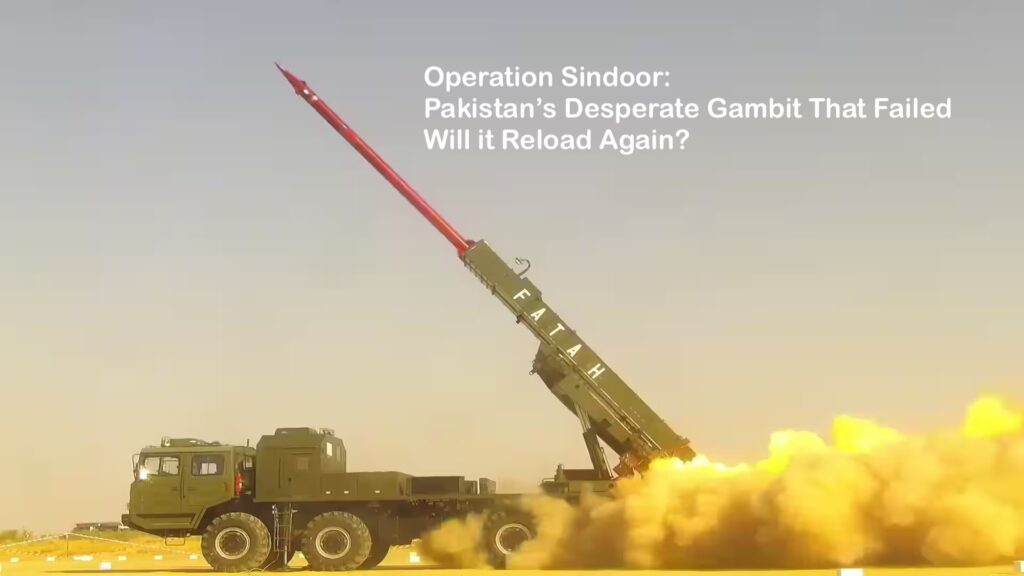
In the final hours of the four-day conflict that gripped South Asia from 06 to 10 May 2025, the skies over northern India became the stage of an unprecedented escalation. As Pakistan launched a frantic barrage of more than 400 hundred drones and cruise missiles under its internal offensive named Operation Bunyan-um-Marsoos, Indian air defenders observed a very different signature on their screens. Shortly after 2:00 a.m. on 10 May, a ballistic trajectory arced towards the National Capital Region. The projectile was identified and widely reported as Pakistan’s Fatah-II, a short-range ballistic missile (SRBM) which becomes hypersonic in the terminal phase to reach up to Mach 8 speed. It has range upto 400 km and suited for tactical nuclear delivery. Its interception over Sirsa, Haryana, marked the most dangerous moment of the conflict and demonstrated the resilience of India’s air defence network.
Pakistan’s Desperate Gambit
Operation Sindoor began as India’s measured response to the 22 April 2025 Pahalgam terror attack, which killed twenty-six civilians in Jammu and Kashmir. By 9 May, after Indian precision strikes damaged runways and hardened shelters at key Pakistani airbases such as Nur Khan, Sargodha and several other key installations, Islamabad appeared determined to break India’s offensive rhythm. Several missile launches were reported through the night. Indian sources confirmed that missiles were aimed at Jammu, Srinagar, Amritsar, Pathankot, Udhampur, Bathinda, and, most provocatively, the Delhi region.
It is bereaved that the missile targeted at Delhi was launched from a Transporter Erector Launcher in Pakistan’s Punjab province. Its intended trajectory suggested a symbolic and psychological strike aimed at undermining civilian confidence and challenging India’s integrated defences. Analysts at the Carnegie Endowment and other research centres later described the move as a “stunning shift towards urban targeting”, indicating an escalation that risked violating long-standing nuclear thresholds. Although Indian counterstrikes caused explosions across entire Pakistan, the Fatah-II launch became the defining moment of that night.
The Intercept: Layered Defence in Action
Sirsa, home to a major Indian Air Force station, became the focal point of the intercept. The missile was detected within seconds by Akashteer, India’s AI-enabled command-and-control system that fuses data from X-band radars, ISRO satellite feeds, and RF pattern detectors. Akashteer’s algorithms predicted the trajectory in real time, allowing defensive units to respond without delay.
The decisive engagement came from a Barak-8 (MRSAM) interceptor fired from a mobile launcher positioned in Haryana. Travelling at more than Mach 2, the interceptor struck the Fatah-II in mid-air and destroyed it, with debris landing across fields near the Sirsa Air Force base. Local authorities recovered fragments resembling guidance fins and inert warhead casings. No casualties were reported. Supporting the Barak-8 were S-400 Triumf batteries and Akash surface-to-air missiles, all linked through Akashteer. Throughout Operation Sindoor, this layered shield achieved a near-perfect interception record against 600+ aerial threats, ranging from low-altitude drones to high-speed cruise missiles.
Videos circulating online captured the bright streak of the interceptor followed by an intense flash in the sky. Pakistani outlets dismissed these images as “propaganda”; however, Indian responders on the ground confirmed the debris and a brief activation of sirens to alert residents.
The Fatah-II: Pakistan’s New Missile Under Scrutiny
Unveiled earlier in 2025, the Fatah-II is a hypersonic ballistic missile with a range exceeding 400 kilometres. Its manoeuvring glide capabilities and 300–500 kilogram warhead capacity were designed to challenge modern air defence systems. From launch sites in Punjab, Delhi lay less than five minutes away. The missile therefore represented Pakistan’s attempt to exploit India’s reaction-time limitations. Yet its first operational use ended abruptly in Indian airspace.
Indian analysts highlighted that while Pakistan viewed the Fatah-II as its new “pride”, India’s interception exposed vulnerabilities in its deployment strategy. India’s own missile forces, especially the Prithvi and Agni series, have far greater reach. However, the intercept showcased the value of India’s indigenous C2 automation, particularly the efficiency of the Akashteer network developed under the Aatma Nirbhar Bharat initiative. Defence experts, including John Spencer of the Modern War Institute, later described the instance as a “blueprint for urban missile defence”, citing the Barak-8’s performance under combat conditions.
Aftermath and Renewed Relevance After the 10 November Attack
The failure of the Fatah-II strike and India’s retaliatory BrahMos missions against multiple Pakistani airbases forced emergency hotline communication between the Directors General of Military Operations by around 6:00 a.m. on 10 May that accelerated a ceasefire announcement later that afternoon.
Despite the ceasefire, India issued a firm declaration: “Any future terror attack will be taken as an act of war, and the response will be military.” This new doctrine has returned to prominence after the 10 November 2025 terror attack in Delhi, which targeted a crowded commercial hub and killed scores of civilians. Investigations are ongoing, but early indicators of cross-border involvement have revived fears that Operation Sindoor may not have been the last chapter in the region’s tensions.
Airports and restricted air corridors gradually reopened by 25 May, yet the missile flare over Sirsa remains etched into public memory. In light of the recent Delhi attack, the Fatah-II incident serves as a reminder of how quickly the region can slide from provocation to confrontation, especially now that India has tied domestic security directly to military retaliation.
A Crisis That Continues to Echo
The Fatah-II missile incident was more than an attempted strike—it was the closest the subcontinent came to a ballistic-level exchange in decades. With India’s declaration that terrorism will trigger a wartime response, and given the shock of the latest Delhi attack, analysts warn that the region may be approaching another dangerous juncture. As India reinforces its commitment to deterrence, Operation Sindoor’s legacy gains renewed relevance: a demonstration of precision, preparedness, and the fragile calm that follows a crisis unresolved.