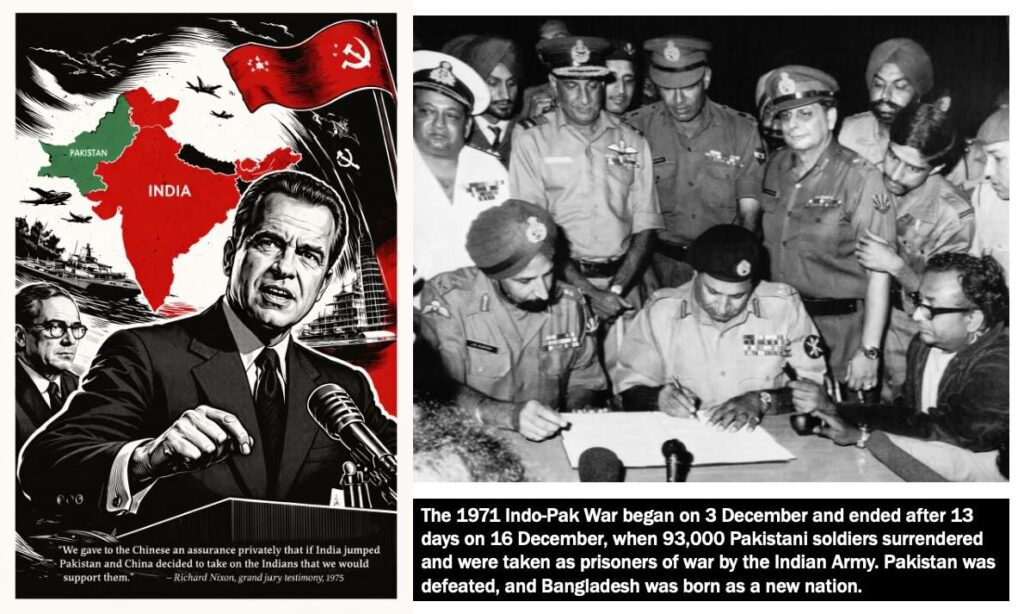
New Nixon Testimony Illuminates the 1971 Indo-Pak War: Deep State, US Espionage, China Assurances, and Cold War Strategy
On February 8, 2026, the New York Times published an opinion essay by Watergate historian James Rosen revealing seven previously sealed pages of Richard Nixon’s 1975 grand jury testimony. These pages, long buried in classified Watergate prosecution files, shed new light on internal U.S. decision-making during the 1971 Indo-Pakistani War (also known as the Bangladesh Liberation War) and the Moorer-Radford affair. Rather than rewriting battlefield history, the testimony enriches understanding of how Washington navigated superpower rivalry, covert leaks, and diplomatic signalling — especially in relations with China — at a historic Cold War inflection point.
What Was Already Known About 1971 and US Policy
The broad strategic contours of the December 1971 conflict are well documented through declassified files, memoirs, and historical works such as The Blood Telegram by Gary Bass. Washington’s approach was shaped by Cold War calculations:
US “tilt” toward Pakistan: Nixon and Henry Kissinger favoured Pakistan despite its brutal suppression of Bengali nationalists. The policy stemmed from Pakistan’s utility as a secret channel to advance Nixon’s rapprochement with China and from perceptions of India’s alignment with the Soviet Union. Public neutrality masked deep private bias in favour of Islamabad.
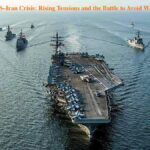
Seventh Fleet in the Bay of Bengal: In mid-December 1971, Task Force 74, anchored on the nuclear carrier USS Enterprise, was sent into the Bay of Bengal. Ostensibly for evacuations, the signal was clearly meant to intimidate India and reassure Pakistan. The move alarmed both New Delhi and Moscow.
Soviet counter-deployment: The USSR sent its naval forces to shadow the American group, deterring escalation. Soviet naval officers later described manoeuvres that effectively constrained US movement.
The US fleets did not engage. Pakistan surrendered in Dhaka on December 16, 1971, with more than 93,000 troops capitulating. The American ships subsequently withdrew, marking the humiliating failure of coercive diplomacy.
Leaked “tilt” disclosures: Journalist Jack Anderson published explosive columns exposing secret White House discussions, earning a Pulitzer and prompting internal investigations that eventually linked to the Moorer-Radford spying ring.
The Moorer-Radford Affair and Newly Revealed Testimony
Yeoman Charles Radford, an enlisted aide in the Nixon White House, systematically copied sensitive documents from senior officials’ briefcases, including materials accompanying Kissinger on travels, and passed them to top Pentagon figures such as Admiral Thomas Moorer. Radford’s activities provided primary source material for leaks that contradicted official narratives, including elements that would later be reported by Anderson and traced back to Radford’s pipeline.
The newly published grand jury pages focus on this spying and internal conflicts within the U.S. national security apparatus. According to summarised testimony, Nixon acknowledged there were strategic assurances provided privately to China during the 1971 crisis — a sensitive contingency plan that was never public until now.
As one source summarising the testimony puts it, Nixon stated:
“We were giving moral support to [Pakistan], and also we gave to the Chinese an assurance privately that if India jumped Pakistan and China decided to take on the Indians that we would support them.”
This line, preserved in grand jury transcripts long kept secret, shows Washington was prepared to signal backing to Beijing if it chose to open a second front against India, a geopolitical gambit designed to check Soviet-Indian influence and to reinforce U.S. leverage in triangular Cold War diplomacy.
Nixon’s Motivation for Secrecy and the Deep State Narrative
Rosen’s essay emphasises not just the content of the testimony but its implications for how executive authority, civil-military relations, and classified information intersect. Nixon’s reluctance to release the pages into the public record was rooted not merely in political embarrassment but in deep concerns about national security and institutional distrust. According to sources summarising the grand jury record, Nixon argued that prosecuting Radford or publicising the disclosures would compromise strategic backchannels, including those facilitating the eventual Nixon opening to China.
The episode feeds into long-standing narratives about the “deep state” — the notion of entrenched bureaucratic interests operating independently of elected leadership — because military figures were passing secret National Security Council documents to Pentagon leadership without presidential sanction. Rosen uses this history to reflect on later political controversies involving leaks, classification battles, and executive vulnerability.
Geopolitical Context — China, the Soviet Union, and South Asia
Soviet Support for India: Moscow’s strategic backing was anchored in the August 1971 Indo-Soviet Treaty of Peace, Friendship and Cooperation, which deterred third-party intervention and secured diplomatic and material support for New Delhi. This cooperation reshaped strategic balances in South Asia.
China’s Position: Beijing supported Pakistan rhetorically and diplomatically. Nixon’s outreach to China, which culminated in his historic 1972 visit, was part of a broader strategy to exploit Sino-Soviet tensions. However, China did not intervene militarily in 1971, even with Nixon’s alleged assurances of U.S. backing.
American Naval Signalling: The Seventh Fleet’s presence demonstrated U.S. resolve but ultimately failed to alter the course of the war, underscoring the limitations of power projection when countered by a peer competitor’s direct support and deterrence.
Historical Impact and Contemporary Resonance
The 1971 war remains a defining moment in South Asian history — India’s decisive military success, the birth of Bangladesh, and shifts in regional alignments are undisputed. What the newly revealed Nixon testimony adds is a more nuanced appreciation of the internal strife, covert assurances, and strategic brinkmanship that marked U.S. policy at the time.
By illuminating how high-level assurances to China were contemplated, how military officers conducted internal espionage against their own administration, and how a president weighed political risk against diplomatic strategy, the testimony deepens our understanding of Cold War governance. It also invites reflection on modern debates about secrecy, executive control, and the enduring complexities of great-power diplomacy.