Nepal Gen Z Movement: From Street Revolt to Political Formation
From Protest to Policy
Kathmandu, October 20 — The Nepal Gen Z movement that exploded across campuses and digital networks in September 2025 has already begun to mutate into something rarer: a serious political experiment. What started as a youth uprising against corruption and censorship has turned into an organised bid to reshape Nepal’s democracy itself.
Within a month of toppling Prime Minister K. P. Sharma Oli, the movement’s leaders are drafting frameworks for a reformist political party expected to contest the March 2026 general elections. The question now gripping Nepal’s corridors of power is whether a digital-age rebellion can institutionalise itself before fatigue or factionalism set in.
The Spark: A Ban That Backfired
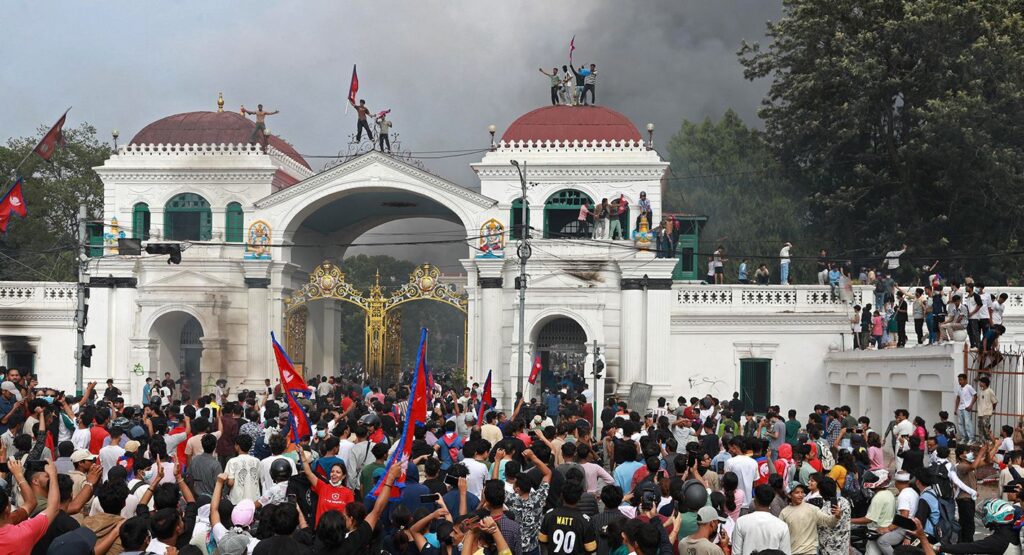
The chain reaction began when the Oli government imposed a blanket ban on 26 global social-media platforms — including Facebook, YouTube and X — under the pretext of national security. The edict silenced online influencers but enraged a generation that sees connectivity as identity. Within 48 hours, encrypted groups on Discord and Viber sprang to life under hashtags like #LetUsSpeak and #HamiNepaliGenZ.
University students, start-up founders and gig-workers flooded the streets, accusing the government of “digital dictatorship”. Videos of baton-charges and slogans against oligarchy went viral. By 9 September 2025, protest turned violant, hundreds killed and thousands injured, Prime Minister Oli resigned. The speed of the collapse surprised even protesters, who suddenly found themselves asked: Now what?
The Faces of a Generation
Two figures quickly emerged as the movement’s public anchors — Sudan Gurung and Miraj Dhungana.
Gurung, 36, founded the NGO Hami Nepal after the 2015 earthquake. His Instagram appeal — “Bring your courage and voice” — became the movement’s moral call to action. Charismatic yet measured, Gurung bridged student activists and older civil-society figures. He now plans to contest the 2026 polls, arguing for citizen-centred governance and transparent budgets.
Dhungana, in his early 30s, represents the younger strategic core — a generation raised on coding boot camps and policy forums. He is drafting a party charter that calls for a directly elected executive, digital transparency laws and independent anti-corruption commissions. While Gurung embodies emotion and experience, Dhungana provides structure and discipline.
“If Sudan gave the revolt its conscience, Miraj gave it structure,” notes political analyst Tara Karki. “That complementarity is why the movement survived its own success.”
Street Energy Meets Statecraft
The interim government under former Chief Justice Sushila Karki — appointed with youth endorsement — has agreed to a timeline for elections and a truth commission into protest-related violence. Seventy-two people died during the unrest. Despite that trauma, public trust in the youth movement remains unusually high: a latest TNT-UNDP poll shows 64 per cent of urban voters under 35 prefer new leaders like Gurung and Dhungana to traditional parties.
Yet beneath the surface, fault lines persist. Federal reformists from rural provinces push for decentralisation, while urban populists around Kathmandu Mayor Balen Shah advocate technocratic control. The tension is palpable: can a movement that thrives on hashtags also handle hierarchy?
Balen Shah: Technocrat, Icon, Cautionary Symbol
Balen Shah, the 35-year-old rapper-engineer-turned-mayor of Kathmandu, was not a front-line protester but became a symbol nonetheless. His anti-corruption lyrics resurfaced as rally anthems, and his municipal reforms — open-data budgets, drone-based infrastructure audits — made him a national reference point. Many Gen Z activists now urge him to seek national office.
Shah welcomes the movement’s energy but warns against impulsiveness. “National wealth lost to violence is our shared loss,” he said at a youth summit. “Your generation must now lead through policy, not anger.” His advice captures the central lesson of Nepal’s transition: protest can ignite reform but cannot replace governance.
Institutionalising Change — Not Just Revolt
That philosophy now guides the Nepal Gen Z movement. Miraj Dhungana and reformist blocs are drafting party charters for the March 2026 elections, aiming to institutionalise change rather than ignite new revolts — although undercurrents remain visible.
Several youth collectives are testing policy pilots: a Digital Audit Portal that lets citizens track local spending in real time, and a Green Nepal Initiative to channel foreign remittances into eco-start-ups. If implemented, these could be Asia’s first civic-tech projects born directly out of street protests.
Still, the movement faces the classic paradox of youth politics — righteous energy versus organisational cohesion. Without consistent structure, idealism can turn into fragmentation, a pattern seen in many digital-age revolts.
Comparative Currents: Madagascar and Bangladesh
Nepal’s trajectory is striking because it breaks the regional pattern. In Madagascar, the Gen Z uprising of October 2025 devolved into military rule within a week as the army installed General Randrianirina as president. Madagascar’s young activists now say they wanted jobs and justice, not new uniforms in power.
In Bangladesh, the situation is equally fraught. After Sheikh Hasina’s resignation in 2024, Nobel laureate Muhammad Yunus formed an interim government hailed as a model of reform. A year later, that promise is fading. The country has yet to set an election date, and many young activists claim the agenda has been hijacked by intellectual elites. As one Dhaka student leader mentioned, “We brought down a dynasty only to see another rise in seminar rooms.”
Across these cases, the pattern is clear: Gen Z can trigger change, but sustaining it requires translation from hashtags to policy documents.
A Generation at the Crossroads
The Nepal Gen Z movement now stands as a regional benchmark for how digital activism can transform into legitimate governance. But success is not assured. Its leaders must navigate old-guard political barons, bureaucratic resistance and ideological splits between federalists and centralists. International observers see Nepal as a testing ground for the future of youth-driven democracy in the Global South.
If Miraj Dhungana and Sudan Gurung can keep their coalition coherent and deliver a credible manifesto by early 2026, Nepal could achieve what neighbouring movements failed to do: turn protest energy into policy power. Otherwise, it risks repeating the region’s cycle of uprising and uncertainty.
Conclusion
The streets of Kathmandu no longer thrum with protest chants, but the echo remains in committee rooms and draft charters. For Nepal’s Gen Z, the goal is no longer simply to speak — it is to govern. If they succeed, their experiment could offer a template for youth movements from Madagascar to Bangladesh. If they fail, the lesson will be equally valuable: digital outrage without institutional architecture can win the day but lose the decade.