Narco-Wars on the High Seas: How Trump’s Drug War Against Venezuela Risks a New Caribbean Crisis
The Caribbean is heating up again — not from hurricanes, but from missiles.
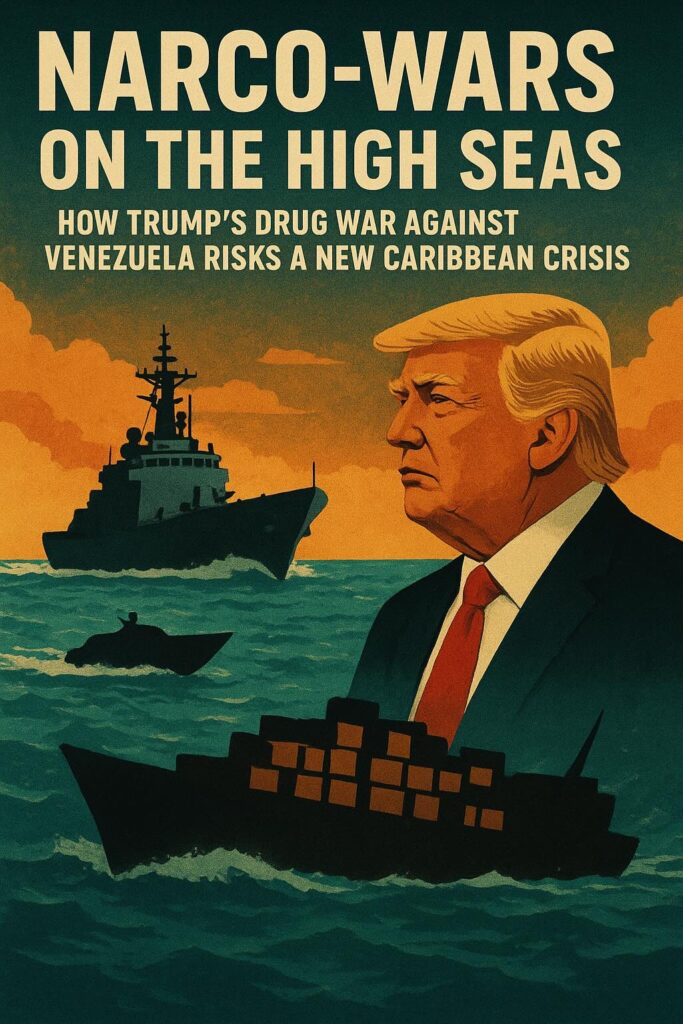
Over the past month, U.S. forces under President Donald Trump have launched two deadly strikes on boats allegedly carrying narcotics from Venezuela, killing more than a dozen people and igniting global controversy.
Trump calls it a “war on narco-terrorism.” Caracas calls it an act of aggression.
And caught in between are questions of law, legitimacy, and power — over who controls the sea lanes, and who controls the narrative.
The Strikes: Two Boats, Two Explosions, and a New Doctrine
The first incident occurred in early September 2025. A U.S. drone strike destroyed a speedboat off the Venezuelan coast, killing 11 people. Washington claimed the vessel was part of the Tren de Aragua network — a powerful Venezuelan criminal syndicate accused of trafficking cocaine and fentanyl into the United States.
A second strike came days later, this time on another small craft in the Caribbean. Three people died.
Both vessels, according to the Pentagon, were “linked to narco-terrorist networks operating under Nicolás Maduro’s protection.”
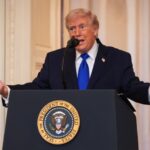
Trump, speaking at a rally in Florida, defended the operations, saying:
“We took out boats that were bringing poison to America. We will stop the Venezuelan drug traffickers before they reach our shores.”
The U.S. Navy’s expanded presence in the Caribbean — including destroyers, drones, and surveillance aircraft — marks the most assertive maritime campaign in the region since the 1980s.
The Drug Angle: The ‘Cartel of the Suns’ and Tren de Aragua
At the heart of Washington’s justification lies the claim that Venezuela’s government itself is entangled in narcotics smuggling.
The U.S. Department of Justice has long accused senior Venezuelan officials — including President Maduro — of running a network known as the “Cartel of the Suns”, allegedly responsible for moving hundreds of tonnes of cocaine annually through state-controlled ports and airbases.
In 2020, the U.S. government placed a $15 million bounty on Venezuelan President Maduro, later raised to $50 million, on charges of “narco-terrorism.”
The recent focus, however, has shifted to Tren de Aragua (TDA), Venezuela’s largest transnational gang.
Once a prison-based group, TDA has evolved into a powerful regional criminal organisation active in Colombia, Peru, Chile, and even parts of the U.S. southern border.
The U.S. State Department formally designated TDA as a Foreign Terrorist Organization in August 2025, claiming it “operates under the protection of Nicolás Maduro’s regime.”
For Trump, this designation provides the legal pretext for military action — extending counterterrorism powers to maritime drug operations.
Maduro’s Response: Sovereignty Under Attack
Venezuela’s government has condemned the strikes as “acts of war.”
In a televised address, Maduro declared:
“Trump’s aggression violates international law and Venezuela’s sovereignty. They attack fishermen and call them terrorists.”
Caracas summoned the U.S. chargé d’affaires and deployed naval patrols and drones near its coastline, warning of “defensive retaliation.”
State-run media in Venezuela framed the strikes as proof of Washington’s imperial ambitions, arguing that the “narco-terrorism” label is a cover for regime-change objectives.
Russia and China quickly echoed those claims. Moscow accused the U.S. of “weaponising counter-narcotics for geopolitical dominance,” while Beijing urged “restraint and respect for sovereignty.”
Inside the U.S. Strategy: Drugs, Politics, and Power
Behind the tough rhetoric lies a blend of domestic politics and strategic manoeuvring.
Facing criticism over rising drug deaths in the U.S., Trump has sought to demonstrate decisive action on fentanyl and cocaine trafficking.
By linking Venezuelan smuggling routes to national security threats, the administration reframes a criminal issue as a terrorism problem, granting broader legal latitude for military strikes.
Washington argues that the operations are lawful because they occur in international waters and target “non-state terrorist actors.”
Legal experts, however, are divided. Many warn that drug trafficking does not qualify as an armed attack under international law, and that such strikes risk setting a dangerous precedent.
The Legal Grey Zone
Critics say the U.S. is stretching the concept of self-defence to justify military force. While counter-narcotics patrols have existed for decades, direct lethal strikes against alleged smugglers are rare and controversial.
Human rights groups have demanded transparency, asking:
- Were these vessels armed?
- Was there proof they were carrying drugs?
- Were civilians aboard?
So far, no physical evidence of seized narcotics has been released publicly.
International maritime law experts note that without proof of imminent threat, the strikes may breach conventions on use of force and navigation rights.
Geopolitical Consequences: The Caribbean Tense Again
The escalation has reawakened Cold War-style anxieties in the Caribbean.
Venezuela is not just a narcotics route — it’s a strategic bridgehead for Russia, Iran, and China.
U.S. officials fear that Maduro could invite Russian naval deployments or Iranian drones to deter future strikes.
Already, Moscow’s Defence Ministry has hinted at “joint patrol exercises” in response to “American provocation.”
Regional governments are alarmed. Colombia, Guyana, and Brazil have all expressed concern that the U.S.–Venezuela confrontation could spill into neighbouring waters, disrupting trade and security.
The Trump–Maduro–Machado Triangle
The timing of these strikes also intersects awkwardly with the Nobel Peace Prize awarded to María Corina Machado, Venezuela’s opposition leader.
While Trump publicly praised Machado and later said she “dedicated her Nobel to me,” the naval escalation risks overshadowing her peaceful message and giving Maduro new ammunition to claim the opposition is aligned with U.S. military aggression.
Diplomats warn that every missile fired in the Caribbean risks undermining Washington’s moral case for democracy in Venezuela.
What’s at Stake
For Trump, the strikes signal resolve: a demonstration that U.S. sovereignty extends to maritime enforcement and that no regime can “shield traffickers behind borders.”
For Maduro, they are a gift — an excuse to rally nationalist sentiment and brand the opposition as agents of foreign aggression.
And for the region, they raise the haunting prospect that a drug war could morph into a geopolitical confrontation — one where human rights, maritime law, and diplomacy sink beneath the waves.
Conclusion: From Cocaine Routes to Conflict Routes
The Trump–Venezuela drug conflict is about far more than narcotics. It’s about narrative dominance, geopolitical leverage, and who writes the rules of force in the post–Cold War Americas.
In this new “narco-war,” the line between counter-crime and counter-regime has blurred. Whether Trump’s strikes deter traffickers or deepen instability remains uncertain — but one thing is clear: the Caribbean has once again become a theatre of power politics disguised as a war on drugs.