The MCC Compact Between the United States and Nepal: A $500 Million Partnership Revived in 2025
A Transformative Investment in Nepal’s Infrastructure
The MCC Compact Nepal 2025 represents a landmark $500 million (about NPR 6,500 crores) grant agreement signed originally in 2017, aiming to reduce poverty by boosting economic growth through vital infrastructure development. This compact focuses on strengthening Nepal’s electricity infrastructure and road transportation networks, critical components for sustainable economic progress and regional connectivity.
Nepal has also pledged NPR 2,561 crores (about $197 million) as counterpart funding, underscoring a shared commitment to fostering economic growth, with a strong emphasis on local ownership and governance.
Two main projects framed under the compact are:
A ~318 km high-voltage electricity transmission line with accompanying substations designed to enhance power supply and enable cross-border power trade with India.
Upgrading and maintaining approximately 300 km of the East-West Highway to improve transportation efficiency, bolster commerce, and expand market access for communities across Nepal.
Political Challenges, Suspension, and Controversy
Despite being signed in 2017, the MCC Compact Nepal faced substantial political hurdles before Nepal’s parliament ratified it on 27 February 2022. The agreement officially came into force on 30 August 2023 — six years after the initial signing.
The protracted delay came from widespread debate surrounding concerns over Nepal’s sovereignty, transparency, land ownership clauses, and dispute resolution mechanisms. These issues triggered significant political opposition and public protests. Furthermore, geopolitical competition between the United States and China in the South Asian region intensified the complexities around the compact.
The turning point occurred when Nepal’s parliament appended an interpretative declaration that reinforced Nepal’s sovereignty, satisfying legislative concerns and allowing ratification to proceed.
The Temporary Freeze and Resumption of MCC Projects
In early 2025, the MCC Compact Nepal experienced further uncertainty when then U.S. President Donald Trump criticised the agreement, citing corruption risks and alleged misuse of funds in Nepal’s governance structures. His statements fueled domestic scepticism and revived political opposition within Nepal, stalling project implementation.
On 20 January 2025, President Trump issued an executive order imposing a 90-day freeze on foreign development assistance, which included funds earmarked for the MCC Nepal Compact. This pause created uncertainty about the future of the program and halted disbursements.
However, in late July 2025, after a comprehensive foreign assistance review, the U.S. government decided to resume funding for the MCC Nepal Compact. The U.S. Embassy in Kathmandu confirmed ongoing support for both major infrastructure projects—the electricity transmission line and the East-West Highway upgrading.
Meanwhile, the Millennium Challenge Account-Nepal (MCA-Nepal) has signed contracts covering two transmission line segments: Ratmate to New Damauli and New Damauli to New Butwal. Since entering into force on 30 August 2023, the compact’s five-year implementation window is planned to continue through August 2028.
Recent Diplomatic Developments and Reinforced U.S.–Nepal Cooperation
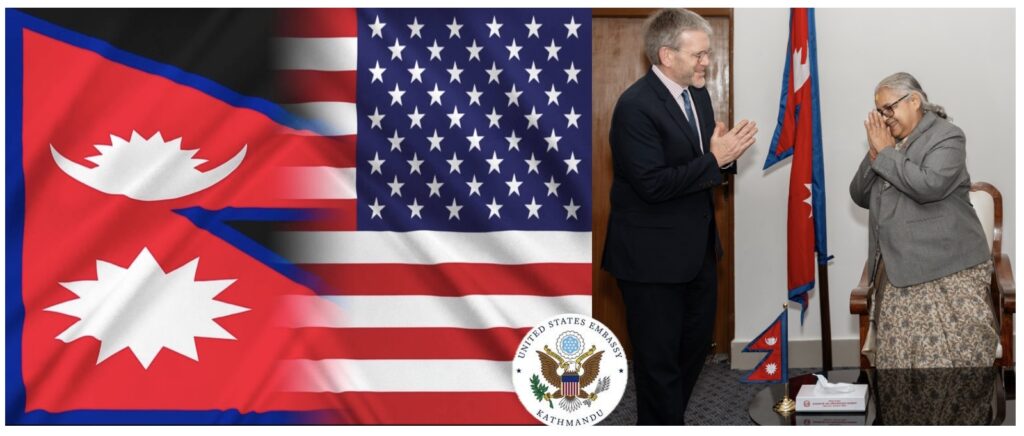
On 18 September 2025, Ambassador Dean Thompson met with Nepal’s Interim Prime Minister Rt. Hon. Sushila Karki to discuss the ongoing partnership and development priorities, highlighting the continued strong ties between the two nations.
Ambassador Thompson offered condolences for the lives lost in Nepal’s recent protests and reaffirmed the United States’ support for Nepal’s peaceful and democratic path forward. Recognizing over 78 years of U.S.–Nepal partnership, the discussion focused on priorities such as furthering trade, accelerating economic growth, strengthening disaster preparedness, and advancing the MCC Compact’s commitment as Nepal’s most transformative infrastructure partnership. This engagement underscores their shared goal of leading to a safer, stronger, and more prosperous United States and Nepal.
Why the MCC Compact Remains Essential for Nepal
The MCC Compact Nepal stands as a significant catalyst for Nepal’s sustainable development and economic growth. The compact’s critical contributions include:
Modernising electricity infrastructure to reduce chronic power shortages, stabilise the national grid, and enable cross-border electricity trade with India, potentially opening new revenue channels.
Enhancing the East-West Highway infrastructure, one of Nepal’s main transport corridors, to reduce travel time, cut transportation costs, and strengthen inter-regional trade and market connectivity.
Directly supporting poverty alleviation by driving job creation, attracting private investments, and improving public service delivery across Nepal.
Beyond infrastructure, this partnership serves as a symbol of bilateral cooperation amid a complex geopolitical environment, reinforcing strong ties between Nepal and the United States.
Conclusion
Following years of political delays, controversies, and a temporary freeze, the MCC Compact between the United States and Nepal is fully operational again in 2025. With robust support from U.S. presidential authorities and Nepalese parliamentarians, the partnership is moving forward with $500 million (NPR 6,500 crores) in funding alongside Nepal’s counterpart investment.
This collaboration promises to transform Nepal’s infrastructure landscape, stimulate sustainable economic growth, and strengthen diplomatic relations between Nepal and the United States for years to come.