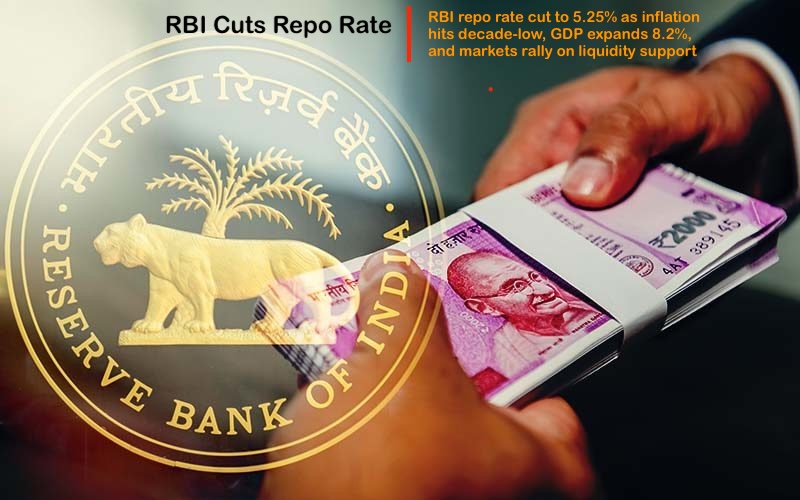
RBI Cuts Repo Rate to 5.25% as “Goldilocks” Economy Emerges
RBI Repo Rate Cut: The Reserve Bank of India’s Monetary Policy Committee (MPC) unanimously reduced the repo rate by 25 basis points to 5.25% on 5 December 2025. This marks the fourth rate cut of the calendar year, taking the cumulative easing to 125 basis points since February. Governor Sanjay Malhotra described the Indian economy as being in a “rare goldilocks phase”, supported by the combination of exceptionally low inflation and strong GDP growth, despite pockets of global uncertainty.
Retail inflation fell sharply below the RBI’s lower tolerance band of 2% for the second consecutive month, touching 0.25% in October, the lowest level since 2012. At the same time, the economy expanded at 8.2% in the second quarter, powered by robust investment activity and resilient consumption. The MPC retained a neutral stance, emphasising balanced risks amid a weakening rupee near ₹90 per dollar and global trade pressures linked to potential new US tariff policies.
Economic Backdrop Supporting the RBI Repo Rate Cut
Disinflation Opens Space for Policy Easing
Retail inflation has remained below the 4% target (±2%) for two months, driven by broad-based disinflation across food, fuel, and core categories. Soft commodity prices, improved supply chains, and mild demand-side pressures have collectively anchored price stability. Consequently, the RBI lowered its FY26 inflation forecast to 2%, down from 2.6%.
This aggressive downward revision signals the central bank’s confidence that price stability will persist despite temporary currency volatility or global fuel price swings. The structural moderation in inflation created ample room to lower the repo rate to support domestic demand without threatening macroeconomic stability.
Upgraded Growth Prospects for FY26
India’s growth outlook appears stronger than earlier projected. The RBI is expected to revise its FY26 GDP estimate to around 7%, higher than the previous 6.8% projection. This recovery is propelled by:
Ongoing fiscal consolidation allowing more predictable policy.
Continued public investment in infrastructure.
Reforms supporting productivity and business confidence.
Steady services sector expansion, including IT, logistics, and financial services.
Despite temporary headwinds from the rupee’s depreciation and global trade tensions, the central bank believes the economy retains adequate buffers. The rate cut aims to sustain momentum by lowering borrowing costs for households and firms.
Market Reactions to the RBI Repo Rate Cut
Financial markets responded positively to the announcement. Rate-sensitive sectors such as banking, NBFCs, automobile manufacturers, and real estate companies rallied by up to 2% in early trade. Investors welcomed the MPC’s emphasis on supporting growth while preserving monetary stability.
Bond markets also reacted with optimism. Yields edged lower and analysts now expect the benchmark 10-year bond yield to test:
6.40% if subsequent policy meetings show continued accommodation.
6.60% if the RBI maintains a tighter-neutral stance in upcoming quarters.
To bolster liquidity and ensure orderly financial conditions, the RBI unveiled a series of supportive measures:
₹1 trillion in Open Market Operation (OMO) purchases to infuse liquidity.
A $5 billion forex swap facility aimed at smoothing currency volatility and providing dollar liquidity to the banking system.
These actions underscore the central bank’s commitment to preventing undue tightening in money markets as the repo rate undergoes recalibration.
How the RBI Repo Rate Cut Impacts Loans and Borrowers
Cheaper Loans and Lower EMIs
The immediate impact of the repo rate cut will be seen in reduced lending rates across banks. Most retail and corporate loans in India are now linked to the External Benchmark Lending Rate (EBLR), which tracks the repo rate. As a result, borrowers will benefit through:
Lower EMIs on floating-rate home loans, auto loans, and personal loans.
Reduced cost of working capital for businesses.
Improved affordability for first-time homebuyers, especially in urban markets.
The pass-through of repo rate changes is expected to be swift, given the current competitive environment in retail lending.
Reduced Tax Deductions on Housing Loans
A notable side effect of lower interest rates is the potential reduction in tax deductions available under:
Section 24(b): Interest paid on home loans.
Section 80C: Certain repayment components.
As interest outgo reduces, homeowners may claim smaller deductions. However, the overall affordability benefits outweigh this drawback for most buyers.
Boost to Consumption and Investment
Lower borrowing costs stimulate economic activity by:
Encouraging household spending on consumer durables and vehicles.
Supporting corporate capital expenditure, especially in manufacturing.
Improving MSME credit flows, which amplify job creation and local demand.
The RBI repo rate cut therefore strengthens both short-term demand and medium-term growth engines.
Future Outlook for Monetary Policy and the Indian Economy
More Cuts Possible, but Data Will Guide Decisions
Although the MPC delivered four cuts this year, it paused in August and October, signalling caution due to strong growth indicators. With inflation now deeply subdued, the central bank has hinted that more easing is possible if disinflation continues into early 2026.
However, the path ahead will be shaped by:
Rupee stability, especially if global risks intensify.
Potential new US tariff policies, which could disrupt export markets.
Global growth concerns that may affect commodity prices and trade flows.
Domestic fiscal conditions leading into the Union Budget.
Economists broadly expect the repo rate to remain steady through most of 2026, unless inflation undershoots further or external conditions deteriorate.
Advice for Borrowers Following the Rate Cut
Borrowers should review their loan agreements, especially repo-linked ones, to ensure immediate EMI adjustments. Fixed-rate borrowers may consider switching if market rates continue to trend downward. Corporates may reassess debt strategies to take advantage of lower financing costs.
The RBI’s latest action reinforces its commitment to stable, growth-oriented monetary policy during a period of rare macroeconomic balance.