Libya GNU Plane Crash: Tragedy or Targeted Strike?
The Libya GNU plane crash on December 23, 2025, that killed Lt. Gen. Mohammed Ali Ahmed al-Haddad, Chief of Staff of Libya’s UN-recognised Government of National Unity (GNU), has become more than a tragic aviation incident. It has emerged as a geopolitical event layered with suspicion, regional rivalry, and proxy-war calculations. The crash occurred only hours after al-Haddad concluded sensitive defence discussions in Ankara, immediately elevating the incident from an accident to a strategic question mark.
In a country where power has remained decentralised, militarised, and externally manipulated since 2011, even routine tragedies acquire political meaning. The Libya GNU plane crash therefore cannot be examined in isolation from Libya’s internal fragmentation or the wider geopolitical contest playing out across the Eastern Mediterranean and North Africa.
The Incident: What Is Known and What Remains Contested
The Dassault Falcon 50 business jet carrying al-Haddad and four senior GNU military officers departed Ankara’s Esenboğa Airport en route to Tripoli. Approximately forty-two minutes after take-off, the aircraft disappeared from radar. Wreckage was later located near Kahramankazan, northwest of Ankara. All five occupants were confirmed dead.
Libyan Prime Minister Abdul Hamid Dbeibah publicly announced the deaths within hours. Turkish authorities immediately launched an investigation in coordination with Libyan officials. The aircraft’s black box was recovered, and preliminary assessments pointed to an electrical or technical malfunction.
As of now, investigators have found no evidence of sabotage, missile impact, or external interference. Turkish officials have been explicit on this point. However, the Libya GNU plane crash occurred in a context where timing itself becomes evidence in the court of public opinion.
The flight followed high-level meetings between al-Haddad and senior Turkish defence officials. These discussions reportedly focused on deepening military cooperation, training programmes, equipment support, and security coordination. Turkey’s role as the GNU’s principal military patron makes this timing impossible to ignore.
Libya’s Fragmented Military Landscape Since 2011
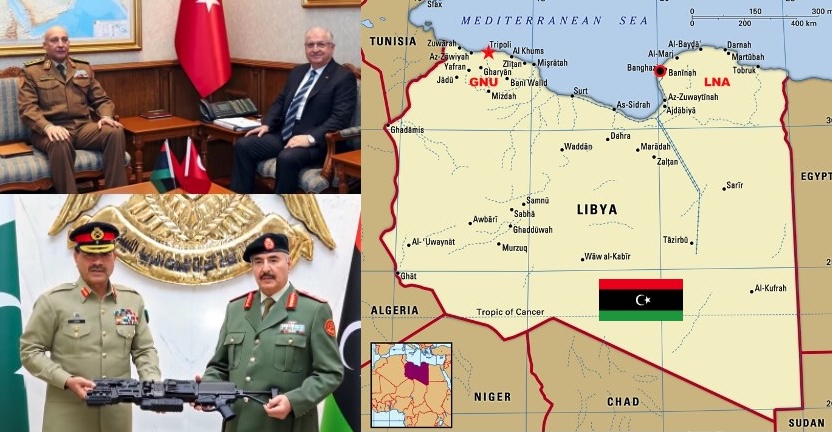
Libya has lacked a unified national army since the collapse of Muammar Gaddafi’s regime. The post-2011 order produced rival governments, competing militias, and fragmented command structures. The GNU, headquartered in Tripoli, enjoys UN recognition but governs through negotiated arrangements with armed groups rather than through a consolidated force.
In eastern and southern Libya, the Libyan National Army (LNA) under Field Marshal Khalifa Haftar functions as a parallel military authority. The LNA controls most oil-producing regions and operates independently of Tripoli. Its political legitimacy derives from the Tobruk-based House of Representatives rather than international recognition.
This dual power structure has endured despite repeated UN-brokered talks. Each faction relies on foreign sponsors, creating a proxy environment where internal reconciliation is perpetually subordinated to external interests.
The UN-recognised Government of National Unity (GNU) is primarily supported by Turkey, with diplomatic backing from the United Nations, the European Union, and the United States. By contrast, the Libyan National Army (LNA) under Khalifa Haftar has received military and financial support from Egypt and the UAE, alongside Russian assistance through Wagner-linked elements, entrenching Libya’s proxy-driven divide.
Mohammed al-Haddad’s Strategic Importance to the GNU
Lt. Gen. Mohammed al-Haddad was not a symbolic figure. He served as one of the GNU’s principal military coordinators and was central to efforts aimed at standardising command structures across western Libya. He worked to integrate militia forces into a more coherent defence framework under civilian authority.
His role extended beyond battlefield coordination. Al-Haddad acted as a political-military interlocutor between Tripoli’s civilian leadership, militia commanders, and foreign partners, particularly Turkey. His death therefore represents both an operational and diplomatic loss.
The Libya GNU plane crash creates a leadership vacuum that could slow or reverse fragile integration efforts. In Libya’s environment, such gaps are rarely temporary.
Turkey’s Strategic Stakes in Western Libya
Turkey’s involvement in Libya is neither episodic nor ideological. It is strategic, economic, and maritime. Since 2019, Ankara has invested heavily in sustaining the GNU against LNA advances, to the extent of courting serious intra-NATO friction. In June 2020, Turkish warships escorting a Libya-bound vessel reportedly locked fire-control radar onto a French frigate enforcing the UN arms embargo under a NATO mission, a move France described as hostile and unprecedented between allies. The fallout saw Paris withdraw from the operation, exposing how Turkey’s Libya strategy has at times overridden alliance protocol. Also, Turkish drones, military advisers, and training programmes proved decisive in halting Haftar’s push towards Tripoli.
In parallel, Turkey signed a maritime boundary agreement with the GNU that reshaped Eastern Mediterranean energy claims. That agreement challenged the ambitions of Greece, Cyprus, Israel, France, and Egypt. For Ankara, Libya is not peripheral; it is central to its Mediterranean doctrine.
Any destabilisation of the GNU weakens Turkey’s leverage. The Libya GNU plane crash therefore triggered immediate concern in Ankara, even as officials emphasised technical explanations.
Haftar’s LNA and the Pakistan Arms Deal
Just days before the crash, the LNA concluded a reported $4–4.6 billion arms deal with Pakistan. The agreement includes JF-17 fighter jets, Super Mushshak trainers, and related systems. It represents the largest defence export in Pakistan’s history.
The deal openly violates the UN arms embargo on Libya, first imposed in 2011 and most recently renewed in November 2025. However, enforcement of the embargo has long been symbolic. Turkey, the UAE, Russia, and Egypt have all armed their preferred factions with little consequence.
The timing of the Pakistan–LNA deal has intensified scrutiny. While no evidence links the deal to the Libya GNU plane crash, its strategic impact is undeniable. Enhanced LNA air capability alters the military balance and complicates any future unification process.
The UN Arms Embargo: Law Without Enforcement
The Libya arms embargo has become a case study in selective international law. It exists formally but fails operationally. Monitoring mechanisms remain weak, and enforcement collapses when permanent members of the Security Council have competing interests.
Pakistan’s deal highlights this erosion. The muted international response underscores how Libya has become an accepted zone of exception, where geopolitical utility overrides multilateral restraint.
This context matters because it frames how events like the Libya GNU plane crash are interpreted. When rules are routinely broken, suspicion becomes rational rather than conspiratorial.
The United States and Strategic Ambivalence
The United States officially supports the GNU and UN-led reconciliation efforts. Simultaneously, it maintains pragmatic engagement with Haftar’s LNA, particularly on counterterrorism and oil security. This dual-track approach reflects Washington’s desire to limit Russian influence without committing to deep involvement.
Critics argue that this ambiguity entrenches Libya’s division. Supporters contend that abandoning Haftar entirely would risk destabilising oil production and expanding Moscow’s footprint.
The Libya GNU plane crash complicates this calculus. Leadership instability in Tripoli weakens the very partner Washington claims to support.
Russia, Wagner, and the Eastern Mediterranean
Russia views Libya as a gateway to Africa and the Mediterranean. Wagner-linked forces have supported the LNA for years, securing strategic airbases and logistical corridors. Weakening the GNU aligns with Moscow’s interest in constraining Turkish influence and expanding leverage south of Europe.
Although there is no evidence linking Russia to the crash, any setback for the GNU indirectly benefits Moscow. This reality fuels speculation, even in the absence of proof.
Pakistan’s Role: Economics, Strategy, and Speculation
Pakistan’s involvement has attracted disproportionate attention online. The arms deal coincided with visits by senior Pakistani military officials to Benghazi. Social media narratives have attempted to link Pakistan’s intelligence services to the Libya GNU plane crash.
These claims lack evidence and often reflect India–Pakistan rivalries rather than Libyan realities. However, Pakistan’s decision to arm the LNA places it squarely within Libya’s proxy ecosystem. Economic necessity, defence exports, and alignment with UAE-backed positions appear to have driven the decision.
Perception matters. In Tripoli, the deal will not go unnoticed.
Turkey–Pakistan Relations Under Strain?
Turkey and Pakistan share longstanding defence and diplomatic ties. These include joint military projects, political support on sensitive issues, and deep people-to-people links. However, Pakistan’s alignment with Haftar’s LNA indirectly undermines Turkey’s Libyan strategy.
While there is no rupture, the Libya GNU plane crash has intensified scrutiny of overlapping interests. Any confirmed hostile action would fundamentally alter bilateral relations, though such a scenario remains hypothetical.
Speculation, Social Media, and Strategic Anxiety
The explosion of conspiracy theories following the crash reflects Libya’s prolonged exposure to external manipulation. In an environment where assassinations, coups, and proxy operations are normalised, disbelief in accidents becomes almost automatic.
However, extraordinary claims require evidence. At present, none exists.
The danger lies not in speculation itself but in its political exploitation. Narratives can harden positions and justify escalation even when facts do not support them.
Why the Libya GNU Plane Crash Matters Beyond Libya
Libya’s stability affects energy markets, migration flows, Mediterranean security, and African geopolitics. Leadership disruptions in Tripoli reverberate far beyond Libyan borders.
The death of Mohammed al-Haddad removes a key stabilising figure at a delicate moment. Even if the crash was accidental, its consequences are strategic.
Where the Evidence Currently Points
Based on available information, the Libya GNU plane crash appears to be a tragic accident. Investigations have found no credible signs of sabotage. Claims to the contrary remain speculative and politically motivated.
Yet Libya’s reality ensures that even accidents reshape power equations. In a proxy battlefield, perception often becomes policy.
The true risk now lies in how actors respond, not in how the aircraft fell from the sky.