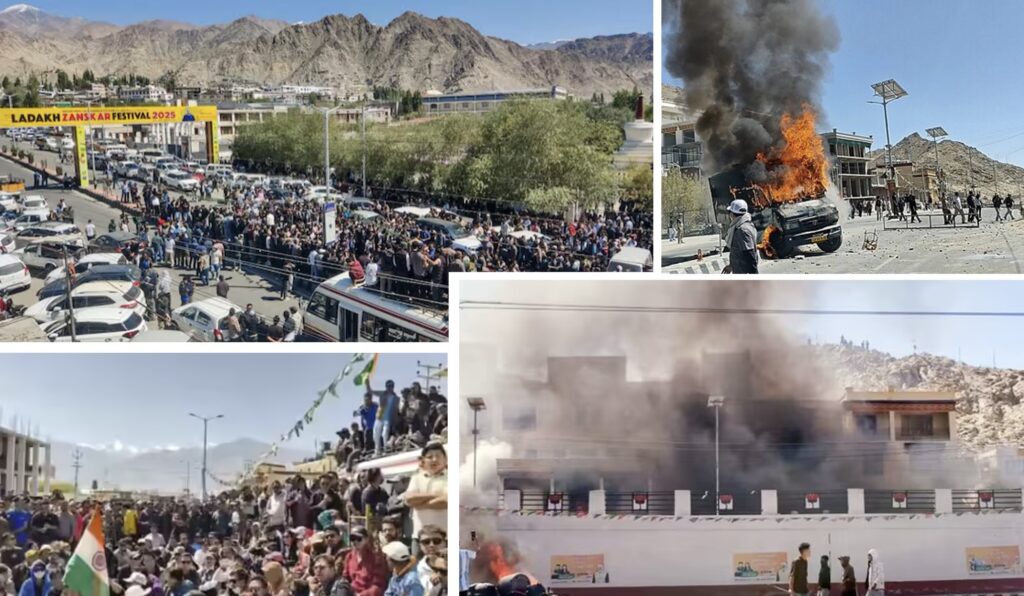
Ladakh Sixth Schedule Protests Turn Violent: Gen-Z Movement Lead Four Dead, 70 Injured
The Ladakh Sixth Schedule protests demanding statehood and tribal autonomy escalated into violence in Leh, resulting in four deaths and over 70 injuries. The demonstrations, led largely by traditional youths (so-called Gen Z), also saw the BJP office and a police vehicle torched, marking one of the most intense episodes in Ladakh’s recent political unrest.
What Sparked the Protests?
The protests centre on the demand to include Ladakh under the Sixth Schedule of the Indian Constitution. This constitutional provision safeguards the tribal population, which makes up 97% of Ladakh, by granting them legislative and executive autonomy. Since Ladakh became a Union Territory in 2019, local groups have campaigned for this and full statehood.
The agitation gained momentum following the hunger strike started on September 10, 2025, by the youth wing of the Leh Apex Body (LAB). The situation took a violent turn after two elderly hunger strikers, aged 72 and 62, were hospitalised on September 23. This event triggered a widespread shutdown and restless demonstrations.
The Gen Z Movement: The New Face of Protest
It is widely reported that this wave of protests marked significant involvement from Generation Z, representing people born roughly between the mid-1990s and early 2010s. This generation, digitally connected and socially conscious yet facing acute challenges like unemployment and political disenfranchisement, has become the vanguard of the unrest. However, the involvement of, and instigation by, other groups cannot be ruled out.
It is to be noted that the climate activist Sonam Wangchuk, who led the hunger strike, expressed deep remorse over the violence and called it a “Gen Z revolution.” He noted that this cohort had been relatively absent from earlier movements but came out in thousands to demand urgent action. Wangchuk emphasised the frustration felt by this generation as peaceful protests and political appeals over the last five years had not yielded any results.
“A large number of Gen Z youth, numbering between 2,000 to 5,000, participated after the hospitalisation of two elderly hunger strikers. This was a spontaneous outpouring of pent-up frustration,” said Wangchuk.
This generational shift helps explain why the movement rapidly escalated from prayers and speeches to large-scale rallies that later turned violent. The young protesters ignited fires, damaged BJP offices and police vehicles, expressing profound impatience with delayed government response, with the next official talks scheduled for October 6, 2025.
Political and Security Responses
Security forces responded with baton charges and tear gas. Authorities imposed prohibitory orders banning assemblies of more than five people to restore order. The BJP has accused opposition parties of inciting the violence, but Wangchuk denied political orchestration, stating the unrest was driven by genuine youth frustration.
Demands and Demography
The protests revolve around four core demands:
Full statehood for Ladakh
Inclusion under the Sixth Schedule for tribal autonomy
Job reservations for local youth
Separate public service commission and two parliamentary seats
With 97% of Ladakh’s population belonging to tribal groups, the demand for Sixth Schedule inclusion reflects broader aspirations to safeguard cultural heritage, control over resources, and economic benefits.
Conclusion
The Ladakh Sixth Schedule protests, led by a digitally empowered and socially aware Gen Z generation, underscore the urgency for constitutional recognition and political solutions. Though deeply committed to peaceful activism, their growing frustration risks further escalation if government dialogues and reforms do not accelerate.
Sonam Wangchuk’s plea for peaceful protest highlights the critical need to balance passionate youth engagement with responsible democratic processes in one of India’s most sensitive and strategic regions.