Japan Election 2026 Results: Takaichi’s LDP Secures Record Supermajority
The Japan Election 2026 results have confirmed one of the most decisive political mandates in the country’s postwar history. Voting for the House of Representatives concluded on Sunday, February 8, 2026, following a snap dissolution of parliament. Early projections released by NHK and reported by international media, including CNBC, indicated a major victory for the ruling Liberal Democratic Party. By February 9, official counts validated those projections, delivering Prime Minister Sanae Takaichi a historic landslide.
The outcome has reshaped Japan’s political landscape. It has strengthened executive authority, marginalised the opposition, and provided the ruling party with unprecedented legislative freedom. Moreover, it has reinforced voter confidence in policy continuity at a time of economic uncertainty and regional geopolitical tension.
Japan Election 2026 Results Confirm LDP Dominance
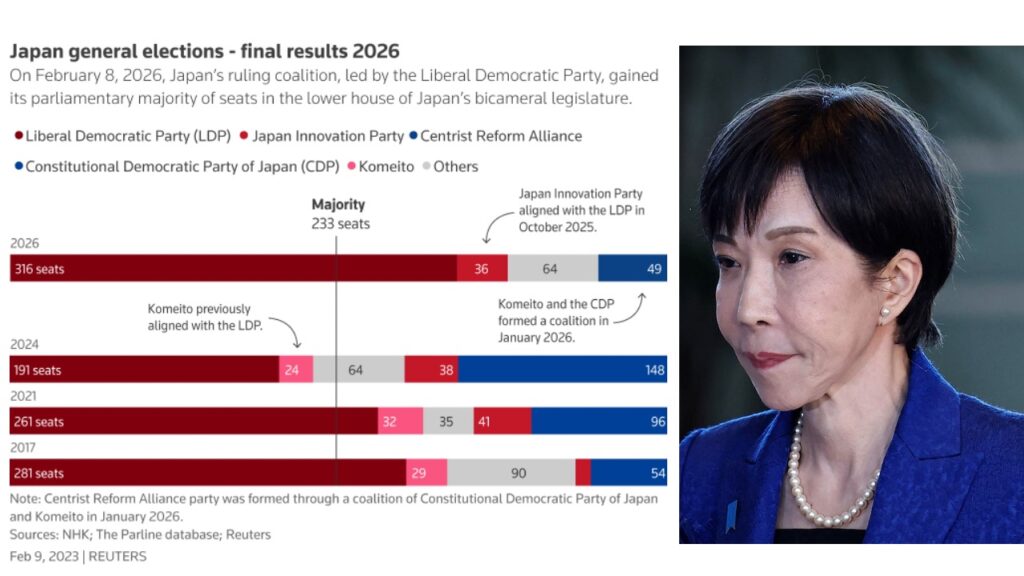
The final Japan Election 2026 results show that the Liberal Democratic Party secured approximately 316 seats in the 465-member House of Representatives. This figure exceeds the two-thirds threshold required for a supermajority. As a result, the LDP can now pass key legislation independently, without relying on coalition partners.
The Japan Innovation Party, which supported the government during the campaign, won around 36 seats. Together, the ruling bloc controls nearly 352 seats. This provides it with the power to override the upper house when necessary and to advance major institutional reforms.
In contrast, the main opposition alliance, formed around centrist and reformist parties, suffered a severe collapse. Its representation fell to roughly 49 to 64 seats, marking one of the weakest performances by opposition forces in decades. This imbalance reflects both voter endorsement of the ruling party and the fragmentation within rival groups.
Background to the Snap Election Under Sanae Takaichi
Prime Minister Sanae Takaichi dissolved the lower house on January 23, 2026, only months after assuming office in October 2025. She became Japan’s first female prime minister following the resignation of her predecessor amid political challenges. Her decision to call an early election was strategic. It aimed to convert personal popularity into institutional strength.
The campaign period was unusually short. However, it remained within legal limits. Takaichi presented the election as a direct referendum on her leadership and policy agenda. She emphasised economic recovery, fiscal stimulus, national security, and a firm approach to regional threats.
Pre-election surveys conducted by Nikkei and Asahi suggested rising public confidence in her leadership. These trends were later reflected in the final vote.
Economic and Geopolitical Factors Shaping Voter Behaviour
Economic concerns played a central role in shaping the Japan Election 2026 results. Persistent inflation, a weakened yen, and declining real wages had placed pressure on household incomes. Nevertheless, voters appeared persuaded by Takaichi’s commitment to proactive fiscal management and targeted relief measures.
Market reactions following the election were strongly positive. Japanese equities reached record highs, reflecting investor confidence in political stability and policy continuity. Financial institutions welcomed the prospect of sustained stimulus and regulatory clarity.
Geopolitically, tensions with China and regional security uncertainties also influenced voting behaviour. The government’s emphasis on defence preparedness and alliance management resonated with a public increasingly aware of strategic risks.
Opposition Collapse and Structural Weaknesses
The opposition’s poor performance was not merely the result of electoral momentum in favour of the LDP. It also reflected long-standing structural problems. Internal divisions, inconsistent messaging, and leadership instability weakened its credibility.
Although attempts were made to consolidate centrist and reformist forces, these efforts failed to generate public enthusiasm. Many voters perceived the opposition as reactive rather than visionary. As a result, it could not capitalise on earlier vulnerabilities within the ruling party.
This collapse has raised concerns about the long-term health of Japan’s democratic competition. A dominant ruling party, while efficient, risks reducing policy debate and accountability.
Legislative and Constitutional Implications of the Supermajority
With a two-thirds majority, the LDP now enjoys extraordinary legislative authority. It can pass budgets, economic reforms, and national security laws with minimal resistance. Furthermore, it can initiate constitutional amendments, subject to referendum approval.
This opens the possibility of revisiting Article 9 and other postwar constraints on military policy. While such reforms remain politically sensitive, the parliamentary arithmetic now favours serious debate.
In addition, the government can accelerate industrial policy, infrastructure investment, and technological initiatives. Programmes supporting national champions and strategic industries are expected to expand under the new mandate.
Japan Election 2026 Results and Policy Continuity
The landslide victory confirms strong public support for continuity rather than disruption. Voters have prioritised stability at a time of global uncertainty. This preference has translated into institutional reinforcement for the incumbent leadership.
Takaichi’s administration is now positioned to pursue long-term economic restructuring, social security reform, and digital transformation. Moreover, it can negotiate international agreements from a position of domestic strength.
Leadership Consolidation and Historical Significance
The Japan Election 2026 results represent a milestone in modern Japanese politics. No single party has achieved such dominance in recent decades. Takaichi’s leadership has combined ideological clarity with electoral pragmatism.
Her status as Japan’s first female prime minister further enhances the symbolic importance of the victory. It reflects gradual social change alongside political continuity.
Historically, comparable victories occurred only during periods of exceptional political alignment, such as in the mid-1980s. The current result surpasses even those benchmarks.
Future Challenges Despite Electoral Success
Despite the overwhelming mandate, significant challenges remain. Demographic decline, labour shortages, and rising social welfare costs continue to strain public finances. External risks, including regional instability and global economic volatility, remain unresolved.
Moreover, prolonged dominance carries the risk of complacency. Sustaining public trust will require transparency, policy effectiveness, and institutional reform.
The government must therefore balance confidence with restraint. The electorate has granted power, but it has also imposed responsibility.
A Defining Mandate for Japan’s Political Future
The Japan Election 2026 results have delivered Prime Minister Sanae Takaichi an unprecedented political mandate. The LDP’s supermajority reflects voter confidence in stability, leadership, and policy direction.
This victory is not merely electoral. It is structural. It reshapes legislative dynamics, strengthens executive authority, and influences Japan’s regional posture. Whether this power will translate into lasting reform depends on governance quality and responsiveness.
For now, Japan enters a new political phase defined by consolidation, continuity, and high expectations. How effectively this mandate is used will determine the country’s trajectory in the coming decade.