Israel Becomes the First Country to Recognise Somaliland
When Israeli Prime Minister Benjamin Netanyahu announced on December 26, 2025 that Israel had formally recognised Somaliland as an independent and sovereign state, the declaration sent shockwaves through diplomatic, security, and African policy circles. For a territory that has functioned as a de facto state for more than three decades yet remained invisible on the international map, Israel’s move marks a decisive break with long-standing global caution.
Israel recognises Somaliland not merely as a symbolic gesture, but as part of a strategic recalibration tied to Red Sea security, counter-terrorism, and shifting alliances in the Horn of Africa. The announcement, framed by Netanyahu as being “in the spirit of the Abraham Accords,” immediately raised a deeper question: why has a peaceful, functioning polity remained unrecognised for so long—and why is that changing now?
Somaliland’s Forgotten Sovereignty
Somaliland declared independence in 1991 after the collapse of Somalia’s central government, but its claim to statehood predates that moment by decades. Formerly known as British Somaliland, the territory gained independence on June 26, 1960 and existed briefly as a recognised sovereign state. More than thirty countries, including the United Kingdom and the United States, acknowledged its independence during those five days.
Driven by pan-Somali nationalist idealism, Somaliland voluntarily united with Italian Somaliland on July 1, 1960 to form the Somali Republic. The union, however, was rushed and deeply flawed. No binding legal instrument was ratified by popular referendum, and political power soon concentrated in Mogadishu. Northern Somalilanders found themselves economically marginalised and politically sidelined.
This imbalance intensified under the authoritarian rule of Siad Barre. During the late 1980s, the regime launched a brutal counter-insurgency campaign against the Isaaq clan in Somaliland. Cities such as Hargeisa were systematically bombed, tens of thousands of civilians were killed, and mass graves still scar the landscape. The episode, now widely described by scholars as the Isaaq genocide, remains largely unacknowledged internationally.
When Barre’s regime collapsed in 1991 and Somalia descended into chaos, Somaliland chose a different path. It reasserted independence within its original 1960 borders and embarked on a slow, internally driven process of reconciliation, constitutionalism, and state-building.
A State That Exists Without Recognition
Despite lacking international recognition, Somaliland has functioned as a state in every meaningful sense. It maintains a defined territory, permanent population, elected government, independent currency, armed forces, police, and border controls. Democratic elections have been held regularly, with biometric voter registration and peaceful transfers of power—a rarity in the region.
For more than three decades, Somaliland has remained largely peaceful in a neighbourhood synonymous with civil war, piracy, and extremism. While southern Somalia has relied heavily on international peacekeepers, Somaliland has secured itself through local institutions and clan-based reconciliation rather than foreign intervention.
Yet the world has largely looked away. Somaliland’s genocide remains unrecognised. Its sovereignty remains denied. Its people, despite meeting every conventional criterion of statehood, remain trapped in diplomatic limbo.
Why Israel’s Recognition Changes Everything
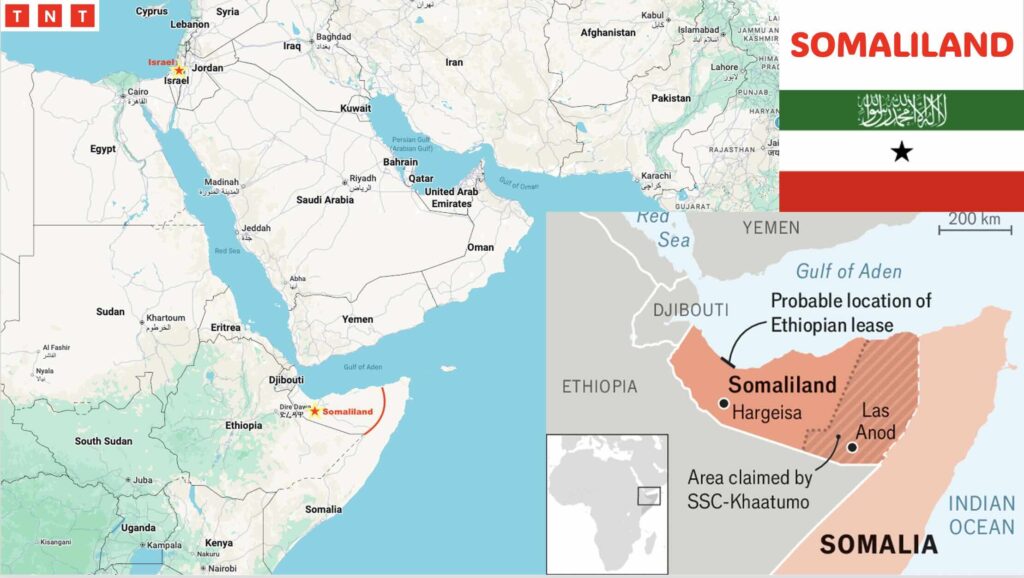
Israel recognises Somaliland at a moment when geography has reasserted itself as destiny. Somaliland’s coastline sits along the Gulf of Aden, adjacent to the Bab el-Mandeb Strait—one of the world’s most critical maritime chokepoints linking the Red Sea to the Indian Ocean. With Iran-backed Houthi forces in Yemen threatening commercial and Israeli shipping, the strategic value of the Horn of Africa has risen sharply.
Reports indicate that Israel’s recognition may be accompanied by expanded intelligence, security, or logistical cooperation with Somaliland. While neither side has confirmed military basing arrangements, the logic is clear. Somaliland offers proximity without instability, access without Islamist entanglements, and cooperation without ideological friction.
For Somaliland, Israel’s move offers something even more valuable than security: legitimacy. Recognition by a technologically advanced state with strong Western ties breaks a diplomatic taboo that has held for 34 years.
Quiet Partners Before Public Recognition
Israel is not the first external actor to treat Somaliland as strategically relevant. The United Arab Emirates invested heavily in the port of Berbera through DP World, transforming it into a modern logistics hub. A UAE-backed corridor now links Berbera to Ethiopia, a landlocked nation of over 120 million people seeking alternatives to Djibouti.
Taiwan took an even bolder step in 2020 by establishing mutual representative offices with Somaliland. The partnership, forged between two diplomatically marginalised but democratic entities, expanded into cooperation in healthcare, agriculture, education, and digital governance. This relationship antagonised China, which has increasingly used Somalia as a diplomatic proxy against Taiwan.
Western governments have also edged closer. The United Kingdom, Denmark, and the Netherlands maintain diplomatic offices in Hargeisa. The US Congress has held hearings on Somaliland’s role in counter-terrorism and maritime security. Reports throughout 2025 suggested that the incoming Trump administration was actively reviewing recognition, possibly linked to a US military presence in Berbera.
Israel’s decision accelerates this momentum.
Backlash, Resistance, and African Anxiety
Predictably, Somalia condemned Israel’s recognition as a violation of its sovereignty. Turkey, Egypt, and Saudi Arabia echoed objections, reflecting fears of precedent. The African Union remains deeply uneasy. Its long-standing principle of preserving colonial borders, though inconsistently applied, remains the primary obstacle to Somaliland’s recognition.
The irony is stark. South Sudan was recognised in 2011 despite later descending into civil war. Somaliland, by contrast, built peace first and asked for recognition later. Stability, it seems, does not generate urgency.
Mogadishu’s resistance is as much symbolic as political. Accepting Somaliland’s independence would acknowledge the failure of the Somali state project itself—a concession Somalia’s leadership has consistently refused to make.
A Moral and Strategic Reckoning
Israel recognises Somaliland at a moment when the international order increasingly rewards functionality over formality. Somaliland did not emerge through violent secession or foreign intervention. It rebuilt itself through local reconciliation, constitutional reform, and democratic practice.
Recognition would not create a state. It would acknowledge one that already exists.
For Western powers, the case for recognition is no longer merely legal or moral. It is strategic. Somaliland represents a rare democratic partner in a volatile region, a buffer against extremism, piracy, and external influence from China, Iran, and Russia.
The World’s Reluctance, Somaliland’s Reality
No Somaliland flag flies at the United Nations. Yet its ports operate, its elections proceed, its borders hold, and its people know exactly who they are. Israel’s recognition forces the international community to confront an uncomfortable truth: sovereignty denied does not erase sovereignty lived.
In recognising Somaliland, Israel has not created instability. It has exposed a contradiction long sustained by diplomatic inertia. The question now is not whether Somaliland exists, but how long the rest of the world can continue to pretend it does not.