IndiGo Flight Disruption and the Fault Lines in India’s Aviation Oversight
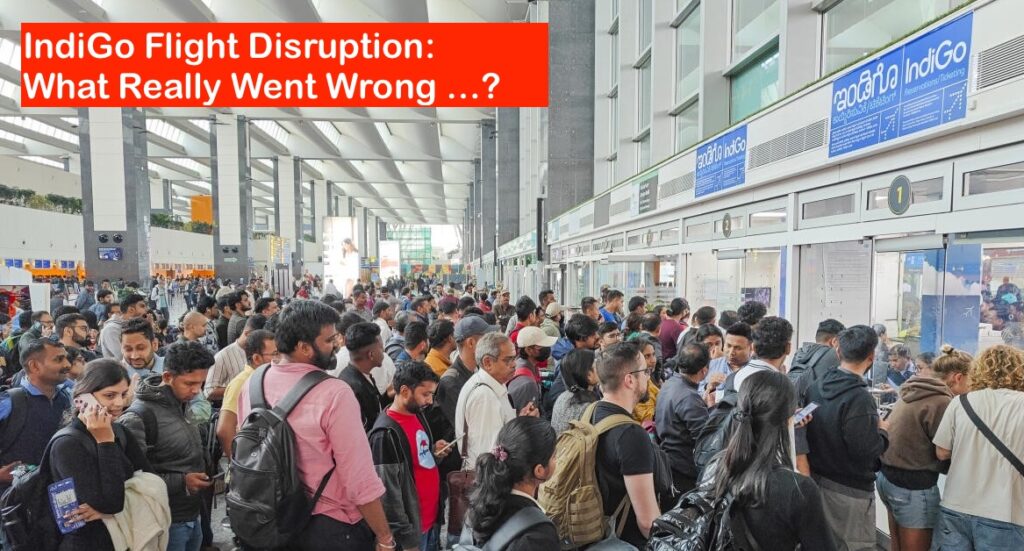
The massive IndiGo flight disruption has raised sharp questions about the airline’s planning, regulatory preparedness and the government’s reactive stance. The aviation ministry claimed flight services would stabilise within days. In contrast, IndiGo’s CEO warned that full normalcy may take far longer. This discrepancy leads to a deeper debate on how India aviation system manages operational risk within a tightly stretched aviation ecosystem. The IndiGo flight disruption has therefore become more than a scheduling crisis. It has become a ‘case study’ in regulatory readiness, corporate responsibility and systemic strain.
Government’s Assurances Versus IndiGo’s Reality
The Ministry of Civil Aviation stated that services would stabilise “tonight” and reach normal levels within a couple of days. The ministry also announced immediate relief steps, including a 24×7 monitoring cell, transparent real-time updates and passenger compensation processes. These assurances aimed to restore calm in the face of nationwide cancellations.
However, IndiGo presented a very different view. Its CEO Pieter Elbers admitted that the airline required an extended period to re-build rosters, restore schedules and fully comply with duty-rest cycles. IndiGo argued that the crisis stemmed from a combination of new pilot-duty rules, operational system reboot challenges and crew bottlenecks. This explanation highlighted gaps in its own strategic planning. The mismatch between the ministry’s promise and IndiGo’s operational horizon raised doubts about communication and competence on both sides.
How IndiGo’s Operational Model Collapsed
A Scheduling System Stretched Beyond Limits
IndiGo operates on a high-utilisation model that relies on tight crew cycles and minimal redundancy. This approach works during stable periods. However, it leaves no cushion for regulatory changes or sudden disruptions. When new DGCA fatigue-management rules entered a later phase of implementation, IndiGo struggled to redesign rosters on time.
The airline admitted that its previous corrective measures were insufficient. It finally executed a full “system reboot” that halted hundreds of flights. The IndiGo flight disruption exposed the brittle nature of its operational architecture.
Regulatory Changes Were Not Sudden
The DGCA’s revised duty-rest norms were not new. They had been announced earlier and rolled out in phases. This means IndiGo had ample time to prepare. Pilot groups argued that the airline delayed roster correction until the final moment, expecting either relaxation or lenient enforcement. When the rules became binding, the system broke.
This sequence suggests poor change-management discipline within the airline. A rule that had been in force for months should not have caused this level of collapse if adequate planning existed.
Was the Crisis Manufactured or Simply Mismanaged?
Speculation emerged about whether IndiGo allowed the situation to worsen in order to push the regulator into relaxing rules. This theory rests on the fact that the DGCA suspended two fatigue-mitigation rules exclusively for IndiGo. However, no credible evidence supports deliberate manufacturing of a crisis.
Available reporting points instead to predictable mismanagement. IndiGo underestimated the impact of the new rules. It over-scheduled flights while lacking the crew capacity to operate them. It initiated a system reboot at the peak of the travel cycle. It also failed to maintain adequate buffer pilots for night and early-morning operations.
The most plausible explanation remains a failure of planning rather than conspiracy. This aligns with global aviation patterns where airlines under pressure often over-stretch capacity and eventually face large-scale disruptions.
Did the Temporary Rollback of Rules Compromise Safety?
Fatigue Rules Exist for a Reason
Fatigue is a major safety concern in aviation. Duty-time limits and mandatory rest periods reduce the risk of human-factor failures. When the government suspended two provisions of the duty-rest norms, it effectively increased the permissible workload for pilots in a short window. Although regulators insisted that safety would not be compromised, the rollback narrowed safety margins.
No Incidents, But Higher Theoretical Risk
As of now, no accidents or safety incidents connected to the IndiGo flight disruption have been reported. However, the relaxation of rules came at a cost. When an airline’s operational strain intersects with fatigued crew, risk naturally rises. Therefore, the temporary rollback must be treated as a short-term pressure valve rather than a precedent.
For long-term consistency, India’s civil aviation authorities must ensure that fatigue-management norms remain non-negotiable. This crisis demonstrates why fatigue rules were strengthened in the first place.
What the Crisis Reveals About India’s Aviation Sector
Oversight Must Be Proactive, Not Reactive
India’s aviation ecosystem has expanded rapidly. Yet oversight mechanisms have not kept pace. Regulators often intervene only after a crisis. This pattern weakens passenger trust and strains the system during peak periods.
Airlines Must Build Structural Buffer
A domestic carrier with over 60% market share cannot operate with near-zero redundancy. India requires airlines to maintain stronger buffer capacity for crew, fleet and scheduling. Without such reforms, a single operator’s failure can disrupt the entire national network.
Need for Transparent Crisis Observation
The public witnessed contradictory statements from authorities and the airline. Clear, data-driven communication must replace public-relations messaging. Aviation depends on trust; ambiguity harms that trust.
The Road Ahead for IndiGo and Indian Aviation
IndiGo will need to rebuild rosters with full compliance. It must strengthen change-management systems and re-evaluate its reliance on tight utilisation models. The DGCA’s probe will be crucial in assessing accountability, identifying structural gaps and recommending reforms.
For the aviation ministry, this is an opportunity to reinforce safety norms, demand higher operational transparency and mandate resilience planning across airlines. A sector that carries millions daily cannot rely on elastic assurances or patchwork relaxations. Resilience must be engineered into the system.
The IndiGo flight disruption stands as a warning. India’s aviation framework must evolve to ensure that rules aimed at protecting safety do not become the trigger for system-wide collapse. Addressing this imbalance is now essential for restoring confidence and stability.