Pralay Missile: India’s Indigenous Quasi-Ballistic Tactical Weapon
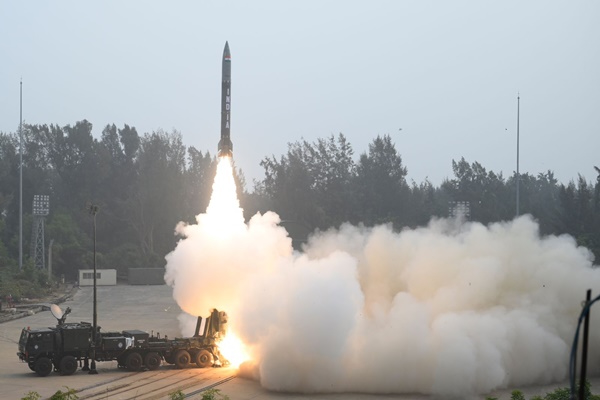
On 31 December 2025, India achieved a major milestone when two Pralay missiles were successfully launched in quick succession from the same mobile launcher during user evaluation trials at the Integrated Test Range in Chandipur, Odisha. Both missiles followed their intended trajectories and struck designated targets with high precision.
The Pralay missile is an indigenous, canisterised, tactical, short-range surface-to-surface quasi-ballistic missile developed by India’s Defence Research and Development Organisation. Designed as a conventional strike weapon, it fills a critical capability gap between longer-range ballistic missiles such as Prithvi and shorter-range rocket systems like Pinaka.
Named after the Sanskrit word for catastrophe, the Pralay missile India programme focuses on delivering rapid, precise strikes against high-value battlefield targets. These include enemy airbases, command and control centres, logistics hubs, and concentrated troop formations. The system is intended to provide the armed forces with a quick-reaction option in limited conflict scenarios.
Development Background and Programme Evolution
Project Pralay was sanctioned in March 2015, marking India’s first attempt to develop an indigenous conventional tactical quasi-ballistic missile. The requirement emerged from the need for a survivable, high-precision strike system capable of operating below the nuclear threshold.
The missile builds upon DRDO’s experience across earlier missile programmes while incorporating newer guidance and manoeuvrability technologies. Over the years, the design evolved into a road-mobile, canisterised system optimised for rapid deployment and launch.
The trials validated the missile’s guidance, navigation, and control systems. Performance was monitored through telemetry, radars, electro-optical tracking systems, and ship-based instruments. The successful salvo launch confirmed the system’s operational readiness and reliability.
Following the trials, Defence Minister Rajnath Singh and DRDO Chairman Dr. Samir V. Kamat congratulated the teams involved. As of January 2026, the Pralay missile is nearing operational deployment, although formal induction has not yet been announced.
Range, Payload, and Accuracy
The Pralay missile India system has a reported range between 150 and 500 kilometres. This allows coverage of critical targets across regions such as Punjab, Sindh, and parts of Balochistan when deployed along India’s western border.
The missile can carry payloads ranging from approximately 350 to 1,000 kilograms. It supports multiple conventional warhead configurations, including submunition penetration-cum-blast, monolithic penetration-cum-blast, and pre-fragmented warheads.
Guidance during the mid-course phase relies on inertial navigation, while terminal homing uses millimetre-wave seekers and radar imaging. This combination reportedly achieves a circular error probable of around ten metres, enabling precise engagement of hardened targets.
Trajectory, Manoeuvrability, and Survivability
Unlike traditional ballistic missiles, the Pralay missile follows a quasi-ballistic trajectory. It remains within the atmosphere for most of its flight and flattens its path during the terminal phase. This profile reduces predictability and complicates interception by enemy air defence systems.
The missile incorporates thrust vector control using jet vanes, along with two sets of small fins designed to reduce radar signature. These features allow evasive manoeuvres during the terminal phase, improving survivability against interceptors.
The system can engage two separate targets or attack the same target from different trajectories, increasing strike effectiveness and kill probability.
Launch System and Operational Deployment
Pralay missile India is deployed on a mobile 12×12 vehicle that carries two missiles. The launcher operates alongside a Battery Command Centre, which manages targeting, coordination, and launch authorisation.
Launch preparation time is limited to approximately ten minutes, with the transition from command to launch achievable in about sixty seconds. This rapid response capability enhances battlefield relevance and reduces vulnerability to pre-emptive strikes.
The missile is expected to be positioned along India’s western borders and near the Line of Control, where quick-reaction conventional strike capability is considered operationally critical.
Role in India’s Conventional Strike Doctrine
The Pralay missile strengthens India’s escalation control in limited conflicts by providing a high-precision conventional strike option. It allows India to respond decisively to military threats without crossing nuclear thresholds.
The system is widely viewed as a counter to Pakistan’s tactical missile deployments, particularly systems intended to offset India’s conventional superiority. By focusing on accuracy rather than yield, Pralay minimises collateral damage while holding critical military assets at risk.
Compared to cruise missiles such as BrahMos, Pralay offers a faster reaction profile and a less predictable flight path, making interception more difficult.
Comparison with Similar Systems
The Pralay missile is often compared with Russia’s Iskander-M system. Both feature manoeuvrable quasi-ballistic trajectories, terminal guidance seekers, and reported accuracy levels of around ten metres. Such systems have demonstrated effectiveness in penetrating modern air defence networks.
However, Pralay remains a fully indigenous system tailored to India’s operational requirements and strategic doctrine.
The successful user trials mark a significant step towards its induction, adding a critical layer to India’s tactical missile inventory at a time of persistent regional security challenges.