India’s AMCA Fighter Jet Program Marks Strategic Shift Away from HAL
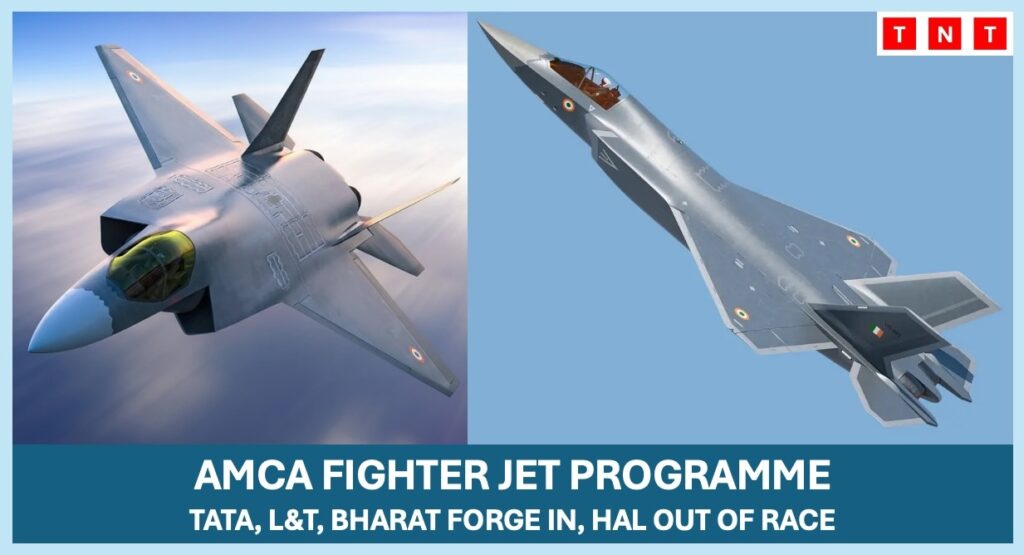
India’s AMCA fighter jet programme has entered a decisive phase with the government choosing private sector leadership over traditional public sector dominance. On February 3, 2026, reports confirmed that Hindustan Aeronautics Limited (HAL) has been excluded from the shortlist for prototype manufacturing of the Advanced Medium Combat Aircraft (AMCA) programme. Instead, Tata Advanced Systems Limited, Larsen & Toubro, and Bharat Forge have emerged as the preferred industry partners for the Defence Research and Development Organisation’s (DRDO) Aeronautical Development Agency (ADA).
This development marks the first time HAL will not lead a major indigenous fighter aircraft programme. The decision forms part of a ₹15,000 crore initiative to build five flying prototypes and one structural test specimen. It reflects the government’s growing emphasis on speed, accountability, and private sector efficiency in strategic defence manufacturing.
With commercial bids expected to be evaluated within three months, the AMCA programme is now positioned to redefine India’s aerospace ambitions.
AMCA’s Long Evolution into a Fifth-Generation Programme
The origins of the AMCA project date back to the early 2000s, when India first conceptualised a Medium Combat Aircraft. The idea matured into a full-fledged fifth-generation fighter programme in 2010 under the leadership of DRDO and ADA.
The AMCA has been designed as a single-seat, twin-engine, all-weather multirole stealth aircraft. It aims to integrate advanced features such as low observability, sensor fusion, artificial intelligence-based decision support, and supercruise capability. The aircraft is expected to weigh nearly 25 tonnes, reach speeds of Mach 2.15, and achieve a combat radius of around 1,620 kilometres.
India’s withdrawal from the Indo-Russian FGFA project in 2018 strengthened AMCA’s strategic importance. Concerns over technology transfer, rising costs, and limited stealth capability led New Delhi to prioritise a fully indigenous platform. Consequently, the Indian Air Force identified AMCA as its primary future air dominance asset, with plans for approximately 120 aircraft.
In 2024, the Cabinet Committee on Security approved full-scale engineering development. In May 2025, the Ministry of Defence formally opened the programme to private participation through a competitive bidding model.
Persistent Delays and Structural Challenges
Despite its strategic importance, the AMCA programme has faced repeated delays. Initial projections targeted a first flight by 2020 and induction by 2025. These milestones proved unrealistic due to institutional, financial, and technological constraints.
Key challenges have included limited domestic expertise in stealth coatings, high-end avionics, composite structures, and high-thrust engines. The failure of the Kaveri engine programme further constrained progress. Bureaucratic procedures and fragmented industrial coordination also slowed development.
The Tejas Light Combat Aircraft programme illustrates these difficulties. Launched in the 1980s, Tejas required more than three decades to reach operational maturity. Similar patterns have affected AMCA.
Design work began in 2015. However, approval for full-scale development came only in 2024. Subsequent reports suggest additional delays of 18 to 20 months due to testing and certification demands. As of 2026, the first flight is projected for 2028–2029, with induction likely in the mid-2030s.
HAL’s Historical Role in AMCA Development
HAL has played a significant role in AMCA’s early phases. Drawing from experience with Tejas, Su-30MKI, and MiG-29 upgrades, the company supported feasibility studies and preliminary design from 2010 onwards.
Its Bengaluru facilities contributed to wind tunnel testing, composite development, avionics integration, and systems validation. HAL also participated in detailed design work completed by 2015. Initially, policymakers envisaged HAL leading production through a special purpose vehicle with ADA and a private partner.
However, HAL’s consortium reportedly failed to meet technical and financial benchmarks during the 2025–2026 evaluation. Its heavy order backlog, including delays in Tejas Mk1A deliveries, raised concerns over execution capacity.
Following the exclusion, HAL’s share price declined by nearly 8%, reflecting investor apprehension. Nevertheless, HAL continues to play a role in related programmes, including GE F414 engine co-production and Tejas Mk2 development.
Government Strategy: Private Sector as Growth Engine
The exclusion of HAL signals a deliberate policy shift. Under the Atmanirbhar Bharat framework, the government seeks to dismantle monopolistic structures and promote competitive defence manufacturing.
By shortlisting Tata, L&T, and Bharat Forge, the Ministry of Defence aims to leverage private capital, managerial efficiency, and international partnerships. Selection criteria focused on manufacturing infrastructure, financial strength, supply chain depth, and project management capability.
Seven entities submitted bids in 2025. These consortiums were L&T+BEL+Dynamatic Technologies, BFL+BEML+Data Patterns, TASL, HAL+VEM+JK, Adani+MTAR, Icomm+PTC, BATL+Goodluck+Axiscades. Only three met the qualifying thresholds. The final selection will be based on commercial competitiveness and execution credibility.
This model mirrors global defence practices, where multiple industrial players share responsibility for complex platforms. It also addresses HAL’s capacity limitations and encourages parallel capability development.
Engine Development: The Core Technological Challenge
Propulsion remains the most critical bottleneck in the AMCA programme. The project follows a two-stage engine strategy.
AMCA Mk1
The initial variant will use the GE F414-INS6 engine, producing 98 kN of thrust. A $1.5 billion agreement provides for 80 per cent technology transfer and local manufacturing, primarily through HAL. This approach reduces early-stage risk and ensures timely prototype availability.
AMCA Mk2
The advanced variant will feature a new 110–120 kN class engine co-developed by DRDO’s GTRE and France’s Safran. Estimated at €6.7 billion, the programme promises full intellectual property access and critical hot-section technologies.
Development may take a decade, with validation expected between 2032 and 2035. Operational induction is projected around 2040. Early AMCA Mk2 aircraft may initially use F414 engines before retrofitting.
Safran’s selection reflects its willingness to support a clean-sheet design and comprehensive technology transfer.
Prototype Development and Timelines
The ₹15,000 crore allocation covers:
- Five flying prototypes
- One structural test specimen
- Integration and testing infrastructure
Rollout is planned for late 2026 or early 2027. The first flight is scheduled for 2028. Developmental trials will continue into the early 2030s.
Mk1 induction is targeted for 2035. Mk2 induction is expected by 2040. Requests for proposals are likely by April 2026, with final selection by year-end.
The selected private partner will manage manufacturing, systems integration, and ground testing under ADA’s design supervision.
The Private Contenders
The competition highlights contrasting industrial models.
Tata Advanced Systems Limited
TASL benefits from global partnerships and modular manufacturing expertise. It produces C-295 fuselages and Rafale components. Its Boeing and Airbus collaborations enhance supply chain resilience. Lower backlog levels allow faster capacity expansion.
Larsen & Toubro
L&T excels in precision engineering and defence electronics. It manufactures Tejas structural components and collaborates on radar systems. Its experience with large-scale defence platforms strengthens its credentials for stealth integration.
Bharat Forge
Bharat Forge brings advanced forging and metallurgy capabilities. It partners with firms specialising in electronic warfare and avionics. However, its limited aircraft assembly experience remains a constraint.
Compared with HAL’s deep integration experience, private firms offer fresher capacity, diversified partnerships, and stronger project discipline. Success will depend on their ability to scale rapidly and coordinate complex subsystems.
Strategic Implications for India’s Air Power
The shift towards private leadership represents a structural transformation in India’s defence ecosystem. It reflects confidence in domestic industry maturity and recognition of past institutional limitations.
If executed effectively, the new model could shorten development cycles, improve accountability, and create multiple aerospace champions. It may also strengthen India’s negotiating position in future technology collaborations.
However, risks remain. Fifth-generation fighters demand sustained funding, stable policy, and advanced test infrastructure. Engine development, stealth validation, and software integration will test institutional capacity.
The AMCA programme’s outcome will determine whether India can transition from licence-based production to genuine design leadership.
India’s decision to entrust private industry with the AMCA fighter jet programme represents a calculated strategic gamble. By reducing dependence on HAL and encouraging competition, policymakers aim to overcome historical inefficiencies.
If timelines hold, AMCA could provide the Indian Air Force with a credible fifth-generation platform by the 2030s. Yet, technological hurdles and execution risks persist. The programme’s success will ultimately depend on sustained political commitment, industrial coordination, and technological discipline.
The coming decade will reveal whether this new model can transform India’s long-standing aerospace aspirations into operational reality.