India-US Trade 2026: Opportunity or Caution?
US-India Interim Trade Framework: India’s Economic Leverage in a Changing Global Order
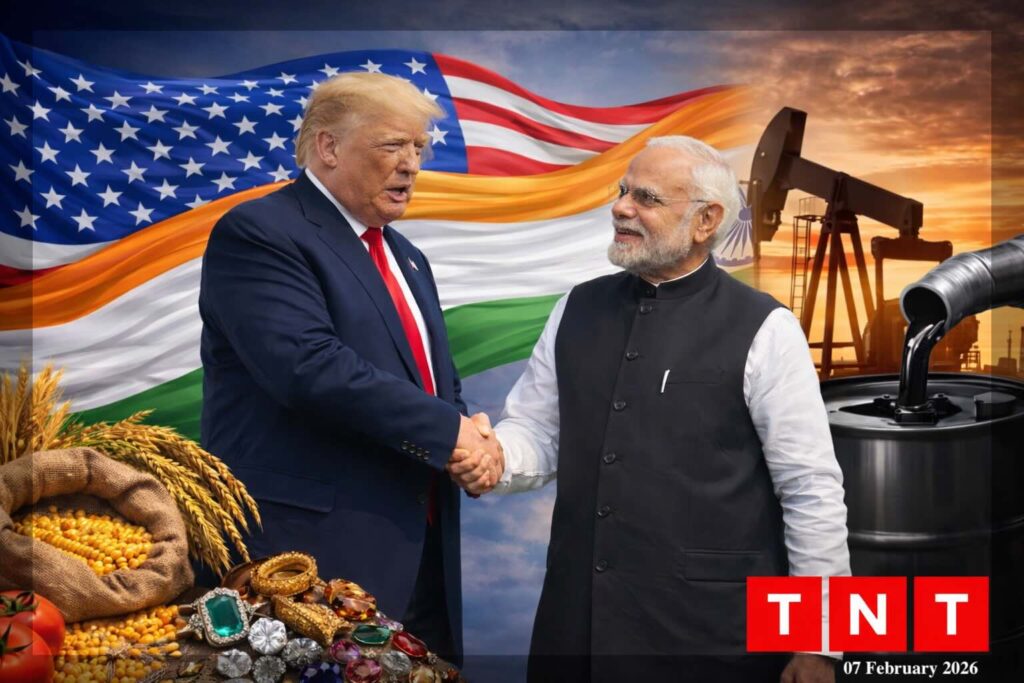
The US-India Interim Trade Framework, a joint statement announced on February 7, 2026, marks a significant moment in bilateral economic relations. The agreement, accompanied by a Presidential Executive Order, recalibrates tariffs, market access, and energy commitments between the two countries. It also reflects India’s growing leverage in global trade negotiations.
With bilateral trade touching nearly $200 billion in 2025, both sides have projected ambitions under “Mission 500”, aiming to raise trade volumes to $500 billion by 2030. However, a close reading of official documents shows that this framework is more about strategic positioning than binding economic surrender.
The US-India Interim Trade Framework, therefore, must be understood as a calculated arrangement where India safeguards its autonomy while extracting tangible economic relief.
Joint Statement on the Interim Trade Framework: Core Provisions
The joint statement titled “United States-India Joint Statement on Interim Trade Framework” outlines a high-level roadmap for trade cooperation. It emphasises “fair, balanced, and reciprocal trade” while stopping short of enforceable obligations.
India’s Tariff Reductions on US Goods
The statement declares:
“India will eliminate or reduce tariffs on all U.S. industrial goods and a wide range of U.S. food and agricultural products.”
These include:
- Dried distillers’ grains (DDGs)
- Red sorghum
- Tree nuts
- Fresh and processed fruit
- Soybean oil
- Wine and spirits
While some agricultural tariffs earlier ranged between 30 and 100 per cent, the framework does not specify fixed timelines. This ambiguity preserves India’s negotiating space. Indian regulators and importers retain discretion over pace and volume.
All the listed items—DDGs/DDGS, red sorghum, tree nuts, fresh and processed fruits, soybean oil, and wine and spirits—were already being imported into India before the February 2026 deal, despite high duties. These imports, mainly from the US and other suppliers, were driven by existing demand. The agreement does not open a new market. It only makes existing imports more price-competitive, especially for US exporters, in non-sensitive sectors.
Yellow Peas Duty Remains at 30 Per Cent
Until October 31, 2025, yellow peas were imported into India duty-free under repeatedly extended exemptions. From November 1, 2025, a 30 per cent duty (10 per cent Basic Customs Duty and 20 per cent Agriculture Infrastructure and Development Cess) was imposed through CBIC notifications to protect domestic pulse farmers from price depression caused by cheap imports. As of February 2026, this duty remains fully in force and has not been altered under the US-India interim trade framework. The levy applies globally and not only to US exporters. The February 2026 joint statement explicitly excludes pulses from tariff concessions, and official positions continue to classify them as sensitive agricultural items. Despite lobbying by US lawmakers in early 2026, no relief was granted, reaffirming India’s decision to keep core food staples outside trade negotiations.
US Tariff Adjustments on Indian Goods
The United States agreed to reduce its reciprocal tariff rate from 25% to 18% under Executive Order 14257.
This applies to:
- Textiles and apparel
- Leather and footwear
- Plastics and rubber
- Organic chemicals
- Home décor
- Artisanal products
- Select machinery
The statement further promises conditional removal of tariffs on:
- Generic pharmaceuticals
- Gems and diamonds
- Aircraft parts
These reductions depend on successful conclusion of the interim agreement. Until then, India retains negotiating leverage.
Removal of Section 232 National Security Tariffs
The US also agreed to remove tariffs imposed under Section 232 on:
- Steel
- Aluminium
- Copper
- Aircraft components
These tariffs, earlier imposed under Proclamations 9704, 9705, and 10962, had severely affected Indian exporters. Their removal restores competitiveness in key manufacturing sectors.
This is a direct economic gain for India.
India’s Import Intent from the United States
The joint statement declares:
“India has expressed its intent to purchase up to $500 billion in U.S. goods over the next five years.”
This proposed ceiling covers major sectors such as:
- LNG
- Crude oil
- Coking coal
- Aircraft and parts
- Precious metals
- Technology
However, this figure does not represent an annual target or a binding commitment. It merely signals a maximum possible volume over a five-year window. The deliberate use of the phrases “up to” and “expressed its intent” removes any legal, financial, or contractual obligation.
There are no fixed timelines, no minimum purchase requirements, and no price-linked guarantees. All purchases remain subject to market competitiveness, commercial negotiations, and domestic demand.
India, therefore, retains full freedom to prioritise economic rationality and source imports strictly on the basis of cost, quality, and strategic interest.
Executive Order on Removal of Russian Oil Punitive Tariff
Alongside the framework, the US issued an Executive Order titled “Modifying Duties to Address Threats to the United States By the Government of the Russian Federation”.
This order removes the additional 25 per cent punitive tariff imposed in August 2025 for India’s purchase of Russian oil.
Basis for Removal
The order states:
“India has committed to stop directly or indirectly importing Russian Federation oil.”
It also links this to:
- US energy purchases
- Expanded defence cooperation
- Strategic alignment
The linkage reveals Washington’s geopolitical objectives. However, India accepted these terms only after securing tariff relief, and asserted that the crude imports will be decided based national need economics.
Effective Date and Financial Impact
The order terminated the additional duty from: 12:01 a.m. EST, February 7, 2026.
This immediately reduced combined tariffs from nearly 43–50 per cent to 18 per cent.
Based on 2025 exports of around $80 billion to the US, India avoided losses of approximately $10–15 billion annually. This is a major economic relief.
Monitoring and Reimposition Clause
The order empowers US authorities to monitor compliance. It allows reimposition of tariffs if India resumes Russian oil imports.
This clause introduces political oversight. However, it remains subject to diplomatic negotiations and market realities.
India retains room for calibrated responses.
Trade and Energy Realities: India’s Strategic Calculations
India’s total annual imports stand at approximately $700–800 billion. Energy imports alone account for $160–175 billion, including:
- Crude oil: $140–150 billion
- LNG: $20–25 billion
Against this backdrop, a $100 billion annual import target from the US is manageable. It does not distort India’s trade structure.
Non-Binding Nature of Commitments
The framework contains no:
- Pricing mandates
- Penalty clauses
- Mandatory quotas
If US crude remains at $70–80 per barrel while Russian crude stays near $50–60, Indian refiners will act rationally. Similarly, LNG must compete with Qatar’s $8–10/MMBtu rates.
Indian firms such as IOC and Reliance retain full commercial freedom.
This protects national economic interest.
Tariff Relief and Trade Balance
India’s trade surplus with the US remains around $30–40 billion. The new tariff regime eases pressure without forcing structural concessions.
At the same time, India’s global trade deficit of $250–300 billion remains unaffected. Reallocating trade towards the US raises its share from 6 per cent to 12–15 per cent, which is strategically useful.
It strengthens defence, aviation, and technology cooperation.
Energy Shift and Market Competition
US energy exports to India stood at $7–10 billion in 2025. These could increase tenfold. However, competition from Qatar, the Middle East, and Africa ensures that prices remain under pressure.
If US suppliers remain uncompetitive, volumes will fall naturally.
India has not sacrificed energy security.
Strategic Implications for India: Gains and Cautions
Key Advantages
- Restoration of export competitiveness
- Removal of punitive and security tariffs
- Expanded market access
- Strengthened defence and technology ties
- Diversified energy sourcing
Unlike earlier Western arrangements, this framework imposes no extractive burden.
Areas of Concern
- Monitoring clause may politicise energy policy
- Short-term energy costs may rise
- Increased US influence in strategic sectors
However, these risks remain manageable through diplomatic and commercial engagement.
India’s Negotiating Maturity in a Multipolar World
The US-India Interim Trade Framework reflects India’s evolution from a rule-taker to a rule-shaper. It demonstrates that India can negotiate with major powers without compromising sovereignty.
The agreement is not transformational in scale. However, it is tactically valuable. It protects exports, preserves autonomy, and enhances strategic options.
Trade volumes, projected at $132 billion in 2025 and beyond, will grow through market forces rather than coercion.
Ultimately, this framework shows that India now negotiates from a position of strength. Success will depend on how effectively Indian institutions and corporations leverage this space.
In a fragmented global order, economic intelligence, not ideological alignment, will determine outcomes. On this front, India has acted with clarity and confidence.