India Successfully Conducts K-4 SLBM Test from Nuclear Submarine
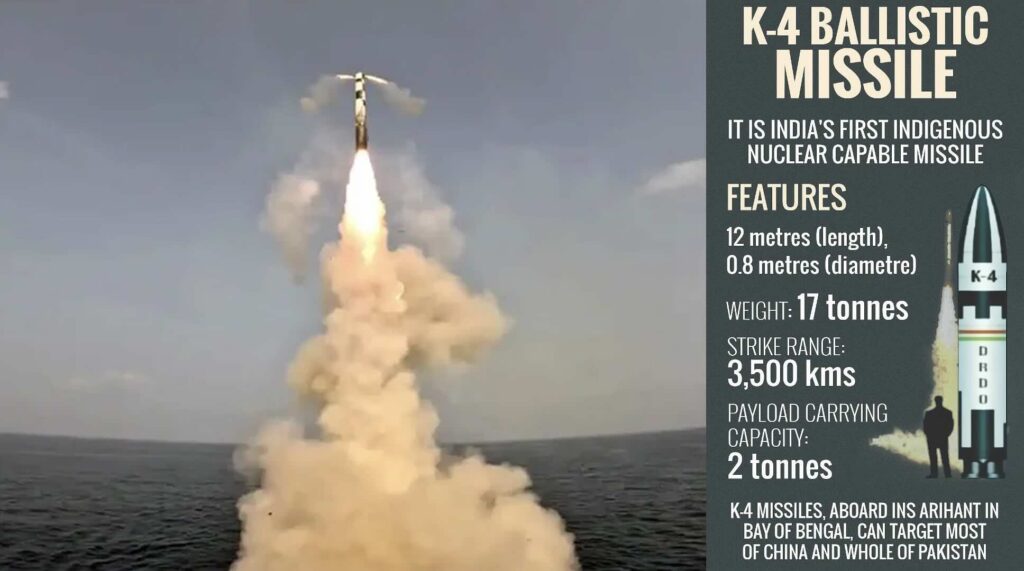
India has successfully conducted a K-4 SLBM test from its nuclear-powered ballistic missile submarine INS Arighaat, marking a significant milestone in the operational readiness of the country’s sea-based nuclear deterrent. The test was carried out in the Bay of Bengal on December 23, defence sources confirmed, and involved a missile with a strike range of approximately 3,500 kilometres.
The launch further strengthens India’s nuclear triad by validating the operational deployment of long-range submarine-launched ballistic missiles under user-controlled conditions.
Launch Conducted from INS Arighaat
According to details reported by several media platforms, the missile was launched from INS Arighaat, India’s second Arihant-class nuclear-powered ballistic missile submarine. The submarine, which displaces about 6,000 tonnes, was commissioned into the Indian Navy in August 2024 and operates under the Strategic Forces Command.
The test was conducted from waters off the eastern seaboard, with maritime safety measures and exclusion zones put in place in advance. Sources indicated that the missile followed its planned trajectory and achieved all designated mission parameters.
K-4 Missile Capabilities and Payload
The K-4 SLBM is a two-stage, solid-fuel ballistic missile developed by the Defence Research and Development Organisation for underwater launch from nuclear submarines. As per the Times of India report, the missile is capable of carrying a nuclear payload of up to two tonnes, significantly enhancing India’s assured retaliation capability.
With a tested range of around 3,500 kilometres, the K-4 allows Indian SSBNs to operate from secure patrol zones while retaining the ability to strike strategic targets, thereby improving survivability and deterrence credibility.
Advancement Over Earlier SLBM Systems
The successful K-4 SLBM test marks a clear technological and operational advancement over India’s earlier submarine-launched ballistic missile capability. Until now, Arihant-class submarines were primarily armed with the K-15 Sagarika, a short-range SLBM with a reach of approximately 750 kilometres, which required deployment closer to potential adversary coastlines.
Each Arihant-class SSBN is fitted with four vertical launch tubes, which can be configured to carry up to 12 K-15 SLBMs in a triple-packed arrangement. While this configuration provided volume, it imposed geographic and operational constraints on patrol areas.
The introduction and validation of the K-4 SLBM, with a tested range of around 3,500 kilometres, fundamentally alters this equation. In a K-4 configuration, the same four launch tubes can accommodate up to four long-range SLBMs, enabling submarines to operate from safer and deeper patrol zones while still retaining credible reach against strategic targets.
This shift from shorter-range, higher-count missiles to fewer but significantly longer-range systems represents a deliberate move towards survivability and assured retaliation. The K-4 SLBM therefore transitions India’s sea-based deterrent from a limited regional capability to a more robust and operationally flexible strategic posture.
Validation of User-Level Operational Readiness
The December 23 launch was conducted as a user trial, indicating that the missile system was operated by uniformed naval personnel rather than development teams. This confirms not only the technical reliability of the missile but also the readiness of the crew, launch systems, and command-and-control architecture.
Such trials are considered essential steps before a weapon system is declared fully operational within India’s strategic forces.
Role in India’s Nuclear Triad
Submarine-launched ballistic missiles form the most survivable leg of a nuclear triad, given their ability to remain concealed underwater for extended periods. The successful K-4 SLBM test reinforces India’s second-strike capability, a cornerstone of its declared no-first-use nuclear doctrine.
India currently operates two Arihant-class SSBNs, with additional submarines at advanced stages of construction. Future platforms are expected to carry a higher number of missiles and support longer-range SLBM variants under development.
Strategic Context
While no official statement was issued immediately following the test, defence sources described the launch as a routine but critical step in India’s strategic force readiness. The test comes amid evolving regional security dynamics and reflects India’s continued focus on maintaining a credible minimum deterrent through indigenous capability development.
The successful K-4 SLBM test from INS Arighaat thus marks another step in the steady maturation of India’s sea-based nuclear deterrence architecture.