India signs $1 billion deal for 113 GE engines — and what happened to the 2021 order that’s still incomplete
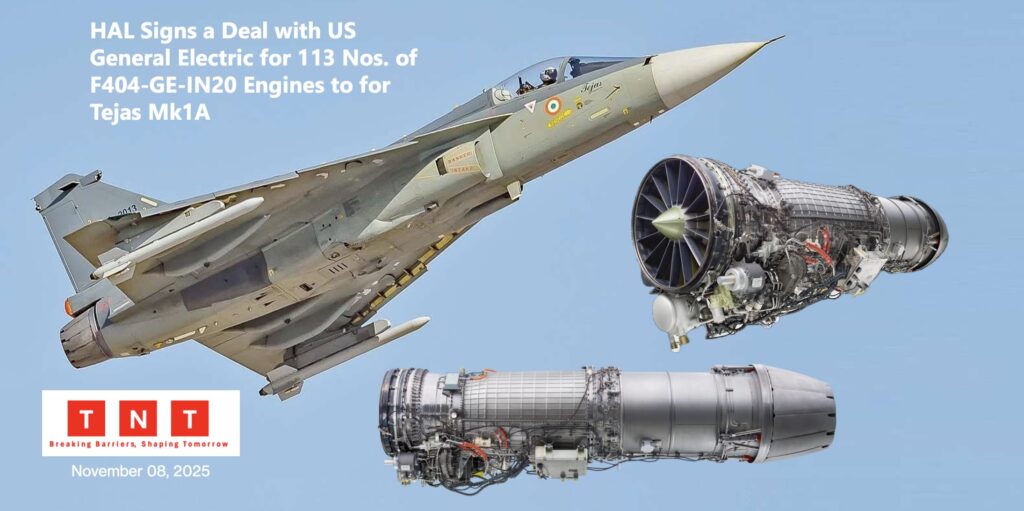
NEW DELHI, 8 November 2025 — India on Friday sealed a roughly $1 billion agreement with U.S. aerospace giant General Electric (GE) to buy 113 F404-series fighter jet engines to power HAL’s Tejas LCA Mk1A aircraft, with deliveries scheduled to begin in 2027 and run through 2032. HAL said the engines come with spares and support to match the induction plan for nearly 97 new Mk1A jets ordered by the Ministry of Defence.
That headline, however, immediately raised the question many readers and defence-watchers have been asking for more than a year: what happened to the earlier 2021 engine order with GE — the $716 million contract for 99 F404 engines that was supposed to underpin the first Tejas LCA Mk1A deliveries?
The short answer: the 2021 order was beset by chronic delays, only a tiny fraction of engines have reached India so far, HAL invoked contractual remedies amid the slippage, and public reporting is mixed on whether formal monetary penalties have been finally imposed.
Below is a consolidated, sourced account that merges the new 113-engine deal with the status and fallout of the earlier 2021 contract.
What the new 2025 agreement covers
Quantity & variant: 113 F404-series engines (reported as F404-GE-IN20) for the Tejas Mk1A programme.
Value & timing: Reported broadly as a roughly $1 billion contract; deliveries to begin in 2027 and continue through 2032 to match HAL’s aircraft-production schedule.
Scope: Engines plus a logistics/support package intended to sustain sortie rates as HAL ramps up deliveries.
The 2021 engine order — timeline and status
Contract award (2021): In 2021 HAL signed a roughly $716 million deal with GE for 99 F404-GE-IN20 engines to power the initial batches of Tejas LCA Mk1A fighters. The timeline then envisaged staged deliveries beginning around 2023.
Delays and causes (2023–2025): Deliveries were repeatedly pushed back. GE attributed part of the hold-up to global supply-chain disruptions emerging from the pandemic and problems with sub-suppliers; Indian reporting flagged supply-chain and production bottlenecks that pushed the effective delivery window to 2025 and later.
How many engines arrived: Multiple outlets state that only a handful of engines had been delivered by late 2025 (reports vary: some mention one engine delivered in early 2025, others report up to four delivered as stopgaps). The bulk of the 99-engine tranche remained outstanding, hampering HAL’s ability to field completed Tejas LCA Mk1A aircraft at the intended pace.
Contractual response — penalties / invoked clauses:
HAL action: Local press reported that HAL formally invoked penalty provisions or contractual remedies against GE for extended delays. Several outlets covered HAL’s move to recover liquidated damages or to seek corrective action.
Government / MoD posture: Coverage has been inconsistent. Some reports in late 2024 said the government would impose penalties; other reports and official statements subsequently downplayed or refuted claims that MoD had imposed formal penalties, noting that the contract was between HAL and GE and that public statements about penalties were premature or the subject of internal action. The public record therefore contains conflicting accounts about whether a settled monetary penalty was ultimately levied.
Operational impact
The shortfall in engines delayed deliveries of air-worthy Tejas LCA Mk1A jets — in some cases airframes were completed but left grounded awaiting engines. HAL has used rotating and reserve engines to keep a small number of aircraft flight-worthy while the procurement issues persisted. The delays intensified calls inside New Delhi to accelerate indigenous propulsion programs even as the government pragmatically pursues foreign buys to meet immediate readiness goals.
Why India signed a fresh 113-engine deal now
Officials and analysts point to a mix of operational urgency and diplomacy: with two large production batches of Tejas LCA Mk1A jets contracted by the MoD, India must secure engines on predictable timelines to avoid further slippages in squadron build-up. The new multi-year supply agreement with GE is framed as a pragmatic bridge to meet short-to-medium term needs while domestic engine development efforts (and any offset/co-manufacturing measures) continue. Observers also note that the fresh agreement comes at a moment of improving India-U.S. commercial ties after a period of trade tensions.
Unresolved questions and what to watch
Completion of the 2021 order: Public sources indicate the 99-engine order is not fully complete as of November 2025; monitor HAL/GE delivery schedules and customs/clearance records for updates.
Final penalty outcome: Reporting remains mixed — some outlets say HAL invoked penalties; MoD/official statements have at times been cautious. Look for formal HAL/MoD financial disclosures or GE statements clarifying whether liquidated damages were assessed and settled.
Domestic engine programmes: Whether the fresh buy includes stronger transfer-of-technology, co-production or local supplier participation clauses will matter for long-term Atmanirbhar Bharat goals. Watch contract notices and HAL/GE statements for offset and industrial participation details.
Bottom line
The $1 billion 113-engine deal secures a predictable supply runway for Tejas Mk1A induction from 2027, but it comes on top of a troubled 2021 contract for 99 engines whose deliveries were delayed and remain largely unfulfilled. HAL’s invoking of contractual remedies and mixed government messaging on formal penalties leave open important accountability questions — even as New Delhi moves to stabilise engine supplies to meet near-term operational demands. The new agreement is therefore both a practical fix and a reminder that India’s longer-term aim of indigenous jet-engine self-reliance has not yet been realised.
Timeline at a glance
2021: HAL signs ~$716m contract with GE for 99 F404 engines.
2023–2025: Repeated delivery delays; GE cites supply-chain issues; delivery schedule slips into 2025 and beyond.
Oct 2024 – 2025: HAL reports delays; local media reports invoked penalty clauses and mixed reports about government action.
Nov 2025: HAL signs fresh pact for 113 engines (reported ~$1bn), deliveries 2027–2032.