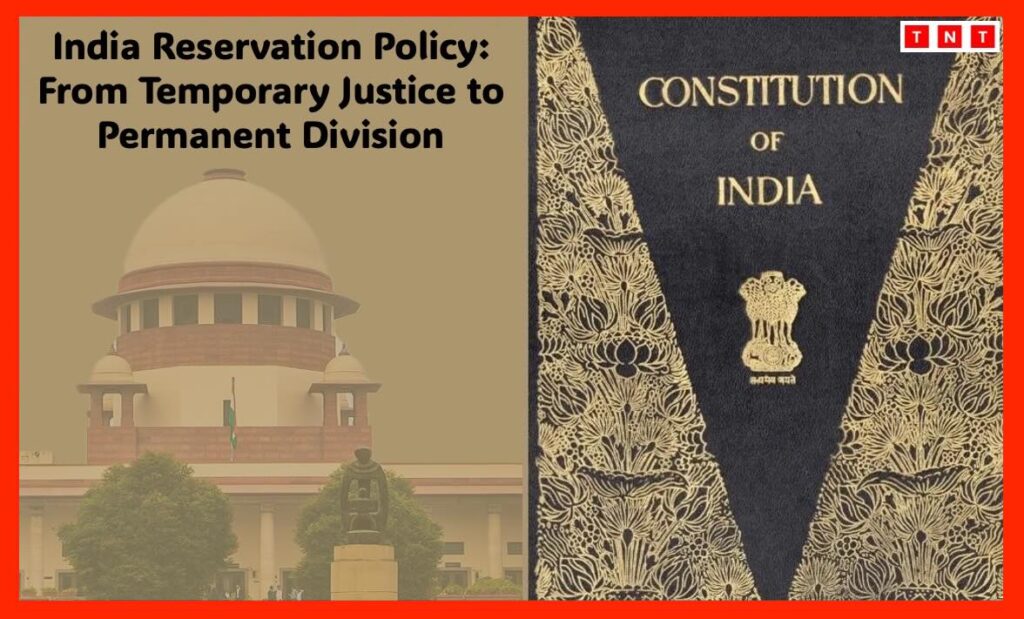
Reservations: From Temporary Social Justice to Perpetual Division – A Call for Constitutional Clarity and True Equality
The Original Vision and India Reservation Policy Reform
When India’s Constitution was written and adopted in 1950, reservations were designed as a temporary exception to the principle of equality. Leaders such as Dr B. R. Ambedkar and members of the Constituent Assembly recognised the deep wounds created by centuries of caste-based discrimination and untouchability. Therefore, Articles 15(4) and 16(4) empowered the State to provide special provisions for Scheduled Castes and Scheduled Tribes, which were later extended to Other Backward Classes.
The intent behind this framework was clear. India’s reservation policy was never meant to create permanent entitlements. Instead, it was designed to function as a time-bound corrective mechanism. However, no specific deadline was set in the Constitution. Whether this was a deliberate choice or a result of limited foresight remains open to debate. The Supreme Court of India has repeatedly described reservations as temporary exception to the rule of equality under Articles 14 and 16. These measures were meant to be reviewed once social backwardness began to decline. Yet, a fundamental question remains: can such an exception be allowed to continue indefinitely?
Over the decades, this temporary arrangement has gradually transformed into a permanent political structure.
Expansion of Quotas and the Politics of Permanence
Seventy-six years later, the reservation framework shows little sign of institutional review. Successive governments, irrespective of ideology, have expanded quotas and resisted comprehensive data-driven assessments. In several states, the 50% ceiling has already been breached.
As a result, India Reservation Policy Reform has been subordinated to vote-bank politics. The creamy layer within reserved categories continues to dominate access to educational seats, promotions, and public employment. Families with senior bureaucrats, politicians, and established businesses often retain reservation benefits across generations.
At the same time, economically vulnerable families in the general category remain outside any meaningful support framework. A Dalit child of a senior officer may enjoy reserved access to elite institutions. Meanwhile, a general category child of a marginal farmer must compete without assistance. This imbalance raises serious constitutional questions about distributive justice.
Therefore, what was meant to reduce inequality now risks institutionalising a new form of structural imbalance and inequality.
Merit, National Efficiency, and Social Consequences
The long-term costs of this imbalance are becoming increasingly visible. Competitive examinations, medical admissions, engineering colleges, and public services reflect growing disparities in entry standards. Consequently, capable candidates from the general category often find themselves excluded despite strong performance.
This trend weakens institutional efficiency. Critical sectors such as healthcare, infrastructure, administration, and research depend on competence and consistency. When merit becomes secondary, overall performance suffers. Over time, this creates a national productivity loss that no developing society can afford.
In addition, resentment continues to grow across social groups. Those who have already achieved stability within reserved communities often continue to occupy limited opportunities. As a result, the most deprived within these communities remain marginalised.
Therefore, the system fails both merit and equity.
Changing Social Realities and Campus Controversies
It is true that caste discrimination still exists in parts of India. Rural atrocities, social exclusion, and marriage barriers persist in several pockets. No responsible observer can deny this reality. However, it is equally true that discrimination is not uniform across the country. There are regions where such discrimination has largely vanished, yet people from the general category gain no corresponding relief and continue to lose opportunities due to reservations.
In urban centres, private workplaces, universities, and among younger professionals, overt caste prejudice has significantly declined. Yet, paradoxically, the reservation framework continues to reinforce caste consciousness.
Many upper-caste students now express that their identity has become their only defining disadvantage. They feel judged not on economic status or ability, but on inherited labels. This perception intensified after the 2026 regulations of the University Grants Commission, which defined discrimination largely in terms of upper-caste behaviour.
The regulations triggered nationwide protests, faculty resignations, and an immediate judicial stay. The backlash reflected genuine concerns about one-sided regulatory approaches in an already polarised academic environment.
Hence, policy design itself has become a source of social anxiety.
Leadership Statements and Judicial Responsibility
The national debate further intensified after remarks by Mohan Bhagwat, chief of the Rashtriya Swayamsevak Sangh (RSS), recently in February 2026. He argued that if discrimination lasted 2,000 years, society should be prepared to provide reservations for 200 years.
Although well-intentioned, the statement highlighted the absence of any measurable endpoint. Without clear timelines, temporary arrangements become permanent entitlements that ultimately harm beneficiaries by weakening competitiveness and reducing the incentive to perform better.
In contrast, senior judicial voices have emphasised constitutional balance. Earlier Chief Justice of India B. R. Gavai has supported extending the creamy-layer principle to SC/ST categories. This approach aligns with Article 14, which mandates equality before law.
It is high time that the Supreme Court institutionalises periodic, transparent, and data-based reviews and reforms. Without such mechanisms, India Reservation Policy Reform will remain politically sensitive but administratively stagnant.
Constitutional Equality and Economic Realities
Today, SC/ST communities enjoy full fundamental rights and legal equality along with reservation benefits. Meanwhile, large sections of the general category face economic distress without comparable institutional support.
This asymmetry contradicts the spirit of constitutional equality. The introduction of the 10% Economically Weaker Sections quota recognised this gap. However, it remains limited in scope and coverage.
Furthermore, social media platforms increasingly reflect upper-caste frustration, with voices from the general category echoing the sentiment that they are left with “nothing but their caste.” Mainstream discourse often avoids these concerns for fear of backlash. Yet, unresolved grievances do not disappear. Instead, they deepen societal fault lines.
A mature democracy cannot rely on silence to manage discontent.
Towards Balanced India Reservation Policy Reform
India now requires bold, evidence-based reform. First, a uniform creamy-layer exclusion must apply across all categories. Second, economic vulnerability should receive greater weight in policy design. Third, periodic nationwide socio-economic surveys must guide adjustments.
In addition, transparent sunset clauses should accompany all affirmative action policies. Political parties must also abandon the cynical use of reservations as electoral instruments.
True social justice lies in expanding opportunity, not freezing privilege.
Some critics may label this perspective as anti-Dalit or upper-caste propaganda. However, confronting systemic distortions is essential for national cohesion. Ignoring present realities in the name of historical guilt only postpones social reconciliation.
The Constitution promises equality to every citizen. India Reservation Policy Reform must now reflect that promise in both letter and spirit. The nation deserves a framework that rewards effort, protects vulnerability, and unites society rather than dividing it.
This debate must continue with honesty, evidence, and constitutional responsibility.