India–Oman Trade Pact Grants Duty-Free Access for Majority of Exports
India–Oman Trade Pact Secures Duty-Free Market Access Through Oman CEPA
India has signed a Comprehensive Economic Partnership Agreement (CEPA) with Oman, granting duty-free access to nearly 98% of Indian exports to the Gulf nation. The agreement marks a significant step in New Delhi’s broader strategy to deepen economic engagement with the Gulf Cooperation Council (GCC) while diversifying export destinations amid rising global trade frictions.
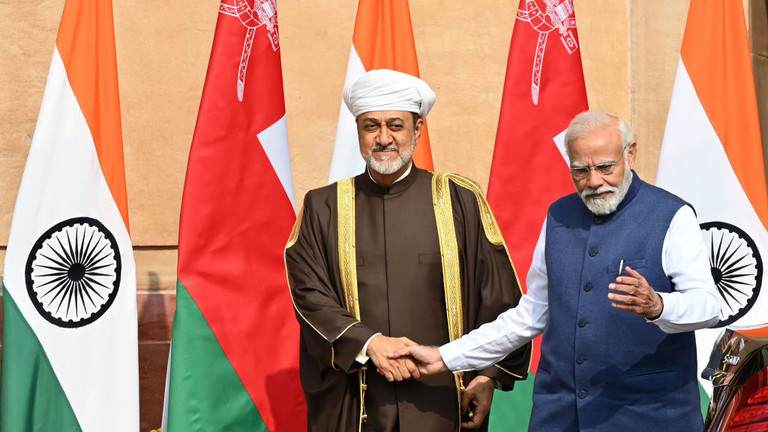
The announcement was made during the India–Oman Business Summit in Muscat, where Prime Minister Narendra Modi described the pact as a decision whose impact would resonate for decades. He characterised the agreement as a forward-looking blueprint designed to energise bilateral ties in the 21st century and unlock opportunities across sectors.
Oman currently stands as India’s third-largest export destination within the GCC, making the agreement strategically and commercially significant.
Key Sectors to Benefit From India–Oman Trade Pact
Under the CEPA framework, India has secured tariff elimination across several labour-intensive and high-employment sectors. These include textiles, garments, gems and jewellery, agricultural produce, leather goods, engineering products, automobiles, and auto components.
Officials expect the agreement to enhance competitiveness for Indian exporters by lowering costs and improving price parity in the Omani market. Labour-intensive industries, in particular, are projected to see stronger demand, supporting employment generation within India.
From Oman’s perspective, India will reduce or eliminate tariffs on key exports such as dates, marble, and petrochemical products, creating a more balanced and reciprocal trade structure.
Bilateral Trade Context and Economic Scale
India–Oman bilateral trade reached USD 10.5 billion in the financial year 2024–25, reflecting steady growth driven by energy, manufacturing inputs, and consumer goods. The CEPA aims to expand this figure further by easing market access and encouraging private sector participation on both sides.
Trade officials view the agreement as a foundation for long-term integration rather than a short-term tariff arrangement. Beyond goods, the pact is expected to facilitate cooperation in logistics, services, investment, and technology-driven sectors.
Part of India’s Expanding Network of Trade Agreements
The Oman CEPA fits into India’s accelerating trade diplomacy across regions. Over the past four years, New Delhi has concluded trade agreements with Mauritius (2021), the UAE (2022), Australia (2022), the European Free Trade Association (2024), and the United Kingdom (2025).
This expanding network reflects India’s effort to lock in preferential access to stable markets while insulating its exporters from protectionist shocks. The GCC region, with its energy wealth, infrastructure spending, and consumer demand, remains central to this strategy.
Trade Diversification Amid US Tariff Pressures
The timing of the India–Oman trade pact is notable. India is currently negotiating a trade agreement with the United States, its largest export market, amid heightened tensions over tariffs.
Washington imposed 50% tariffs on Indian goods in August, with a portion explicitly framed as punitive measures linked to India’s continued import of Russian oil. More recently, US President Donald Trump threatened additional tariffs, accusing India of dumping rice into the American market.
Against this backdrop, India is actively pursuing trade diversification to reduce vulnerability to unilateral tariff actions. The Oman CEPA strengthens India’s position in the Gulf while reinforcing its policy of strategic autonomy in trade and foreign relations.
Gulf Engagement and Strategic Balancing
India’s growing economic engagement with Oman also highlights its broader diplomatic posture in West Asia. Oman maintains cordial relations with the United States, Iran, and Russia, positioning it as a stable and pragmatic partner.
For India, deeper economic ties with Muscat complement its engagement with other Gulf states while supporting supply chain resilience, energy security, and overseas employment for Indian workers in the region.
A Signal of India’s Trade Direction
The India–Oman CEPA underscores a clear policy direction. New Delhi is prioritising market access, employment-intensive exports, and diversified partnerships over dependence on a limited set of economies.
As negotiations continue with the US, Mexico, and multiple regional blocs, agreements such as the Oman trade pact provide India with strategic leverage, economic cushioning, and long-term trade certainty in an increasingly fragmented global trade environment.