India–New Zealand FTA Reveals Fragility of New Zealand’s Coalition Government
A Trade Breakthrough Followed by Political Friction
The conclusion of the India–New Zealand Free Trade Agreement has been presented as a landmark achievement in bilateral relations, yet its political aftershocks are now being felt inside New Zealand’s government. Finalised on December 22, 2025, after an unusually swift nine-month negotiation process, the agreement has immediately exposed divisions within the ruling coalition, with New Zealand First publicly opposing the deal and threatening to block its ratification in Parliament.
The India New Zealand FTA is intended to reshape trade ties at a time of global economic uncertainty. However, the domestic response in Wellington highlights how international trade agreements can collide with coalition politics, particularly in governments formed under proportional representation.
The Long Road to the India–New Zealand FTA
Trade engagement between India and New Zealand has evolved gradually over several decades. Formal negotiations toward a comprehensive trade agreement began in 2010 under the proposed Comprehensive Economic Cooperation Agreement. These talks stalled by 2015 due to disagreements over market access, most notably India’s reluctance to open its dairy sector, which remains politically and economically sensitive.
New Zealand has long viewed India as a priority growth market. This was formalised through its “Opening Doors to India” strategy first launched in 2011 and reaffirmed in 2015. Despite growing bilateral trade, high tariff barriers continued to constrain expansion. India’s import duties of up to 30 percent on dairy products remained a central obstacle.
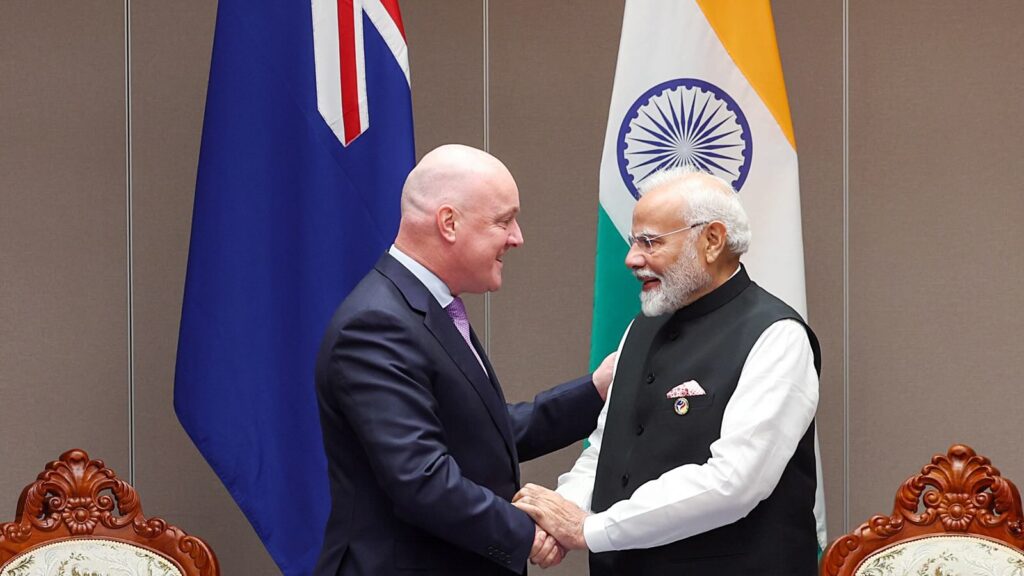
Momentum returned in March 2025 when New Zealand Prime Minister Christopher Luxon visited India and relaunched negotiations with a clear political mandate to conclude a deal quickly. Officials on both sides described the pace of talks as exceptional, driven by strategic urgency rather than incremental bargaining.
What the Agreement Actually Delivers
The India New Zealand FTA covers goods, services, investment, and labour mobility. For New Zealand exporters, the agreement provides tariff elimination or reductions on approximately 95 percent of exports to India. More than half of these goods will become duty-free immediately, benefiting sectors such as sheep meat, wool, coal, and horticulture.
India, in return, secures zero-duty access for all its goods exports to the New Zealand market. This asymmetry has become the most controversial aspect of the deal. India’s dairy tariffs, which protect a sector worth tens of billions of dollars annually, remain largely untouched. While negotiators describe this as a pragmatic compromise, critics argue it undermines the agreement’s claim to reciprocity.
The deal also includes expanded visa access, post-study work rights, and labour mobility provisions for Indian nationals. These concessions are more generous than those offered under New Zealand’s recent agreements with Australia and the United Kingdom, adding another layer of domestic sensitivity.
Does New Zealand Really Have a Working Coalition Government?
Yes, New Zealand is governed by a coalition, and this fact is central to understanding the current dispute. Following the October 2023 general election, no single party secured a parliamentary majority under the country’s Mixed Member Proportional electoral system. As a result, the National Party formed what is known as the Sixth National Government through a three-party coalition.
The coalition comprises the National Party, ACT New Zealand, and New Zealand First. Each party retains its own leadership, policy identity, and voter base. Importantly, coalition agreements in New Zealand often include provisions allowing partners to publicly disagree on non-core issues without triggering a collapse of the government. This arrangement is designed to preserve stability while acknowledging ideological differences.
However, such agreements do not eliminate tension. They merely manage it.
New Zealand First’s Revolt from Within
The India New Zealand FTA has become a flashpoint precisely because it touches on issues central to New Zealand First’s political identity. Party leader Winston Peters, who also serves as Deputy Prime Minister and Foreign Minister, has openly criticised the agreement, describing it as unfair to New Zealand farmers and inconsistent with national interest.
New Zealand First argues that granting India full market access while failing to secure meaningful dairy concessions creates an imbalance. The party has also raised concerns about immigration provisions, claiming they risk undermining local employment and domestic control over labour policy.
Crucially, New Zealand First has signalled its intention to vote against the legislation required to implement the agreement. While this does not automatically bring down the government, it complicates the ratification process and exposes the limits of coalition discipline.
Implications for Ratification and Regional Strategy
The National Party maintains that the India New Zealand FTA fulfils an election commitment to expand trade and diversify economic partnerships. If New Zealand First withholds support, the government may need to rely on opposition parties to pass the implementing legislation, an outcome that would underline the fragile nature of the coalition.
For India, the agreement aligns with a broader strategy of expanding trade ties across the Indo-Pacific while protecting sensitive domestic sectors. For New Zealand, the deal offers long-term access to a vast and growing market but at the cost of short-term political friction.
As the formal signing approaches in 2026, the fate of the India New Zealand FTA will depend not only on economic logic but also on the durability of coalition governance itself. The episode serves as a reminder that in proportional systems, international agreements are negotiated not just across borders, but within governments as well.