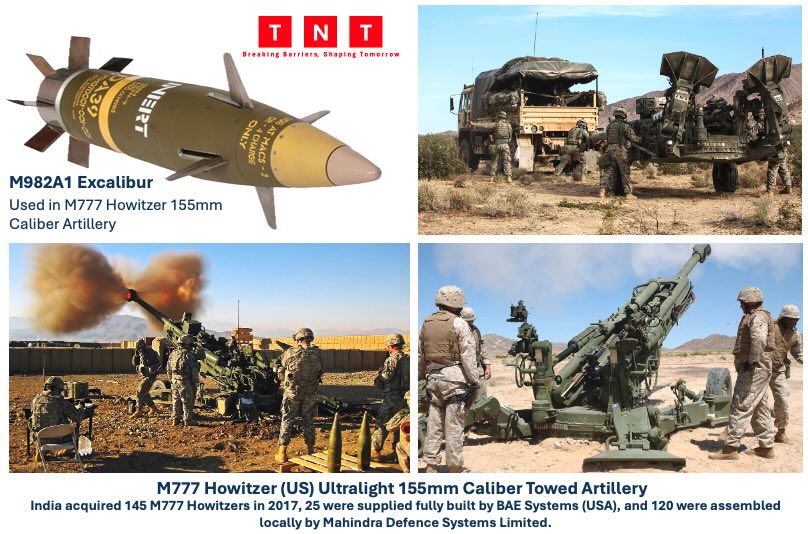
India’s Excalibur Artillery: Precision for Counter-Terrorism
India’s Excalibur Decision: Why New Delhi Is Paying for Precision, Not Volume
Nearly six weeks after the United States approved the sale of precision-guided M982A1 Excalibur artillery to India, the conversation around the decision has shifted from procurement headlines to deeper institutional questions. Why did India opt for one of the world’s most expensive artillery rounds? What domestic signals does this purchase send to India’s own defence ecosystem? And what does it reveal about how the Indian Army now visualises the next land conflict?
Unlike the Javelin missile clearance, which addressed an immediate infantry-level capability gap, the Excalibur artillery approval strikes at the core of India’s artillery doctrine, long built around massed firepower. This is not merely a weapons acquisition. It is a statement of intent—about precision, survivability, and the limits of attrition-based warfare in India’s future battle-spaces.
Excalibur Artillery: From American Experiment to Global Benchmark
The M982 Excalibur was born out of the US Army’s post-Cold War reassessment of artillery effectiveness. Conventional shells were accurate only in aggregate; destroying a point target often required dozens of rounds, prolonged firing, and high exposure to counter-battery fire.
Excalibur inverted that logic. Developed as a GPS-guided 155 mm projectile, it offered near-missile accuracy from standard howitzers. Early combat use in Iraq and Afghanistan demonstrated what doctrine papers could not—one-round, one-target engagement, even in complex terrain.
Over successive upgrades, culminating in the M982A1 variant, Excalibur evolved into a mature, combat-proven system with a circular error probable under five metres and ranges exceeding 40 kilometres. It is not designed for saturation. It is designed for decisive strikes on high-value targets—command nodes, hardened positions, bridges, and logistics hubs.
For India, this distinction matters.
Why India Chose an Expensive Solution—Deliberately
Excalibur’s cost—often cited as USD 70,000–100,000 per round—has drawn predictable criticism. But cost per shell is the wrong metric. India’s choice reflects four hard operational realities, not indulgence.
First, terrain economics. Along the Line of Actual Control, logistics dominate combat math. Every additional shell hauled to high altitude exacts a cost in time, manpower, and vulnerability. One Excalibur artillery round replacing 30–40 conventional shells is not expensive—it is efficient.
Second, counter-battery survivability. China’s artillery units are increasingly integrated with counter-battery radars, drones, and long-range precision fires. Prolonged fire missions invite retaliation. Excalibur allows “fire, displace, survive” in minutes, not hours.
Third, political and escalation control. Precision limits collateral damage. In limited conflicts or standoffs, the ability to neutralise targets without flattening areas provides New Delhi with military options below the escalation threshold—something massed fire cannot offer.
Fourth, integration with networked warfare. Excalibur fits seamlessly into India’s growing ISR architecture—UAVs, satellites, and battlefield management systems. Conventional shells do not exploit this networked advantage; precision rounds do.
Fifth, training and doctrinal transition. Limited induction allows the Army to develop precision-fire doctrine without immediately overhauling its entire ammunition ecosystem.
India did not buy Excalibur to replace conventional artillery. It bought it to change how artillery is used.
The Counter-Terrorism Use Case Conventional Artillery Cannot Solve
Consider a realistic operational scenario along the Line of Control. Intelligence identifies a terrorist launch pad or hideout located 40 to 50 kilometres across the LoC—well within artillery range, but outside the envelope where infantry or special forces insertion is viable without escalation risk.
Using conventional artillery shells in such a case is inherently flawed. Even with multiple rounds fired, the probability of a direct hit remains uncertain. Misses are not merely tactical failures; they are strategic ones. The first inaccurate round alerts the target, allowing militants to disperse, relocate, or take shelter. Simultaneously, the firing signature alerts Pakistani artillery units, inviting counter-battery fire or forcing Indian guns to displace prematurely. The entire intelligence cycle—surveillance, confirmation, planning—collapses in seconds due to inaccuracy.
Indigenous “smart” or course-corrected shells marginally improve dispersion but still lack the single-round certaintyrequired for time-sensitive counter-terror operations. They reduce error; they do not eliminate it.
At this point, India’s alternatives escalate rapidly. A BrahMos strike delivers near-perfect accuracy but carries an unmistakable strategic signature—radar tracks, satellite observation, international attention, and political signalling that far exceeds the tactical objective. Airstrikes introduce even higher escalation thresholds, require multi-layered clearances, risk pilot exposure, and guarantee global scrutiny.
This is where Excalibur occupies a critical middle ground.
With BrahMos like accuracy and a conventional artillery signature, Excalibur allows India to neutralise such targets quietly, quickly, and proportionately. A single shell, fired from Indian territory, can destroy a fixed terrorist target without prolonged firing, without airspace violation, and without triggering the diplomatic and military ripples associated with missile or air power.
In cost terms, the comparison is equally stark. An Excalibur round, though expensive by artillery standards, is a fraction of the cost of a BrahMos missile or a full airstrike package. More importantly, it preserves escalation control—an increasingly valuable currency in sub-conventional conflict.
In this context, Excalibur is not an artillery upgrade. It is a counter-terror precision strike option that fills a gap no other Indian system currently addresses with the same discretion.
Domestic Strategic Ripples: Signals to Industry and Institutions
The Excalibur decision sends uncomfortable but necessary signals within India.
To the domestic defence industry, it underscores that precision remains a gap. Indigenous programmes have made progress in guns, rockets, and sensors, but not yet in mature, mass-produced precision artillery ammunition. Imports, in this context, are a bridge—not a betrayal.
To the Army itself, the message is doctrinal. Precision is no longer an adjunct; it is a core capability. Artillery officers trained on volume-centric thinking will need to adapt to effects-based targeting.
To policymakers, the purchase reinforces a hard truth: indigenisation without operational credibility risks battlefield irrelevance. Selective imports remain necessary where domestic timelines lag operational need.
What Alternatives Existed—and Why They Fell Short
India did not lack alternatives.
Indigenous guided artillery concepts exist, but none are yet operationally mature at Excalibur’s level of accuracy and reliability. Rocket-based systems like Pinaka offer reach and volume but lack gun-fired precision and flexibility in constrained terrain.
Foreign alternatives, including Russian Krasnopol laser-guided rounds, impose dependence on continuous target illumination—dangerous in drone-saturated environments and less reliable in adverse weather.
Excalibur’s fire-and-forget GPS guidance, combined with platform compatibility, made it the least risky precision option, not the most glamorous one.
Precision Versus Volume: India, Pakistan, and China
Pakistan remains committed to volume-centric artillery backed by limited precision augmentation. This doctrine works defensively but struggles against a networked opponent capable of rapid counter-battery action.
China is closer to India’s thinking, fielding Beidou-guided artillery rounds and long-range precision fires. However, China compensates with scale. India compensates with selective precision.
Excalibur does not neutralise numerical disadvantages—but it narrows decision windows and raises the cost of enemy exposure.
Excalibur as a Bridge to the Post-M777 Era
Excalibur’s relevance extends beyond ammunition. It shapes the debate on future artillery platforms.
Ultra-light and light-weight howitzers after the M777 will not be judged merely on range or mobility. Their value will lie in how efficiently they deliver precision effects in difficult terrain.
Excalibur establishes that benchmark. The next artillery platform discussion—imported or indigenous—will revolve around precision compatibility, rapid deployment, and network integration, not just barrel length.
This transition deserves a dedicated examination and will be addressed separately.
What India Still Must Fix
Excalibur solves nothing permanently.
India must develop indigenous ‘precision artillery ammunition’ at scale. Dependence on imported rounds is untenable in a prolonged conflict.
Sensor-to-shooter integration must move down to battalion and battery levels, not remain a high-command capability.
Finally, doctrine must clearly define when precision replaces volume—and when it does not. Precision without doctrinal clarity risks misuse as much as underuse.
Paying for Precision Is Paying for Time
India’s Excalibur decision is not about buying accuracy. It is about buying time, survivability, and options in a battlespace that no longer tolerates prolonged exposure.
In modern war, volume compensates for uncertainty. Precision eliminates it.
Excalibur signals that India understands this shift—and is willing to pay for it, selectively, deliberately, and with eyes open.