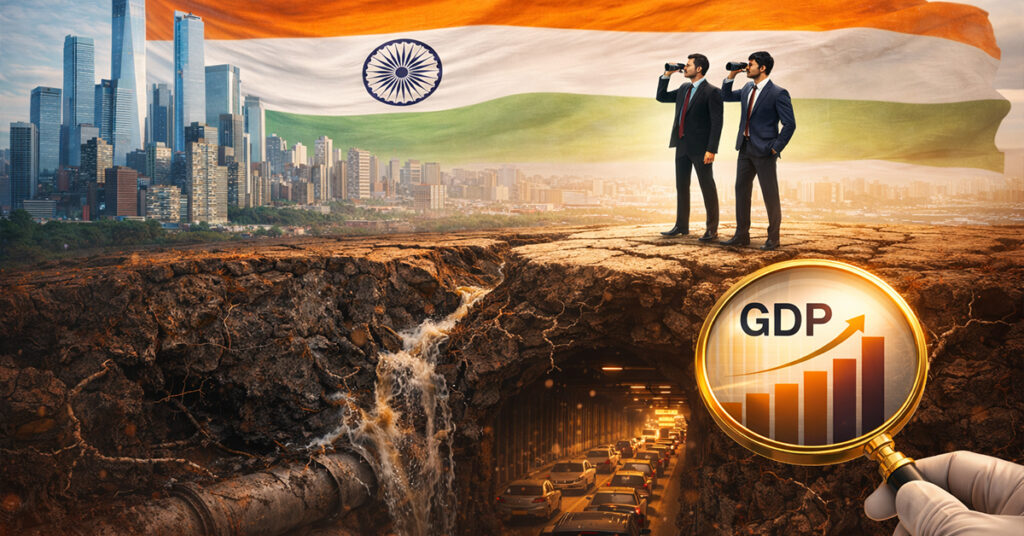
India’s rapid growth hides structural challenges
India’s economy has drawn global attention for its impressive growth numbers. From outperforming major economies to becoming a preferred destination for investment, the country is often described as the fastest-growing large economy in the world. Yet behind these headline figures lies a more complex reality—one that includes unresolved structural challenges, uneven development, and long-term risks that could shape India’s economic trajectory in the years ahead.
While growth has been strong on paper, sustaining it requires confronting issues that do not always show up in quarterly GDP data.
Also read: India Unveils Indigenous Hypersonic Anti-Ship Missile at Republic Day Parade
A Growth Narrative That Commands Global Attention
India’s economic expansion has been driven by a combination of domestic consumption, public infrastructure spending, digital transformation, and a growing services sector. Manufacturing incentives, rising exports in select industries, and strong performance in areas like technology and finance have reinforced optimism.
For global investors seeking alternatives to slowing economies elsewhere, India appears well-positioned. Stable institutions, a large workforce, and improving ease of doing business have strengthened confidence. However, growth driven by momentum alone is rarely enough to ensure long-term prosperity.
Also Read: Sharp Sell-Off Hits South Indian Bank Shares: What Triggered the Sudden Market Shock?
Uneven Growth Across Sectors and Regions
One of the most pressing challenges lies in uneven growth distribution. While urban centers and service-heavy industries thrive, rural regions and traditional sectors often struggle to keep pace. Agriculture, which still supports a significant portion of the population, remains vulnerable to climate risks, productivity gaps, and income instability.
This imbalance creates a widening gap between regions, potentially limiting consumption growth and social stability. Sustainable economic progress requires broader participation, not just concentrated success.
Also Read: UGC Equity Regulations 2026 Trigger Government Review as Supreme Court Challenge Intensifies
Employment: The Growth-Job Mismatch
Despite rapid economic expansion, job creation has not kept pace with workforce growth. Many new jobs are informal, low-paying, or lack long-term security. High-skilled sectors flourish, but opportunities for semi-skilled and low-skilled workers remain limited.
This mismatch raises concerns about whether growth is truly inclusive. A young population can be an advantage, but only if the economy generates sufficient, quality employment to absorb new entrants into the workforce.
Also Read: Precious Metals Remain in the Spotlight: Why Gold and Silver Are Holding Their Shine
Manufacturing Ambitions Face Structural Barriers
India has made manufacturing a central pillar of its growth strategy, aiming to become a global production hub. While progress has been made, structural barriers persist. High logistics costs, regulatory complexity, and skill mismatches continue to affect competitiveness.
In comparison to established manufacturing giants, India must still improve supply chains, invest in workforce training, and reduce bureaucratic friction to translate ambition into durable results.
Also Read: Industrial Momentum Strengthens: December Output Growth Touches a 26-Month Peak
Consumption Strength Masks Income Stress
Consumption has played a major role in supporting growth, but it increasingly relies on a narrow base. Middle- and upper-income households drive spending, while lower-income groups face pressure from inflation, rising living costs, and limited wage growth.
If consumption becomes overly dependent on debt or government support, it may lose momentum. Long-term growth depends on rising real incomes across a broader population base.
Also Read: Indian Stock Market Rally As EU Deal Fuels Market Optimism
Fiscal Pressure and Public Spending Limits
Public investment in infrastructure has been a growth catalyst, improving roads, railways, and digital connectivity. However, sustained high public spending places pressure on fiscal balances.
As global financial conditions tighten, managing debt while continuing development spending becomes more challenging. Balancing fiscal discipline with growth needs will test policymakers in the coming years.
Also Read: Gold Breaks $5,200 as Global Uncertainty Drives Historic Safe-Haven Rush
External Risks and Global Uncertainty
India’s growth does not exist in isolation. Global slowdowns, geopolitical tensions, and volatile commodity prices pose external risks. While India has shown resilience, exports and capital flows remain sensitive to global trends.
Energy dependence and trade disruptions can quickly affect inflation and currency stability, influencing domestic economic conditions.
Productivity and Education Gaps
Long-term growth depends on productivity gains, which in turn rely on education, health, and skill development. While India has made progress in digital inclusion and higher education, learning outcomes and workforce readiness remain uneven.
Bridging this gap requires sustained investment in human capital—not just infrastructure and technology.
Governance and Reform Momentum
Economic reforms have played a key role in India’s growth story, but reform momentum must continue. Simplifying regulations, improving judicial efficiency, and strengthening institutional capacity are essential to maintaining investor confidence.
Reforms often yield results gradually, and political cycles can influence their pace and direction.
Conclusion: Growth With Guardrails
India’s world-beating growth is real and significant, but it is not immune to structural challenges. Sustaining momentum will require addressing employment gaps, inequality, productivity constraints, and fiscal pressures—while navigating global uncertainty.
The true test of India’s economic success will not be how fast it grows in a single year, but how well that growth translates into stable jobs, rising incomes, and shared prosperity over time.
FAQs
Q1. Why is India considered the fastest-growing major economy?
India’s strong domestic demand, public investment, and services sector growth have helped it outperform many global peers.
Q2. What are the biggest risks to India’s growth story?
Uneven job creation, income inequality, fiscal pressure, and global economic uncertainty pose key risks.
Q3. Is India’s growth inclusive?
Growth has been uneven, with urban and high-skill sectors benefiting more than rural and low-income groups.
Q4. How important is manufacturing for India’s future growth?
Manufacturing is critical for job creation and export competitiveness but faces structural challenges.
Q5. Can India sustain high growth in the long term?
Sustainability depends on continued reforms, human capital investment, and balanced development across sectors and regions.