India-Brazil Ties Boost: Strategic Partnership Deepens with Critical Minerals Deal and Ambitious $20 Billion Trade Target
February 21, 2026 | New Delhi
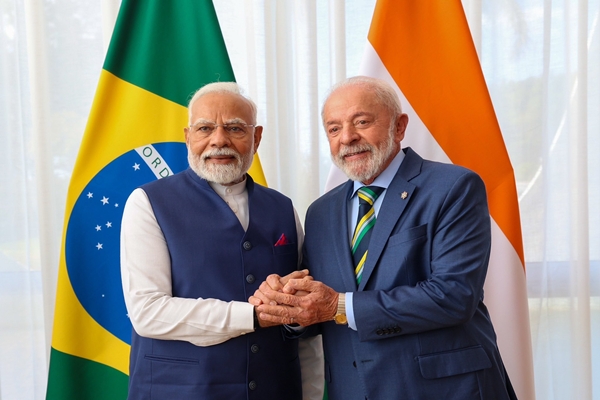
India-Brazil strategic partnership relations received a major boost on February 21, 2026, with the signing of a landmark agreement on critical minerals and rare earths. The pact was finalised during high-level talks between Prime Minister Narendra Modi and Brazilian President Luiz Inácio Lula da Silva in New Delhi.
The two leaders also set an ambitious target to raise bilateral trade beyond $20 billion within the next five years. The agreements were concluded during President Lula’s state visit to India from February 18 to 22, 2026.
The visit included his participation in the India AI Impact Summit 2026 and the India-Brazil Business Forum, reflecting growing alignment between two leading democracies of the Global South.
Landmark Agreements Signed During High-Level Talks
The centrepiece of the bilateral engagement was the Memorandum of Understanding on cooperation in critical minerals and rare earth elements. The agreement is aimed at strengthening India’s access to essential raw materials for electronics, steel, electric vehicles, and clean energy technologies.
Officials noted that the pact would reduce over-dependence on dominant global suppliers, particularly China, and enhance supply chain resilience.
Prime Minister Modi described the agreement as a major step towards building secure and diversified industrial ecosystems. President Lula highlighted renewable energy and mineral cooperation as pillars of sustainable development.
Several additional MoUs were exchanged during the visit, covering:
Digital partnership in artificial intelligence, semiconductors, blockchain, and digital public infrastructure
Cooperation in pharmaceuticals, health regulation, MSMEs, and postal services
Collaboration in defence, agriculture, and traditional knowledge systems
These agreements build on earlier cooperation frameworks, including MoUs signed during PM Modi’s 2025 visit to Brazil.
Expanding Trade and Economic Engagement
Bilateral trade between India and Brazil reached approximately $15 billion in 2025, representing a growth of nearly 25 percent over the previous year. Brazil remains India’s largest trading partner in Latin America.
Key Indian imports include crude oil, sugar, vegetable oils, and cotton. Meanwhile, Brazilian exports to India are expected to expand further in poultry and agricultural products.
Both leaders committed to pushing trade well beyond $20 billion within five years. Long-term projections discussed during the visit indicated potential for even higher volumes.
The India-Brazil Business Forum 2026, attended by nearly 300 Brazilian business leaders, reinforced private-sector participation in this expansion. The opening of the first office of ApexBrasil in New Delhi further strengthened institutional support for trade.
Discussions also explored upgrading the India-MERCOSUR preferential trade agreement.
Leadership and Diplomatic Engagement
High-level political engagement played a central role in advancing bilateral ties.
President Lula emphasised moving “from vision to action” in the strategic partnership established in 2006. He stressed the importance of joint leadership among Global South nations.
Prime Minister Modi highlighted cooperation in supercomputing, climate action, and digital innovation as key pillars of the relationship.
The visiting delegation received a ceremonial welcome at Rashtrapati Bhavan, hosted by President Droupadi Murmu. Delegation-level talks further reinforced mutual trust and diplomatic warmth.
Strategic and Global Context of the Partnership
The visit coincided with the twentieth anniversary of the India-Brazil Strategic Partnership. Over two decades, cooperation has expanded across defence, energy transition, biotechnology, space research, and food security.
Both countries are founding members of the BRICS grouping and co-founders of the Global Biofuel Alliance.
Brazil is set to hand over the BRICS presidency to India in 2026, further strengthening multilateral coordination.
The critical minerals pact complements India’s parallel engagements with the United States and the European Union, positioning New Delhi as a key player in global supply chain restructuring.
Implications for Technology and Renewable Energy Cooperation
The new agreements are expected to accelerate joint projects in renewable energy, battery manufacturing, and electric mobility. Brazil’s mineral reserves and India’s manufacturing capacity create natural complementarities.
Technology cooperation in artificial intelligence, digital governance, and fintech also reflects shared priorities in inclusive development.
Officials indicated that joint research programmes and startup exchanges would be expanded under the new digital partnership framework.
Looking Ahead: Strengthening the Global South Partnership
As India and Brazil deepen their engagement, the focus remains on resilient, sustainable, and equitable growth. The emphasis on critical minerals, clean energy, and digital infrastructure positions the partnership for long-term relevance.
Trade targets, institutional mechanisms, and political commitment suggest strong momentum in bilateral relations.
With multiple agreements in place and strategic convergence growing, the India-Brazil partnership is poised to play an influential role in shaping a multipolar world order centred on the Global South.
Readers can follow further developments on @TattvamNews as cooperation between the two nations continues to evolve.