India Bangladesh Visa Suspension Highlights Growing Tensions After Hadi Death Protests
The India Bangladesh visa suspension following violent protests in Dhaka and Chattogram is not an isolated consular dispute. Instead, it reflects a deeper structural stress in India’s neighbourhood policy, where domestic political turbulence in neighbouring states increasingly spills into bilateral relations.
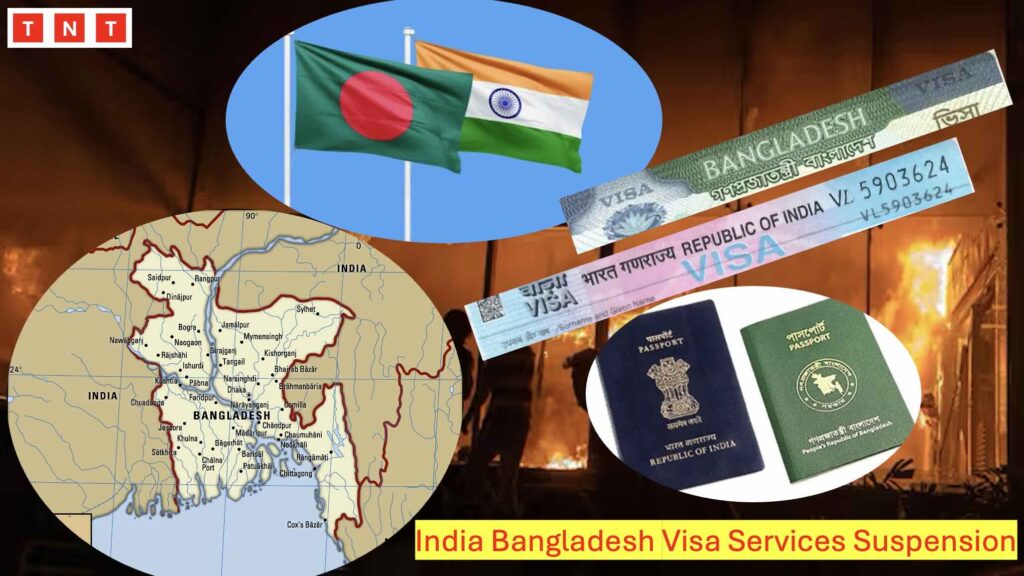
Bangladesh’s decision to temporarily halt visa and consular services for Indians in New Delhi, widely seen as a counter-move to India’s suspension of visa operations in Chattogram, comes at a moment of heightened instability in Dhaka. The unrest triggered by the death of youth leader Sharif Osman Hadi has pushed India–Bangladesh ties into unfamiliar territory, testing assumptions that the relationship remains insulated from street politics.
Domestic Unrest in Bangladesh and Its Diplomatic Spillover
Bangladesh’s current turbulence stems from unresolved political fault lines following the collapse of the Sheikh Hasina government. The protests after Hadi’s death exposed how quickly political mobilisation can turn violent and nationalist, especially when opposition narratives frame India as an external patron of the old regime.
Anti-India slogans, attacks on symbols of Indian presence and attempts to march towards diplomatic premises created a security environment that New Delhi could not ignore. India’s suspension of visa services in Chattogram was therefore less a diplomatic signal and more a risk-management decision aimed at protecting its personnel and missions.
However, Dhaka’s reciprocal move transformed a security-driven administrative step into a bilateral flashpoint, reinforcing the perception that domestic instability in Bangladesh now has direct foreign policy consequences.
From “Model Neighbour” to Vulnerable Partner
For over a decade, Bangladesh was held up in New Delhi as a success story of India’s neighbourhood diplomacy. Cooperation on counter-terrorism, connectivity, energy trade and river water management created a sense of strategic comfort.
That comfort rested heavily on political continuity in Dhaka. With that continuity broken, India is confronting a familiar problem across South Asia: relationships built on elite alignment struggle when power shifts or streets mobilise.
The India Bangladesh visa suspension exposes how quickly goodwill can erode when interim or unstable governments face pressure to demonstrate political distance from New Delhi. Visa policy becomes an easy instrument for signalling sovereignty, even when it disrupts ordinary citizens more than decision-makers.
Limits of India’s Non-Interference Doctrine
India’s neighbourhood policy has long balanced engagement with a stated principle of non-interference in domestic politics. The current Bangladesh crisis tests the limits of that approach.
New Delhi cannot openly shape Dhaka’s internal political outcomes. At the same time, it cannot remain indifferent when unrest directly threatens Indian missions, minorities or economic interests. The visa suspension episode shows how security concerns now force India into reactive postures rather than strategic ones.
This reactive stance carries costs. Each suspension, even when justified, feeds narratives in neighbouring countries that India uses mobility and access as leverage. Over time, such perceptions weaken India’s soft power and complicate people-to-people ties that underpin long-term influence.
Implications for Act East and Regional Connectivity
Bangladesh occupies a central position in India’s Act East policy, serving as a bridge between the Indian mainland, the Northeast and Southeast Asia. Disruptions in visa services, even temporarily, affect more than tourism.
Medical travel, educational exchanges, business delegations and cross-border trade networks all depend on predictable consular systems. When these systems become collateral damage in political crises, India’s broader regional integration goals suffer.
The India Bangladesh visa suspension therefore raises a strategic question: how resilient is India’s regional vision when it depends so heavily on domestic stability in partner countries?
A Pattern Across India’s Neighbourhood
Bangladesh is not an isolated case. Similar dynamics have played out in Sri Lanka, Nepal and the Maldives, where domestic political shifts have repeatedly recalibrated attitudes towards India.
In each instance, India’s challenge remains the same. It must protect immediate interests without appearing coercive. It must engage new power centres without abandoning long-standing partnerships. Most importantly, it must prepare for volatility as a structural feature of its neighbourhood rather than a temporary disruption.
The current episode reinforces the need for India to diversify its engagement beyond ruling elites, strengthening institutional, cultural and economic links that can survive political transitions.
What This Means Going Forward
Diplomatic signals from both sides suggest that the visa freeze is temporary. However, the deeper issues will persist long after consular services resume.
For India, the lesson is clear. Neighbourhood policy cannot rely solely on stability assumptions. It must factor in protest politics, identity mobilisation and rapid shifts in public sentiment amplified by social media.
For Bangladesh, prolonged disruption risks undermining its own economic and social interests, especially given the scale of medical, educational and commercial engagement with India.
The India Bangladesh visa suspension is therefore best understood not as a tit-for-tat episode, but as a warning. In South Asia’s volatile political landscape, diplomacy is increasingly shaped by streets as much as by statecraft.