From Liberation to Tensions: The Historical Journey of India–Bangladesh Relations
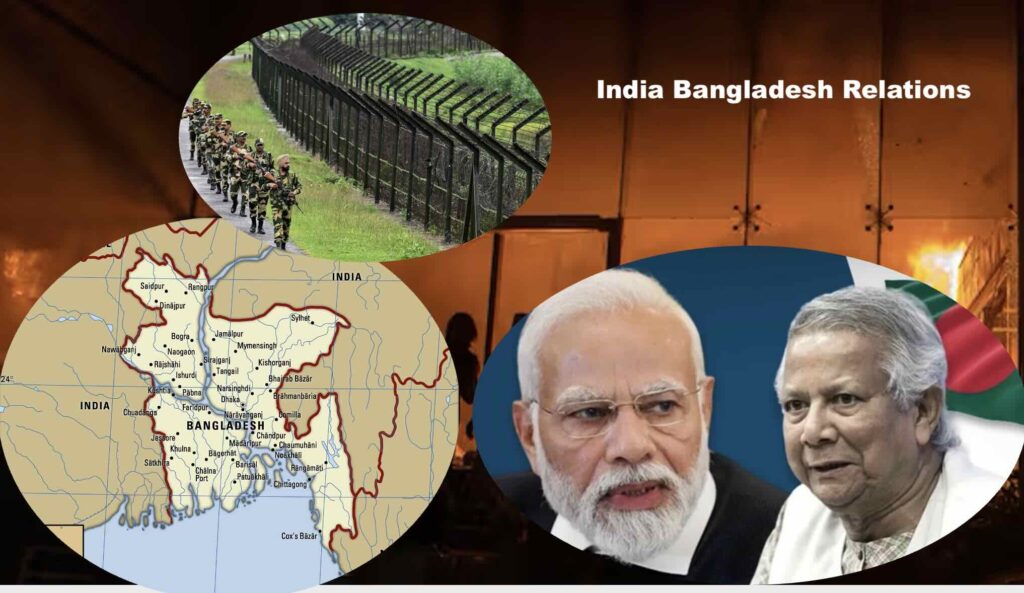
India and Bangladesh share a relationship forged in war, displacement, and sacrifice. Yet more than five decades after Bangladesh’s independence, the emotional and political foundations of that relationship appear increasingly fragile. Public discourse in Bangladesh now frequently frames India as an overbearing neighbour rather than a decisive ally. This shift did not occur overnight. It is the outcome of a long historical process in which memory fractured, ideology intruded, and politics gradually detached itself from the circumstances of Bangladesh’s birth.
Understanding today’s tensions requires revisiting 1971 not as nostalgia, but as context.
The War That Created a Nation
The decisive rupture came in December 1971. After months of humanitarian collapse in East Pakistan, Pakistan launched pre-emptive air strikes on Indian airfields on 3 December. India responded by formally entering the conflict in support of the Bengali liberation movement.
Indian forces, working alongside the Mukti Bahini, advanced rapidly across East Pakistan. The campaign was swift and decisive. Within thirteen days, Indian troops encircled Dhaka. On 16 December 1971, Pakistani General A.A.K. Niazi signed the Instrument of Surrender before Indian General Jagjit Singh Aurora. Bangladesh emerged as an independent state.
India’s intervention was not cost-free. Nearly 4,000 Indian soldiers were killed, with thousands more wounded. The war diverted scarce economic resources and placed heavy strain on a developing economy. Yet New Delhi chose intervention over neutrality, convinced that continued inaction would enable mass atrocities on its eastern frontier.
Restraint After Victory: POWs, Diplomacy, and Moral Capital
Victory gave India extraordinary leverage. Nearly 93,000 Pakistani soldiers and officials were taken prisoner, marking one of the largest surrenders since the Second World War. India could have pursued retribution. It did not.
Instead, New Delhi held the prisoners in accordance with the Geneva Conventions. It refrained from prosecuting hundreds accused of war crimes. Through the 1972 Simla Agreement, India negotiated their repatriation and facilitated Pakistan’s eventual recognition of Bangladesh.
This restraint was strategic and moral. India sought regional stability, not humiliation. In doing so, it invested heavily in a future relationship built on goodwill rather than fear.
The Refugee Crisis and India’s Humanitarian Burden
Before the war, the humanitarian collapse had already reached staggering proportions. Pakistan’s Operation Searchlight, launched in March 1971, unleashed systematic violence across East Pakistan. Civilian deaths are estimated between 300,000 and three million. Entire communities fled.
Nearly ten million refugees crossed into India, most of them Hindus and other minorities. India established dozens of camps, providing food, medical care, and shelter despite limited resources. The financial burden on exceeded USD 700 million in 1971–72 alone, a significant sum for India at the time.
After independence, India extended reconstruction aid to Bangladesh, emerging as one of its earliest and largest supporters. These efforts were not symbolic. They were foundational.
1975: The Moment Bangladesh’s Founding Story Began to Fracture
The continuity of 1971 did not survive the decade. On 15 August 1975, Sheikh Mujibur Rahman, Bangladesh’s founding leader, was assassinated in a military coup. Most of his family was killed with him. Only his daughters, Sheikh Hasina and Sheikh Rehana, survived because they were abroad.
The assassination marked more than a change in leadership. It ruptured Bangladesh’s ideological trajectory. Military regimes that followed diluted secular principles and gradually rehabilitated political forces that had opposed independence. History became contested terrain.
India’s role in 1971 began to recede from official memory, replaced by nationalist narratives that emphasised sovereignty over solidarity.
From Ideological Drift to Anti-India Narratives
Over time, this ideological drift hardened. Islamist groups regained legitimacy. Political Islam expanded its influence within state and society. India, once a partner in liberation, was increasingly portrayed as a Hindu majoritarian threat.
Disputes over water sharing, border management, and trade provided fertile ground. Radical groups reframed pragmatic disagreements as civilisational conflicts. The memory of 1971, with India as liberator, sat uneasily with these narratives.
Anti-India sentiment thus did not emerge spontaneously. It was cultivated, normalised, and politically rewarded.
Sheikh Hasina, Exile, and the Contest Over Memory
For much of the past two decades, Sheikh Hasina functioned as the most visible custodian of Bangladesh’s liberation legacy. Her government pursued close cooperation with India, cracked down on Islamist militancy, and reaffirmed secular constitutional principles.
Her removal in August 2024 disrupted this continuity. Seeking refuge in India, Hasina became both a political symbol and a diplomatic flashpoint. Calls for her extradition followed. India maintained that her presence was a humanitarian and legal matter governed by domestic law and international norms.
In Bangladesh, perceptions diverged sharply. Supporters viewed India’s stance as consistent with historical ties. Critics framed it as interference. Islamist groups weaponised the episode to reinforce anti-India sentiment.
Hasina’s Intervention from Exile
Against this backdrop, Hasina’s recent email interview with ANI marked a significant political intervention. She accused the interim government led by Muhammad Yunus of deliberately manufacturing hostility toward India. According to her, extremists empowered under the current arrangement had shaped foreign policy, undermined minority protections, and normalised street violence.
She described attacks on Indian diplomatic premises, media institutions, and religious minorities as symptoms of state abdication. India’s security concerns, she argued, were justified. Violence, she warned, had become routine, eroding Bangladesh’s credibility and alarming neighbours.
Hasina also criticised rhetoric targeting India’s Siliguri Corridor, calling it reckless and strategically illiterate. Bangladesh’s dependence on India for trade and connectivity made such posturing self-defeating. On Pakistan, she reiterated support for balanced relations but questioned an unelected government’s authority to realign foreign policy.
Why Anger Appears Organic—and Why It Is Not
Much of today’s anti-India sentiment in Bangladesh presents itself as organic. Economic grievances, periodic border enforcement incidents, and political uncertainty offer ready explanations for popular resentment. On the surface, this anger appears spontaneous, rooted in lived experience rather than orchestration.
Yet history suggests a more complex process at work. When a nation’s founding narrative weakens, ideological space opens for replacement. In Bangladesh, the gradual dilution of the secular and pluralist ethos that emerged from 1971 created conditions in which discontent could be reframed and redirected. Over time, resentment that might otherwise have remained diffuse acquired a sharper external focus.
This transformation did not occur in isolation. Political choices, shifts in education and public memory, and the rehabilitation of forces once opposed to independence steadily altered how India’s role was perceived. External actors may have amplified these trends at various moments, but they did not invent them. The groundwork had already been laid through years of selective remembrance and ideological repositioning.
India’s role in Bangladesh’s creation remains historically incontestable. What has changed is not the record itself, but how that record is recalled, interpreted, and mobilised in contemporary politics. As memory fractured, gratitude gave way to ambiguity, and ambiguity to suspicion.
The present tension, therefore, is not a repudiation of 1971. It is the consequence of forgetting why 1971 mattered—and of what was lost when that memory ceased to anchor the nation’s political imagination.