India at Zapad 2025: Strategic Autonomy or Crossing a Red Line with Russia-Belarus War Games?
Introduction
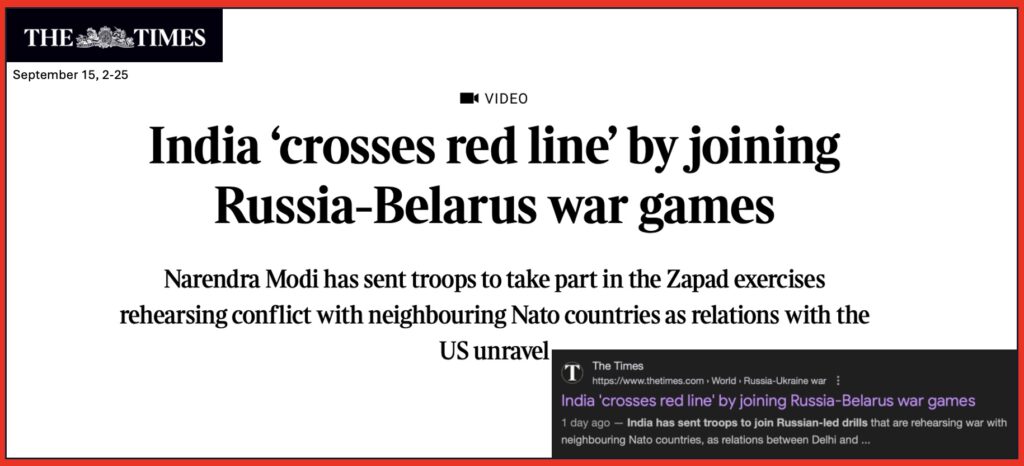
On September 16, 2025, The Times splashed a dramatic headline across its front page: “India Crosses Red Line by Joining Russia-Belarus War Games.” Within hours, the story ricocheted through Western media outlets, NATO briefings, and diplomatic circles, casting India’s participation in the Zapad 2025 military exercises as a dangerous tilt toward Moscow at the expense of its Western partnerships.
The framing was powerful, but was it accurate? By portraying India’s presence at Zapad 2025 as a geopolitical betrayal, the coverage amplified fears that New Delhi was abandoning its delicate balance of strategic autonomy. Yet the facts reveal a far more layered and pragmatic picture.
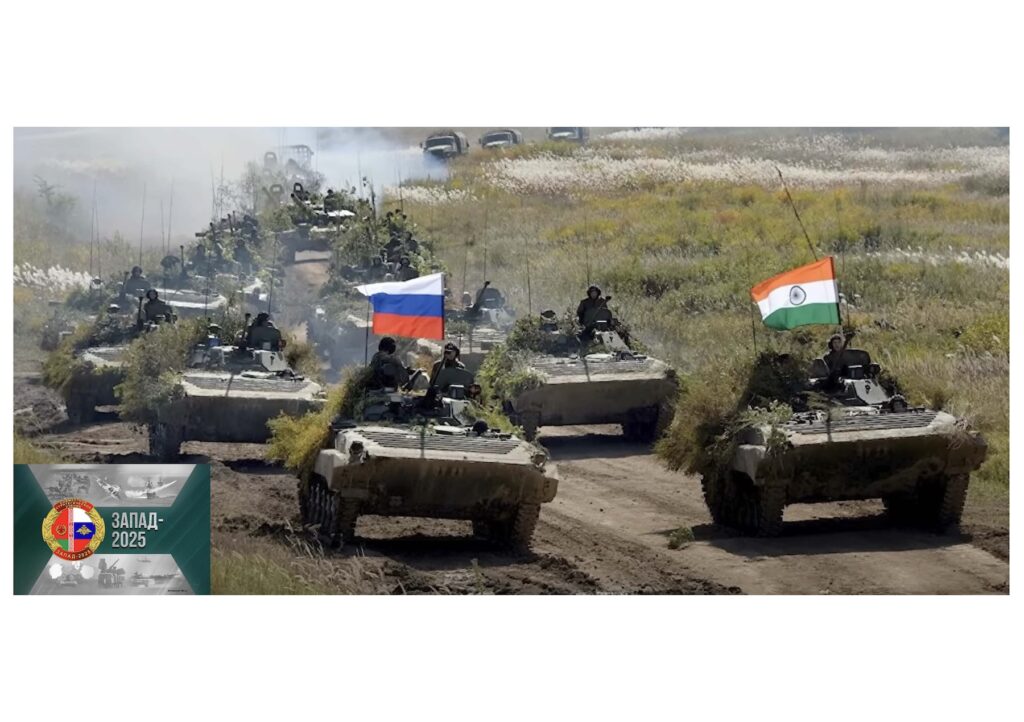
Zapad 2025 was not a Russia-only affair. It was a large-scale multinational drill featuring over 20 nations, including China, Pakistan, Bangladesh, Iran, and even NATO members like Germany, Turkey, and the United States as observers. India sent a 65-member tri-service team—not as a show of alignment with Russia, but as part of its broader defense engagement strategy, which also included exercises with the U.S. in Alaska and with Egypt in Exercise Bright Star during the same month.
So why then did the headline proclaim a “red line” had been crossed? Was this a genuine strategic concern, a media narrative designed for impact, or an example of journalistic failure that overlooks nuance?
What Was Zapad 2025?
Zapad (Russian for “West”) is a large-scale joint military exercise conducted by Russia and Belarus every four years. Zapad 2025 ran from September 12–16, 2025, focusing on:
Simulated conventional warfare near NATO borders
Missile strike drills
Deployment of nuclear-capable systems
Multinational troop coordination
This year’s edition included participation or observation by 20+ countries, among them:
India, China, Pakistan, Bangladesh, Iran
Central Asian and African nations
NATO members and observers: Germany, Turkey, and notably, the United States
India contributed a 65-member tri-service contingent, including the Kumaon Regiment, showcasing its professionalism without committing to political endorsement.
At the same time, India also joined Exercise Yudh Abhyas with the U.S. in Alaska and Exercise Bright Star in Egypt—evidence of its multi-aligned defence strategy.
Western Media’s “Red Line” Narrative
Western media headlines labeled India’s participation a “red line crossing.” Analysts suggested New Delhi was moving closer to Moscow and distancing itself from the West in the wake of the Ukraine conflict.
Several factors amplified this narrative:
Strained U.S.-India relations after years of trade disputes
NATO’s heightened anxiety about Russia’s military expansionism
Political signaling in Western journalism, where impactful headlines often overshadow nuance
The implication: India was siding with Russia and Belarus against the West—a framing that oversimplifies India’s global role.
NATO’s Reaction to Zapad 2025
NATO’s official response included:
Strengthening air defenses near its eastern borders
Issuing warnings of possible secondary sanctions for participants deemed too close to Moscow
Heightened monitoring of troop movements during the exercises
However, NATO’s presence as an observer in Zapad 2025 complicates the claim of a “red line.” If the U.S. and Germany could watch the drills firsthand, India’s limited contingent hardly signifies alignment with Russia’s geopolitical ambitions.
India’s Strategic Autonomy in Defense Diplomacy
For decades, India has pursued a doctrine of strategic autonomy—engaging with multiple powers without permanent alignment. Its defense diplomacy rests on three pillars:
Diversification of military ties – Partnering with Russia, the U.S., France, Israel, and others
Operational preparedness – Gaining exposure to diverse battle doctrines and technologies
Balancing global powers – Maintaining maneuverability in a multipolar world
By participating in Zapad 2025 alongside China, Pakistan, and the U.S. as observers, India demonstrated not loyalty to Russia but pragmatism in global military cooperation.
Journalism or Political Narrative?
The “red line” framing raises the question: is this responsible reporting or narrative-building?
Media Competitiveness: Headlines compete for global attention, often prioritizing impact over nuance
Simplification of Complexity: India’s multi-aligned diplomacy is reduced to a binary—“with us or against us”
Political Signaling: Stories echo NATO anxieties, reinforcing Western geopolitical perspectives
Such journalism risks misleading global audiences and fueling diplomatic misunderstandings.
Conclusion: Beyond Simplistic Narratives
India’s participation in Zapad 2025 was not a reckless gamble but a calculated demonstration of defense diplomacy. By engaging in Russia-Belarus war games while simultaneously joining U.S.-led and multinational exercises, India underscored its independence and multipolar engagement strategy.
The reality: India did not cross a red line—it reaffirmed its role as a pragmatic, pivotal actor in global geopolitics.
For journalism, the lesson is clear: avoid reductive headlines, embrace context, and respect complexity. Oversimplifying India’s choices only distorts reality and risks escalating tensions in an already fragile global order.