What Is the IMEC Trade Corridor? Full Route Breakdown, Lengths, and Sea–Land Segments
The IMEC Trade Corridor, formally known as the India–Middle East–Europe Economic Corridor, is a proposed multimodal connectivity project launched during the G20 Summit in New Delhi in September 2023. The initiative aims to connect India with Europe through the Middle East, using an integrated network of shipping routes, railways, highways, digital cables, electricity grids, and potential hydrogen pipelines.
The IMEC Trade Corridor seeks to reduce dependence on traditional maritime routes, especially those passing through the Suez Canal, while also offering an alternative to China’s Belt and Road Initiative. According to multiple projections, the corridor could cut transit time by up to 40 per cent and logistics costs by nearly 30 per cent for selected cargo categories.
Importantly, the project combines existing infrastructure with new construction, particularly across the Arabian Peninsula. Although still in development, the corridor gained renewed attention in 2026 following infrastructure agreements and port expansion initiatives in southern Europe.
Overall Structure of the IMEC Trade Corridor
The IMEC Trade Corridor operates through two interconnected segments that together form a continuous logistics chain between South Asia and Europe.
Eastern Maritime Corridor
The eastern section connects western Indian ports with major Gulf hubs through established sea lanes. This segment primarily links ports such as Mundra, Kandla, and JNPT with facilities in the United Arab Emirates and Saudi Arabia.
This maritime leg forms the foundation of IMEC, as it relies on mature shipping networks and modern port infrastructure. As a result, this section remains the most operationally reliable component of the corridor.
Northern Multimodal Corridor
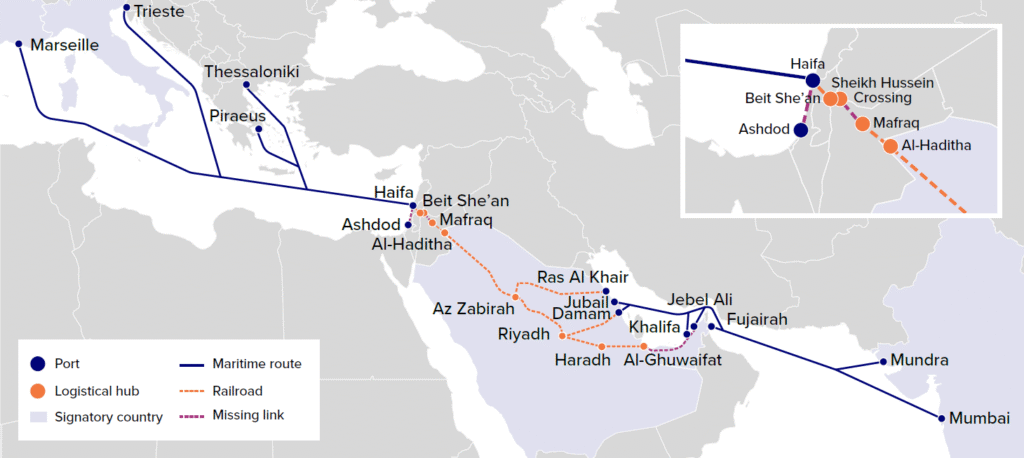
The northern section represents the core innovation of IMEC. It uses rail and road links to move cargo from Gulf ports across Saudi Arabia, Jordan, and Israel to Mediterranean terminals. From there, goods move by sea into southern Europe.
This “land bridge” shortens the traditional maritime loop via the Red Sea. Therefore, it plays a critical role in achieving time and cost efficiency.
Key Ports and Connectivity Hubs
The IMEC Trade Corridor integrates several strategic logistics centres across three continents.
In India, major gateways include Mundra, Kandla, and Jawaharlal Nehru Port near Mumbai. In the Gulf region, primary nodes are Jebel Ali, Fujairah, Khalifa Port, Dammam, Jubail, and Ras Al Khair.
In the Mediterranean zone, Haifa and Ashdod in Israel act as primary transfer points. From there, European ports such as Piraeus, Thessaloniki, Trieste, and Marseille compete to become the principal entry hub.
Notably, recent agreements between Indian port operators and European terminals have increased competition for handling IMEC-bound cargo.
Total Length and Sea–Land Distribution
The overall length of the IMEC Trade Corridor varies depending on route selection and final destination. However, most strategic assessments, including studies by the Atlantic Council, estimate the corridor at approximately 6,400 kilometres from western India to southern Europe.
Some alternate projections place the length between 4,800 and 7,200 kilometres, depending on port choices and inland alignments.
Maritime Segments
Sea routes account for roughly 2,500 to 4,500 kilometres of the corridor.
The eastern maritime leg between India and the Gulf measures around 1,500 to 2,500 kilometres. For example, the route from Mundra to Jebel Ali covers nearly 2,100 kilometres and typically takes five to six days.
The western maritime leg between the Mediterranean and European ports spans about 1,000 to 2,000 kilometres. Routes such as Haifa to Piraeus require approximately five days under normal conditions.
These segments rely on established shipping corridors, thereby reducing operational uncertainty.
Overland Land Bridge
The land component forms the backbone of IMEC’s time advantage. It spans approximately 2,600 to 2,800 kilometres and could exceed 3,000 kilometres when full connectivity is achieved.
The United Arab Emirates section extends around 400 to 600 kilometres. Saudi Arabia hosts the longest segment, ranging from 1,200 to 1,500 kilometres. Jordan contributes about 300 to 500 kilometres, while Israel completes the route with 100 to 300 kilometres of rail connectivity.
Once fully developed, this network is expected to enable cargo movement across West Asia within three to six days.
IMEC Trade Corridor vs Traditional Suez Route
The IMEC Trade Corridor was designed in response to repeated disruptions in the Red Sea and Suez region. Incidents such as the Ever Given blockage in 2021 and Houthi attacks during 2024–2026 highlighted the vulnerability of maritime chokepoints.
In terms of distance, IMEC reduces the journey to nearly 6,400 kilometres, compared with 11,000 to 12,000 kilometres via the full Suez route. Consequently, transit time could drop to 12–15 days, while traditional shipping often takes 20–25 days or more.
Cost estimates suggest that IMEC may reduce container transport expenses to around USD 3,000–4,000 per TEU. In contrast, Suez-based routes can exceed USD 5,500 per TEU due to canal fees, insurance premiums, and security surcharges.
However, IMEC introduces new risks. These include border tensions, infrastructure vulnerability, and coordination challenges. Meanwhile, the Suez route remains exposed to maritime piracy, weather disruptions, and political instability.
Strategic and Economic Benefits
The IMEC Trade Corridor offers multiple long-term advantages.
First, it diversifies trade routes and reduces dependence on fragile chokepoints. As a result, supply chains become more resilient.
Second, the corridor supports multidimensional connectivity. It integrates transport infrastructure with digital cables, renewable energy networks, and green hydrogen pipelines.
Third, IMEC strengthens geopolitical alignment among participating countries. It complements the India–EU trade agreement signed in January 2026 and reinforces economic partnerships.
Finally, large-scale infrastructure development across Saudi Arabia and Jordan is expected to generate employment and stimulate regional growth.
Encouraging Developments and Existing Assets Supporting IMEC
Despite geopolitical uncertainty and funding constraints, several existing assets and recent developments continue to strengthen the operational foundation of the IMEC Trade Corridor. These factors demonstrate that the corridor is evolving on the basis of functioning infrastructure rather than purely conceptual planning.
Port Infrastructure and Private Sector Support
A major strength of IMEC lies in the involvement of DP World through its flagship facility at Jebel Ali Port. As one of the world’s busiest container hubs, Jebel Ali offers high-capacity handling, advanced automation, and deep integration with global shipping networks.
Its role as a primary eastern gateway ensures efficient transshipment from Indian ports. In addition, DP World’s operational experience and financial capacity continue to attract private investment, improving IMEC’s commercial viability.
Rail and Road Connectivity Backbone
Progress in regional rail infrastructure has significantly improved IMEC’s overland readiness. The UAE’s Etihad Rail network, covering nearly 1,200 kilometres, has supported freight operations since 2023. Passenger services are being introduced in phases during 2026, connecting major urban and industrial centres.
At the same time, strong highway corridors already enable continuous trucking from UAE ports through Saudi Arabia to the Jordanian border. These routes cover approximately 2,000 to 2,500 kilometres and provide operational redundancy. They also serve as transitional platforms for future rail expansion.
Energy Hubs and Strategic Alignment
Energy and logistics resilience further support IMEC’s long-term prospects. The port city of Fujairah functions as a major energy hub, supported by large storage facilities and the Habshan–Fujairah pipeline, which bypasses the Strait of Hormuz. This infrastructure reduces exposure to maritime disruptions and enhances energy cargo security.
Diplomatic and commercial momentum has also increased. The India–EU Free Trade Agreement of January 2026 and the Adani–Marseille MoU of February 2026 reflect growing institutional confidence. Strategic initiatives promoted by Benjamin Netanyahu further indicate efforts to build coordinated security and connectivity frameworks. Existing GCC power and digital networks also align with IMEC’s broader objectives.
Challenges and Structural Constraints
Despite its promise, IMEC faces substantial hurdles.
Geopolitical instability remains the biggest obstacle. The Gaza conflict, Iran–US tensions, and regional rivalries have slowed progress on the northern corridor.
Infrastructure development in desert terrain presents engineering difficulties. Sand movement, extreme temperatures, and water scarcity significantly increase construction costs.
Funding also remains uncertain. Preliminary estimates suggest that trillions of dollars may be required over several decades, with financing gaps still unresolved.
Furthermore, overland transport is less cost-effective for bulk commodities. Therefore, IMEC may primarily serve high-value and time-sensitive cargo.
Official Timeline and Current Status
The IMEC Trade Corridor was formally announced in September 2023. By April 2025, construction began on selected logistics and rail segments.
During 2026, progress focused on maritime links and port upgrades. Key developments included the India–EU Free Trade Agreement in January and port cooperation agreements with France in February.
The GCC railway network, which forms a critical enabler, targets completion by 2030. Partial corridor operations may begin in the early 2030s, while full integration could take until 2040–2050 under stable conditions.
At present, the northern segment remains partially suspended due to regional tensions. Nevertheless, diplomatic engagement continues.
Strategic Outlook for the IMEC Trade Corridor
The IMEC Trade Corridor represents a fundamental shift in Eurasian connectivity planning. It combines maritime efficiency with inland speed to create a hybrid logistics system.
In practice, the project’s success depends on political stability, sustained investment, and regulatory coordination. While eastern maritime links are advancing steadily, the Saudi–Jordan–Israel land bridge remains the decisive factor.
For India and Europe, IMEC offers a long-term hedge against supply chain disruptions. For the Middle East, it provides an opportunity to reposition itself as a central logistics hub.
As infrastructure work continues and geopolitical conditions evolve, the corridor’s real-world impact will become clearer in the coming decade.
TNT’s IMEC Watch series will continue to track developments, financing patterns, and implementation milestones shaping this ambitious transcontinental corridor.