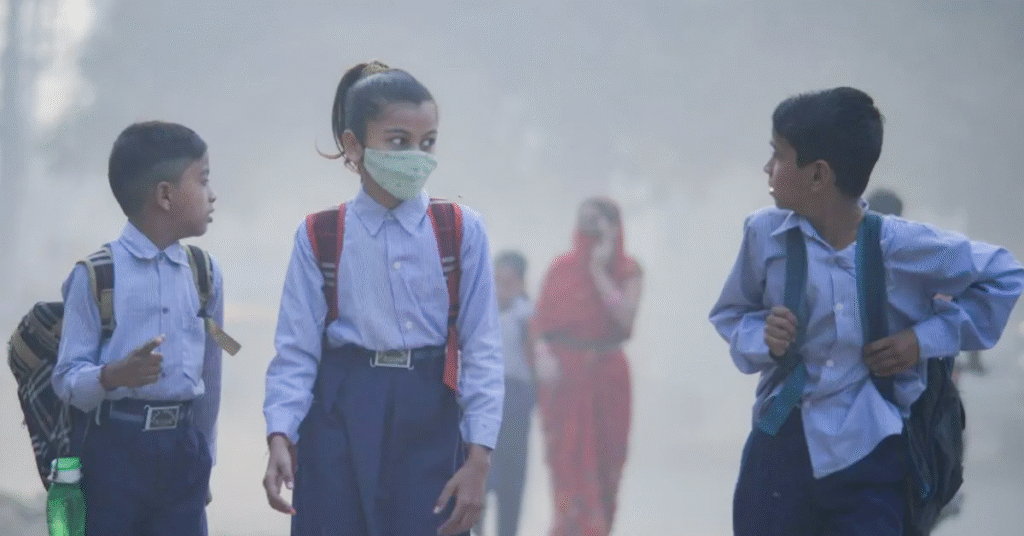
Hybrid Mode Returns at Delhi Schools as GRAP-3 Takes Effect Amid Severe Pollution
Delhi’s youngest learners will soon split their time between the classroom and home again. On Tuesday, the city’s Education Department directed all schools—government, aided and private—to adopt hybrid mode (both online and offline teaching) for students up to Class 5, effective immediately and until further notice. The step follows the invocation of Stage III of the Graded Response Action Plan (GRAP) by the Commission for Air Quality Management (CAQM), triggered as air pollution in Delhi-NCR deteriorated to the “severe” category.
This decision reflects both a precautionary response to health risks and a balancing act between educational continuity and environmental urgency.
Why This Move Happened
The air quality in Delhi has plunged sharply in recent days. Monitoring stations reported average Air Quality Indices (AQIs) jumping from the “very poor” to the “severe” category, thanks to stagnant winds, cooler temperatures, and a dense pollutant layer near the surface.
Under GRAP Stage III, authorities imposed a range of restrictions: suspension of major construction and demolition work, a ban on older diesel vehicles, increased road-sweeping, and the directive for schools to shift younger classes to hybrid mode.
Children in primary grades are especially vulnerable to air pollution—they breathe more air per kilogram of body weight, and their developing lungs absorb particulate matter more easily. Poor air also disrupts concentration, study routines and overall well-being. With these risks in mind, the hybrid model appears to offer a middle path: keep children learning while reducing their exposure to polluted outdoor air.
Also Read: Delhi-NCR Chokes as AQI Crosses 700: A Call to Breathe
What Hybrid Learning Will Look Like
From now on, children in classes I to V will experience a blend of online and in-person classes. Schools must inform parents swiftly about the change. According to the notification, the classroom component will continue “wherever feasible,” but virtual lessons will supplement when pollution spikes or outdoor exposure becomes unsafe.
Teachers will prepare schedules that indicate which days students attend physically and which days they join remotely. Schools are instructed to minimise outdoor activities, keep windows closed or filtered, and ensure indoor air quality meets safety standards. Parents receive the option to prefer online attendance until further clearance.
For classes above V, many schools will continue face-to-face teaching—particularly because mid-term assessments, board preparations or curriculum deadlines loom large. The hybrid shift thus applies to younger learners whose exposure risk is higher.
The Health & Learning Trade-off
The move highlights a core tension in education policy: protecting health versus maintaining full classroom engagement. On one hand, hybrid mode responds responsibly to environmental hazards—particularly given the impact of air pollution on children’s respiratory health. On the other hand, the shift poses challenges: not all students have equal access to devices or stable internet; teachers must adapt to two modes of instruction; parents must arrange supervision at home on online days.
Schools already face the task of ensuring equity: internet access, quiet study space and parental support matter a great deal. For young children, the absence of regular school rhythms can affect social interaction and foundational learning. Teachers must plan accordingly: interactive online sessions, frequent check-ins, and careful tracking of progress.
Yet given the circumstances, the hybrid model is clearly the pragmatic choice. It keeps classrooms open for hands-on learning while giving families flexibility during severe pollution events.
Administrative and Policy Response
In announcing the directive, the Directorate of Education emphasised that all recognized schools—including those under the Delhi Cantonment Board, NDMC and MCD—must comply immediately.
The government also underscored that this is a temporary measure “until further orders,” indicating that schools must remain flexible and responsive to air-quality data.
Across the capital, enforcement of GRAP Stage III intensified. Officials increased vigilance on vehicle emissions, industrial fuel use and dust control at construction sites. Schools are now part of this ecosystem of response, not simply academic institutions but public-health stakeholders.
Impact on Students, Parents and Teachers
Parents of younger children welcomed the decision with relief, while simultaneously acknowledging disruptions. For many working parents, hybrid mode introduces logistical burdens—creating space for online learning, supervising children, and rearranging schedules. Some families live in areas where air quality stays dangerously high for extended periods; for them, online days offer breathing room.
Teachers must adapt lesson plans rapidly: preparing for in-class interactions, managing breakout sessions, checking engagement remotely and tracking attendance across two platforms. Many schools have invested in training for online tools, but the sudden switch still imposes stress.
Students, especially those in foundational years, face new routines. Younger kids often engage better in lively classroom settings; doing so from home may challenge attention spans. Schools are working to keep sessions interactive, with shorter durations, activity breaks and parent-teacher check-ins.
What Schools Must Do Now
Schools can take proactive steps to succeed in this hybrid phase:
- Communicate clearly: Send home schedules, access-links and guidelines for online days; alert parents about pollution levels and when physical attendance may be suspended.
- Ensure air-safe classrooms: Run purifiers, keep doors/windows shut when possible and minimise outdoor exposure.
- Support online access: Provide device loans, low-bandwidth content and offline materials for students with connectivity issues.
- Maintain physical-class quality: Use in-person days for hands-on learning—art, science experiments, reading, peer interaction.
- Monitor performance: Track attendance, engagement, comprehension levels and adjust strategy if online performance dips.
- Prioritise health education: Teach children about mask-use, dusty air signals, hydration and rest during polluted days.
If schools handle this transition well, they can turn this environmental challenge into a resilient, flexible learning model—strengthening preparedness for future disruptions.
The Bigger Picture: Environment, Education and Urban Life
The shift to hybrid learning underscores a deeper issue: how urban life and schooling must adapt to worsening environmental conditions. Delhi’s winters have become a predictable haze-season, with air quality shocks recurring each year. The education sector now stands at the intersection of public health and learning policy.
Stage III GRAP measures alone cannot address the root causes—vehicle emissions, construction dust, crop-stubble fires, and regional weather patterns. Schools highlight one aspect: how children’s everyday lives get disrupted. If pollution continues unchecked, we risk seeing more frequent switches to remote learning, restricted outdoor play and diminished educational experiences.
This move also reflects a shift in governance: education, environment and health are overlapping domains. Policymakers must design urban systems where children’s schooling is resilient to climate and pollution shocks. Sessions might lean more on digital tools, indoor planning and adaptive curricula.
Looking Ahead: What to Expect
For now, the hybrid model remains in place “until further notice.” Parents and educators must stay alert to daily air-quality updates. If conditions improve, schools may return to full-time physical classes—but if pollution persists or worsens, further restrictions including full online mode or closure could be triggered.
From a policy viewpoint, this incident may accelerate investment into better indoor-air quality in schools, improved digital infrastructure, and awareness among parents and children about environmental health. Schools might build permanent hybrid capabilities—not as emergency backups, but as flexible learning systems.
The hope is that by the end of the season, Delhi-NCR can draw lessons: how to keep education continuing even in adverse environmental conditions, how to design safe school infrastructure and how to equip teachers and students for dual-mode teaching.
Conclusion
When the air outside turns hostile, schools must pivot—and Delhi’s move to hybrid mode for children up to Class 5 reflects that reality. It is a decision born of caution, necessity and care. The measure ensures that youngsters keep learning, even when stepping outside becomes risky.
At the same time, it signals a broader reality: in the 21st-century city, education cannot sit apart from the environment. Safe classrooms, flexible teaching modes and resilient systems are no longer optional—they are essential.
For parents, teachers and students, the message is clear: stay informed, stay safe, and adapt. Delhi’s youngest students will now browse screens one day, attend class the next—and the real lesson may be this: resilience doesn’t mean going back to the old normal—it means moving ahead in new forms that protect health and nurture minds.
Education continues—not just despite pollution, but in spite of it.