Great Nicobar Island Project: India’s Strategic Development with Tribal Welfare
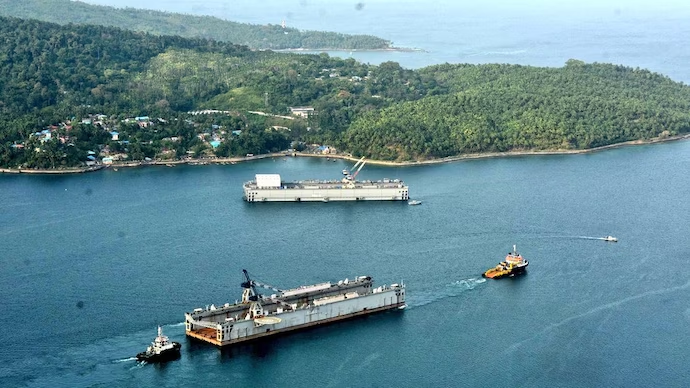
India’s Great Nicobar Island project ranks among the largest and most ambitious infrastructure ventures. Announced in August 2020, valued at roughly ₹81,000 crore (around $10 billion), it plans a world-class deep-sea international container transshipment terminal, a greenfield international airport, townships, and gas-solar power plants. NITI Aayog leads this initiative, while the Andaman and Nicobar Islands Integrated Development Corporation (ANIIDCO) drives implementation.
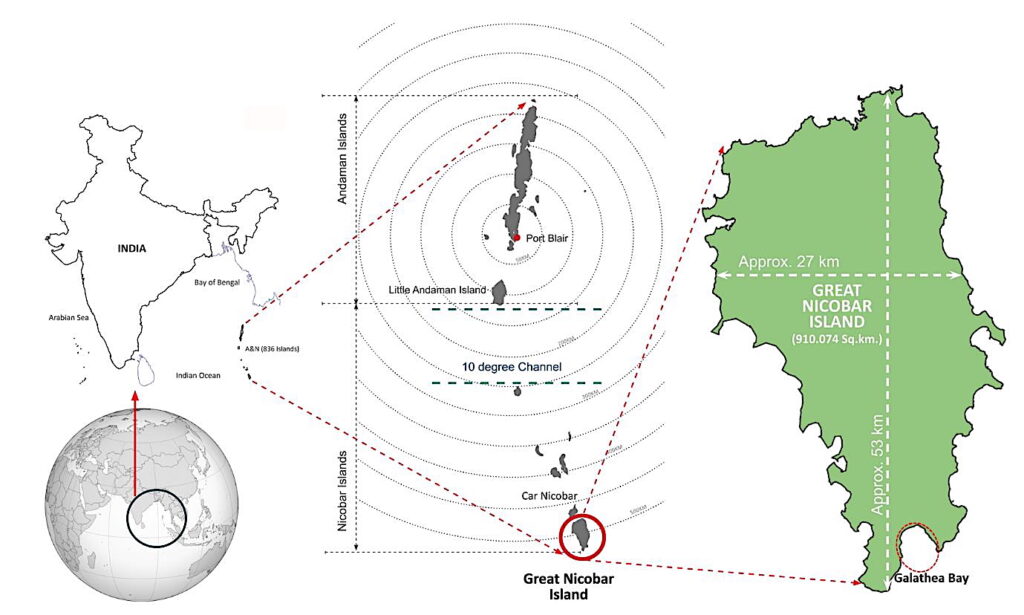
A major strategic and economic initiative project spans 166 square kilometres on Great Nicobar Island, facilitating a strategically located port at the island’s southern tip near the western entrance to the Malacca Strait, a critical maritime corridor.
However, Congress Chairperson Mrs. Sonia Gandhi has labeled it a “grave misadventure” in her article dated 07 Sept 2025 that has been reposted by the Leader of Opposition Mr. Rahul Gandhi, Congress MPs from Kerala Mr. Shashi Tharoor and Mrs. Priyanka Gandhi Vadra. Mr. Tharoor mentioned the importance of development and having a strategic base on the island, but stressed it can also be done in an ecological manner.
This Insight Report examines key facts and offers a balanced perspective on why the project must proceed responsibly to serve India’s growth and protect tribal welfare.
Strategic and Economic Importance
Great Nicobar Island lies near the Malacca Strait, a vital global maritime corridor. The Galathea Bay Port will handle up to 16 million TEUs (twenty-foot equivalent units). This capacity will reduce India’s dependence on foreign transshipment hubs like Colombo, Port Klang and Singapore. Furthermore, a greenfield airport will handle 4,000 passengers per hour by 2050, supporting civilian and defense operations.
The planned township will house 300,000 to 400,000 residents, including residential and commercial areas. The project also includes a 450 MVA gas and solar power plant to ensure energy security. These facilities promise job creation, economic growth, and better connectivity.
Importantly, the project supports India’s Act East Policy and SAGAR (Security and Growth for All in the Region) initiative. These frameworks strengthen India’s maritime presence and secure vital sea lanes amid rising Chinese influence. Therefore, this development marks a key step toward securing India’s maritime future and economic prospects.
Ecological and Tribal Concerns
The development will affect about 130.75 square kilometers of forest, impacting unique biodiversity such as the Nicobar megapode and leatherback turtles. Over one million trees will be felled.
The island hosts approximately 1,200 indigenous people, mainly Nicobarese (1,000) and Shompen (200), with the latter classified as a Particularly Vulnerable Tribal Group (PVTG). Around 84 square kilometers fall under tribal reserves, while 7.11 square kilometers will be denotified for development.
The government insists no tribal villages will face forced displacement. Instead, plans include re-notifying tribal reserves in other island areas. Tribal welfare initiatives focus on housing, education, skill development, and healthcare, all developed with continuous tribal consultations to ensure their participation and consent.
Oversight and Monitoring Committees
To address environmental and social issues, the Ministry of Home Affairs sanctioned ₹88.69 crore for conservation, tribal welfare, and pollution control. The estimated total spending for biodiversity conservation and tribal development over 30 years reaches ₹9,162 crore.
Three committees oversee compliance. These panels include experts from the Wildlife Institute of India, Botanical Survey of India, Zoological Survey of India, and ANIIDCO. They monitor ecological health, tribal rights, and pollution levels. These committees perform rigorous fieldwork, provide reports, and suggest mitigation strategies.
Opposition and Political Narrative
Sonia Gandhi and Congress leaders criticized the project as “an ecological disaster” and “a planned misadventure.” Their objections focus on deforestation, the threat to tribal cultures, legal bypasses, and seismic risks. They also claim the government sidestepped constitutional protections for tribal groups.
Although these points raise important ethical and environmental concerns, political rhetoric sometimes overshadows constructive discussion. Meanwhile, the government has tried to address challenges transparently through clearances, monitoring, and dialogue with tribes. Labeling the entire project as a misadventure overlooks strategic priorities and visible progress.
The project received environmental clearance in November 2022 after thorough impact assessments. Monitoring committees activated in 2023 led to ₹88.69 crore allocation for conservation and tribal welfare to date. Preparatory actions like dredging and breakwater construction have started or will commence between 2024 and 2025.
Project Timeline and Current Status
Environmental clearance was granted in November 2022 after detailed impact assessments. Since 2023, monitoring committees have been active, and Rs 88.69 crore has been allocated to conservation and tribal welfare. Preparatory and preliminary infrastructure work, such as dredging and breakwater construction, is underway or scheduled from 2024-2025 onwards.
The first construction phase aims to operate the port’s 4 million TEU capacity by 2028. The full project will expand in phases over 30 years, with township and infrastructure development continuing through the 2050s.
Conclusion: A Balanced Path Forward
The Great Nicobar Island project reflects India’s goals for maritime security, economic growth, and regional influence. It promises benefits in employment and infrastructure.
At the same time, the project demands respect for ecology and indigenous tribes. It requires careful handling, independent oversight, and inclusive governance.
Opposition should avoid politicized accusations. Rather, critics need to provide meaningful input to protect tribal rights while supporting India’s development ambitions.
India can achieve a win-win outcome. It can strengthen its geopolitical position while uplifting communities and conserving nature. Responsible, transparent, and inclusive development will drive this transformation.