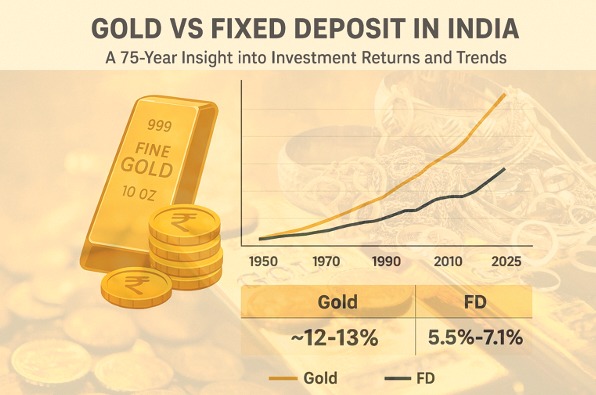
Gold vs Fixed Deposit in India: A 75-Year Insight into Investment Returns and Trends
Gold prices surged above $4,050 per ounce on October 8, 2025, marking a new all-time high. The metal has risen 53% since the beginning of the year, far outpacing major U.S. stock indices such as the Dow Jones, S&P 500, and Nasdaq Composite. This remarkable rally highlights gold’s enduring appeal as a global safe-haven asset amid inflationary pressures and market volatility.
In India, where gold is more than just an investment but a symbol of wealth, security, and tradition, this global surge reinforces its long-standing cultural and financial significance. For decades, Indian households have debated whether to hold gold jewellery (22-karat) or convert that wealth into fixed deposits (FDs) for assured returns. The crucial question remains: over seven decades, which of these options has delivered superior long-term growth?
This article offers a data-driven comparison of gold vs fixed deposit in India, supported by verified gold price records from 1950 to 2025 and current FD interest rate trends.
Gold Price Evolution in India (1950–2025)
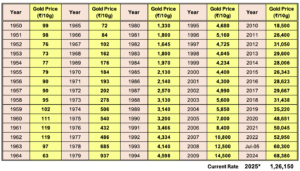
Below is the complete price history of 10 grams of gold (₹/10g), tracing its extraordinary rise from ₹99 in 1950 to ₹1,26,150 in 2025.
[Sources: Arthgyaan, BankBazaar, Motilal Oswal, Forbes India]
Fixed Deposits: The Safe Yet Slower Path
Fixed deposits remain a staple of Indian saving habits because of their security and guaranteed income. However, their returns have generally been modest.
According to ICICI Bank’s official rate chart, most FDs in 2025 offer 5.5%–7.1%, with senior citizens getting up to 7.5%.
While this steady income suits risk-averse savers, inflation and taxation often reduce the real returns. During the 1990s, FDs briefly touched 12–13%, but those levels have not returned since.
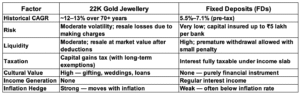
Head-to-Head: Gold vs Fixed Deposit
The Road Ahead: Can Gold Sustain Its Momentum?
Experts from major financial houses (Motilal Oswal, Forbes India) expect gold to maintain an upward trajectory.
Forecasts suggest gold could reach between ₹1,40,000 and ₹2,25,000 per 10 g by 2030, implying an annual growth rate of roughly 7–11%, while FDs may stay below 7%.
Strategic Recommendations for Investors
Long-Term Wealth Builders: Hold a portion of assets in gold coins or bars for higher resale value.
Risk-Averse Savers: Continue using FDs for secure and predictable income.
Balanced Approach: Diversify with a blend of gold, FDs, equities, and bonds for optimum growth.
Modern Alternatives: Consider Sovereign Gold Bonds (SGBs) and digital gold, which provide liquidity and tax advantages.
Conclusion
Over the last 75 years, gold has consistently outperformed fixed deposits as a long-term store of wealth in India. While FDs ensure safety and stability, their inflation-adjusted returns are modest.
Gold, on the other hand, remains both a cultural and financial pillar — providing resilience against inflation, currency depreciation, and market volatility.
A prudent strategy combines the strengths of both — gold for value preservation and FDs for steady income — ensuring your portfolio remains both secure and growth-oriented.