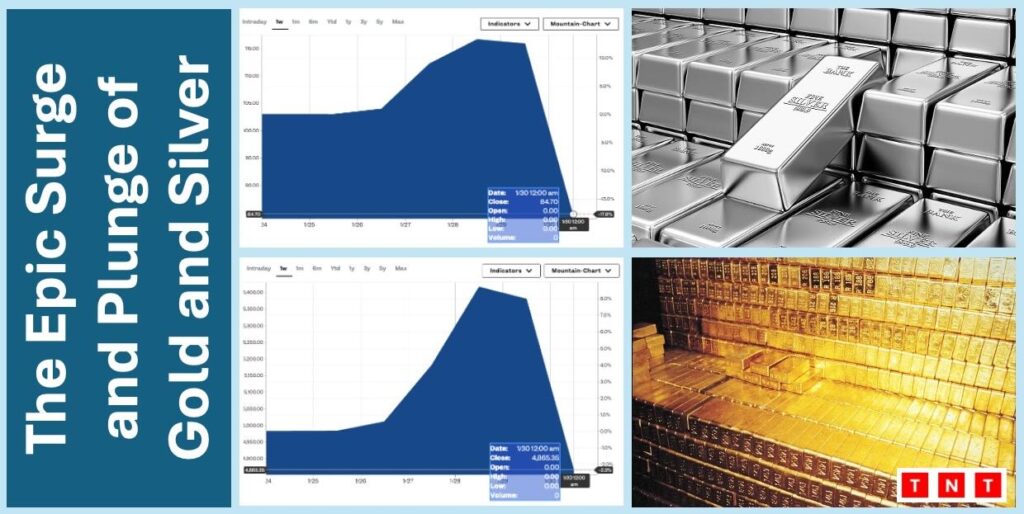
The Meteoric Rise and Catastrophic Crash of Gold and Silver: A $7 Trillion Wipeout in Precious Metals
Gold and Silver Crash 2026: From Record Highs to Rapid Unwind
The global precious metals market suffered one of its sharpest reversals in modern history on January 30, 2026, as gold and silver prices collapsed following a sudden reassessment of US monetary policy.
Gold fell from a record high above $5,600 per ounce to intraday lows near $4,700, while silver plunged from over $121 to around $77. The combined market value erosion across bullion, derivatives, exchange-traded funds, and mining equities is estimated at $6.5–7 trillion, making the episode one of the largest wealth contractions ever recorded in commodity markets.
The speed of the decline transformed what had been celebrated as a “new precious metals super cycle” into a case study in leverage-driven instability.
How the Precious Metals Boom Took Shape
Inflation Anxiety and Dollar Weakness
The rally that culminated in January 2026 began accelerating in late 2025. Persistent inflation pressures, fiscal expansion debates in Washington, and concerns over currency debasement pushed global investors toward hard assets.
The US dollar weakened steadily through much of 2025, reinforcing demand for dollar-denominated commodities. Gold, traditionally viewed as a monetary hedge, benefited directly from this trend.
By mid-January 2026, gold had crossed $5,000 for the first time, reflecting gains of nearly 30% within a few months.
Central Bank Accumulation and Geopolitical Risk
Central banks—particularly in Asia, the Middle East, and parts of Africa—continued diversifying reserves away from Western currencies. Official sector purchases added structural support to prices.
Simultaneously, geopolitical uncertainty—from Middle East conflicts to renewed trade frictions—sustained safe-haven inflows, reinforcing bullish sentiment.
Silver’s Speculative Acceleration
Industrial Demand and Technology Narratives
Silver’s rally outpaced gold due to its hybrid identity. Alongside its monetary appeal, silver plays a critical role in solar panels, semiconductors, EVs, and advanced electronics.
The rapid expansion of AI infrastructure and renewable energy capacity translated into optimistic long-term demand projections, drawing capital from both industrial and financial investors.
ETF Inflows and Leverage Expansion
Exchange-traded funds such as iShares Silver Trust (SLV) and SPDR Gold Shares (GLD) recorded record inflows during late 2025 and early 2026. Futures open interest also surged as hedge funds and retail traders increased leveraged exposure.
By January 29, silver had breached $120 per ounce, posting year-to-date gains exceeding 40% and attracting comparisons with previous commodity manias.
The Policy Shock: Fed Leadership Repriced Risk
Kevin Warsh Nomination Alters Expectations
The decisive turning point came when President Donald Trump nominated Kevin Warsh as the next Chair of the Federal Reserve.
Markets had anticipated a dovish successor aligned with calls for rate cuts and monetary accommodation. Warsh’s record, however, suggested commitment to price stability and institutional independence.
The nomination abruptly altered interest rate and currency expectations.
Dollar Rebound and Capital Rotation
Following the announcement, the US dollar index surged against major currencies. Rising yields and renewed confidence in policy discipline prompted capital to rotate away from inflation hedges.
This shift undermined the central narrative sustaining the metals rally.
Leverage, Margin Calls, and Market Contagion
Forced Liquidation in Futures Markets
As prices fell, margin requirements were breached across futures positions. Brokers and clearing houses issued widespread margin calls, forcing traders to liquidate holdings.
Gold futures closed down nearly 9% at around $4,901, while silver futures declined over 31% to approximately $78.50.
Spot prices briefly fell lower before stabilising.
Impact on Equities and ETFs
Mining stocks, commodity ETFs, and resource-linked equities experienced heavy losses. Broader equity markets also weakened as investors reassessed growth and liquidity assumptions.
The episode illustrated how derivative-driven markets can transmit shocks rapidly across asset classes.
Fundamentals Versus Financial Engineering
Physical Demand Remains Resilient
Despite the financial turbulence, physical demand indicators showed little deterioration. Jewellery consumption, industrial usage, and central bank accumulation remained broadly intact.
Mine supply constraints and rising production costs also continue to limit long-term output growth.
Speculation and Structural Fragility
Most analysts view the collapse as a correction of excessive positioning rather than a fundamental breakdown.
High leverage, crowded trades, and narrative-driven capital flows created systemic fragility that was exposed by a single policy signal.
Controversies and Market Confidence
Manipulation Allegations Resurface
As in previous commodity downturns, claims of institutional manipulation surfaced on social media. Critics cited margin hikes and alleged short selling by major banks.
However, regulatory filings and exchange disclosures indicate that standard risk management mechanisms were applied amid extreme volatility.
Transparency and Market Trust
The episode has renewed debate over transparency, position limits, and retail investor protection in commodity derivatives markets.
Outlook: Reset or Structural Turning Point?
Short-Term Consolidation
By early Saturday, prices showed tentative signs of stabilisation, with gold near $4,880 and silver around $85.
Technical indicators suggest consolidation rather than immediate trend reversal.
Medium-Term Drivers Remain Intact
Structural factors—including geopolitical fragmentation, reserve diversification, energy transition, and fiscal expansion—continue to support long-term demand for precious metals.
However, valuation discipline and leverage control are likely to shape future cycles more strictly.
A Lesson in Modern Market Dynamics
The gold and silver crash of 2026 demonstrates how contemporary markets operate at the intersection of narrative, leverage, and policy.
What appeared to be a structurally supported rally proved vulnerable to a single shift in expectations. In an era of algorithmic trading and derivative dominance, price discovery has become increasingly sensitive to institutional signals.
For investors, the episode reinforces a central truth: in finkncialised commodity markets, conviction without risk management is indistinguishable from speculation.
ALSO READ
👉🏿 Gold Breaks $5,200 as Global Uncertainty Drives Historic Safe-Haven Rush
👉🏿 Precious Metals Remain in the Spotlight: Why Gold and Silver Are Holding Their Shine