GHATAK: India’s Shadow-Wing—A Silent Blade Forged for the 2030s Battlefield
The Aircraft Born in Silence
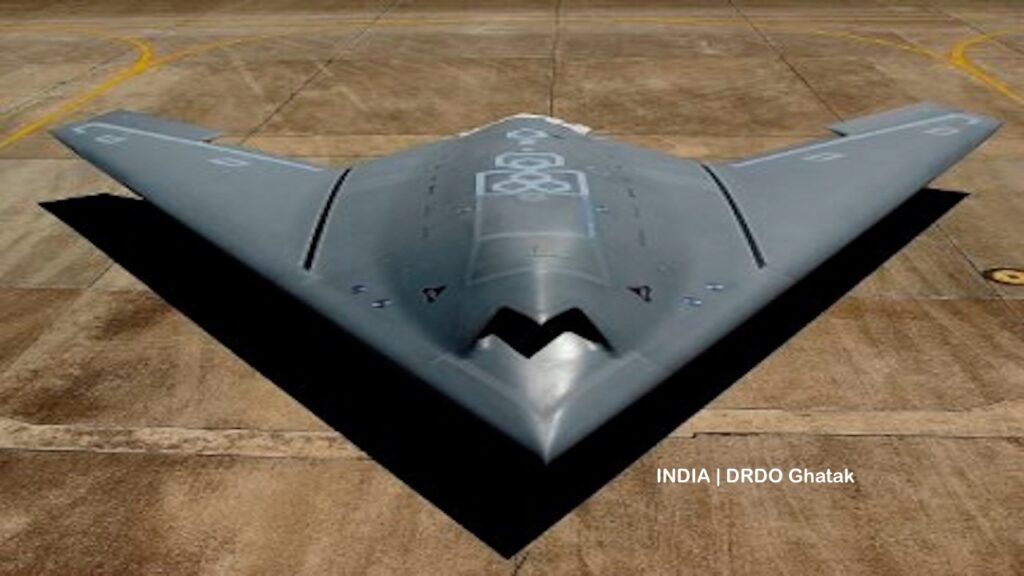
In an anonymous corner of a Bengaluru research compound, a dark, angular shape rests under floodlights, silent and half-born. Engineers from the Aeronautical Development Establishment (ADE) walk around it with a quiet sense of urgency. The atmosphere resembles the calm before a significant breakthrough. The prototype is Ghatak (घातक), India’s stealth Unmanned Combat Aerial Vehicle (UCAV), and though it is still taking shape, its purpose already represents a decisive shift in India’s airpower ambitions.
Modern air warfare has evolved faster than manned doctrine can adapt. Long-range radars, layered missile defences and sophisticated sensor grids have turned the first hours of conflict into the most dangerous. India needed a system that could enter this hostile airspace first, strike without hesitation and survive. Ghatak emerges as the weapon designed for that mission.
Origins and the Need for a Shadow-Wing
This UCAV is not a support drone or a reconnaissance tool. It is a strike aircraft built for the most lethal parts of a mission. Its flying-wing geometry, softened edges and internal weapons carriage exist solely to reduce radar detectability. In a future conflict, it may cross the enemy’s border long before manned fighters appear. It could blind air-defence radars, cripple command nodes and carve safe lanes in the sky.
Yet Ghatak did not begin here. Its roots lie in the Autonomous Unmanned Research Aircraft (AURA) programme, which started in 2009 as an experiment in flying-wing stealth. AURA never aimed for flight but taught India vital lessons about tailless aerodynamics and stealth shaping. Those early experiments shaped the aircraft that Ghatak would later become.
SWiFT: The Testbed That Made Ghatak Possible
The leap from concept to flight was made through SWiFT (Stealth Wing Flying Testbed), the scaled demonstrator that first flew in 2022. SWiFT proved that a tailless flying-wing could take off, manoeuvre and land autonomously. It validated stealth contours, composite structures and control laws essential for Ghatak. Many of its trials were never publicised, yet within India’s aerospace community they are seen as the foundation that allowed the UCAV to progress.
The Bureaucratic Hurdle and the Determined March Forward
While technology advanced, paperwork slowed the programme. The Cabinet Committee on Security (CCS) is yet to clear the full financial sanction of roughly ₹5,000 crore. But India has seen rare persistence in this UCAV programme. Under phased allocations, ADE and its partners have already moved ahead with fabrication, full-scale testing and integration. In the Indian defence ecosystem, Ghatak is one of the few programmes where engineering progress outpaces official paperwork.
Stealth, Strike and the Design for Survival
Ghatak’s purpose is stark. It must be nearly invisible. Its manta-ray-like profile, internal weapon bays and carefully sculpted wing edges all contribute to its low radar cross-section. Even its exhaust is positioned to reduce thermal signature. This architecture reflects the Indian Air Force’s slow but certain embrace of unmanned-first operations. Ghatak is expected to precede fighters such as Tejas Mk-II and the Advanced Medium Combat Aircraft (AMCA) into contested airspace, executing missions far too risky for human pilots.
The Engine That Returned From the Past
At the heart of the UCAV lies a remarkable comeback story—the dry Kaveri engine, developed by the Gas Turbine Research Establishment (GTRE). Once deemed inadequate for the Tejas fighter, the non-afterburning Kaveri variant turned out to be ideal for a stealth UCAV. It produces around 49–52 kN thrust, offers better fuel economy and emits lower heat signatures. High-altitude tests in Russia proved its viability. In-flight trials aboard an Ilyushin-76 (Il-76) platform are expected to complete certification by 2026. With this, India may field a stealth UCAV powered by an indigenous engine, an accomplishment achieved by only a handful of nations.
The Evolution of Stealth Materials
Stealth is not only about shape. India is developing advanced coatings such as the RAMA (Radar Absorption & Multispectral Adaptive) multispectral system. It absorbs radar energy and reduces infrared detection. Although its integration with Ghatak is not confirmed, its very existence strengthens the programme. It also signals a maturing stealth ecosystem in the country.
The Rise of a Public–Private Aerospace Alliance
The Ghatak programme marks the most significant collaboration between DRDO and private industry in an aircraft development cycle. Larsen & Toubro (L&T) fabricates the airframe under the Development-cum-Production Partner model. Godrej Aerospace produces early engine units, while institutes such as the IIT Bombay and IIT Kanpur contribute aerodynamic computation, structural modelling and systems analysis. This hybrid ecosystem reflects the model India will need for all major aerospace programmes in the future.
The Road Ahead and the Promise of a New Doctrine
The first full-scale prototype is expected to roll out by 2026, with a maiden flight targeted for late 2025 or early 2026. The IAF has already factored Ghatak into its 2030s doctrine and anticipates around 150 aircraft in service. In that future battlespace, the UCAV will work seamlessly with manned fighters, operating as an autonomous strike partner and a frontline penetrator.
Above all, Ghatak represents a deeper transformation in India’s airpower philosophy. It acknowledges that the riskiest missions should no longer fall on pilots. It accepts that survival in modern warfare depends on invisibility. And it marks India’s entry into a domain where machines strike first, long before radar operators know something is coming.
GHATAK Specifications
Ghatak is a flying-wing stealth UCAV with an approximate maximum take-off weight of around 13 tonnes.
It carries its armament internally and is expected to support a payload close to 1.5 tonnes of precision-guided munitions.
It is built for deep-penetration strike missions at subsonic speeds with a service ceiling reaching nearly 30,000 feet.
The aircraft uses a dry Kaveri turbofan engine generating roughly 49–52 kN thrust for improved endurance and lower infrared visibility.
The UCAV is designed for SEAD/DEAD (Suppression/Destruction of Enemy Air Defences) roles, high-risk reconnaissance and autonomous operations in heavily defended airspace.
GHATAK Agencies
ADE of the Defence Research and Development Organisation (DRDO) leads the programme, handling design, integration and autonomous flight systems.
The Aeronautical Development Agency (ADA) contributed the early flying-wing concept through the AURA programme and continues as an advisory design partner.
GTRE develops the dry Kaveri engine that powers the UCAV and manages all propulsion trials.
The IAF defines operational requirements and plans for nearly 150 UCAVs across future squadrons.
Larsen & Toubro fabricates the airframe as the Development-cum-Production Partner and supports prototype construction.
Godrej Aerospace manufactures the initial batch of dry Kaveri engines for integration and testing.
IIT Bombay and IIT Kanpur support aerodynamic studies, control-law research and structural optimisation work.
A New Shape in India’s Strategic Sky
When Ghatak finally cuts through the air on its maiden flight, it will represent years of persistence, experimentation and quiet determination. It will also mark the moment India steps into a league where only a few nations operate fully indigenous stealth strike UCAVs. It is a shadow-wing built for battles no pilot should face. It is the future taking shape in silence.
Read more about the combat drones and the modern warfare:
Modern Grammar of Warfare: How India Is Using Drones to Draft Its Own Chapter