NATO Ally, Japan Advance 100kW Laser Weapons as Counter-Drone Warfare Accelerates
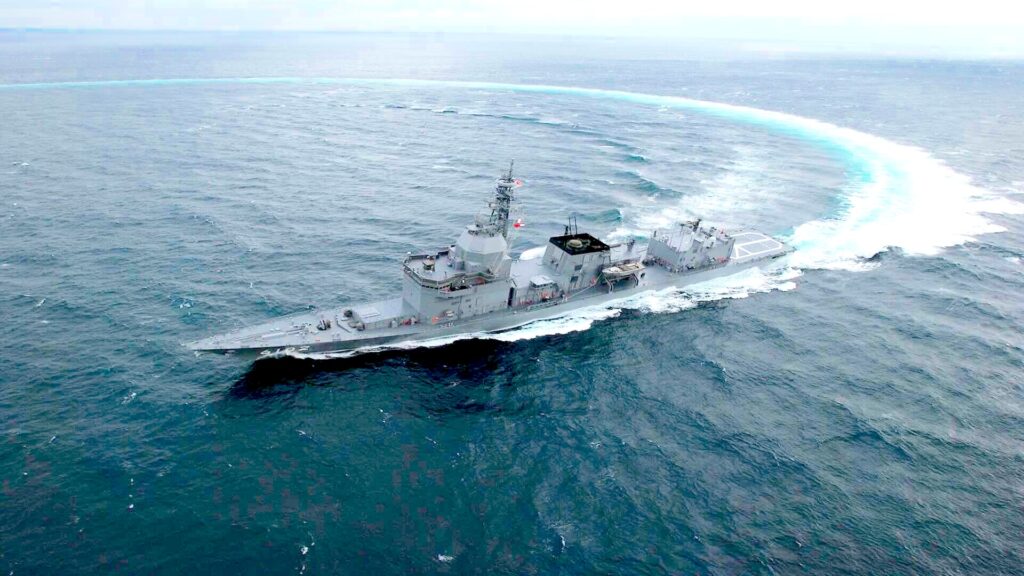
The quiet delivery of a 100kW high-energy laser weapon by Australia-based EOS to a European NATO country, followed by Japan’s installation of a similar system on its naval test ship JS Asuka, signals more than technological progress. It marks a doctrinal inflection point in how modern militaries are preparing to fight the drone-dominated battles of the coming decade.
Directed-energy weapons, once dismissed as laboratory curiosities, are now being treated as credible frontline tools. The shift reflects a strategic recognition that missile-centric air defence models are increasingly unsustainable against cheap, mass-produced, and expendable aerial threats.
The Economics of Air Defence Are Breaking
Traditional air defence systems were designed to counter aircraft and missiles that were themselves expensive and limited in number. That logic collapses when a defender is forced to fire million-dollar interceptors at drones costing a few thousand dollars.
This is where the 100kW laser weapon fundamentally alters the equation. With a cost per shot measured in cents, laser systems invert the attacker–defender cost ratio. For the first time in decades, defence becomes economically scalableagainst saturation attacks.
From a strategic perspective, this is not just a tactical advantage. It restores deterrence credibility by denying adversaries the ability to overwhelm defences through numbers alone.
Why 100kW Is the Threshold That Matters
Lower-power lasers have existed for years, but they were largely confined to dazzling sensors or damaging optics. The 100kW class represents the threshold where lasers can reliably destroy airframes, control surfaces, and propulsion systems in seconds.
At this power level, lasers become kinetic substitutes, not supplements. They engage targets at the speed of light, require no reloads, and can fire repeatedly as long as power and cooling are available. This explains why militaries are converging around the 100kW benchmark.
The EOS system’s modular design—combining multiple 50kW beams—also points to a future where power levels can be scaled further without redesigning entire platforms.
Japan’s Naval Laser: A Signal to the Indo-Pacific
Japan’s decision to mount a 100kW laser on the JS Asuka is strategically significant. It reflects Tokyo’s assessment that future naval threats will include drone swarms, loitering munitions, and low-cost aerial platforms operating close to surface vessels.
Missiles remain indispensable, but they are ill-suited for persistent drone harassment. Lasers, by contrast, offer a first layer of defence, conserving missiles for higher-end threats.
Japan’s emphasis on testing under real maritime conditions—sea spray, humidity, ship motion—suggests a sober understanding of laser limitations. The trials are not publicity exercises; they are an attempt to determine whether lasers can be operationally reliable, not merely powerful.
The ‘Unlimited Magazine’ Concept and Its Limits
The phrase “unlimited magazine” is often used to describe laser weapons. Strategically, this is both true and misleading. Lasers are constrained by power generation, cooling cycles, and atmospheric conditions.
However, even with these constraints, a laser-equipped ship or vehicle can engage dozens of targets consecutivelywithout exhausting ammunition stocks. In sustained engagements, this endurance becomes decisive.
For militaries planning for long-duration conflicts rather than short, high-intensity wars, this endurance may prove more valuable than raw destructive power.
A Global Convergence, Not Isolated Experiments
The parallel progress of EOS in Europe, Japan in the Indo-Pacific, the US Army, and Israel’s Iron Beam suggests convergence rather than coincidence. Different threat environments are producing the same conclusion: missiles alone cannot defend against the drone age.
Israel’s operational claims, the US Army’s long-running prototypes, and Japan’s disciplined test programme indicate that directed-energy weapons are moving along different timelines but toward the same destination.
This convergence also hints at future interoperability within alliances, where laser-equipped units provide layered defence alongside traditional systems.
Strategic Implications: Defence Without Escalation
One understated advantage of laser weapons is their escalation control potential. Lasers can neutralise threats with minimal collateral damage, no explosive debris, and no secondary detonations.
In grey-zone conflicts and peacetime deterrence scenarios, this matters. A laser interception is less escalatory than a missile launch, particularly near civilian infrastructure or contested maritime zones.
For NATO and Indo-Pacific navies alike, this may allow firmer defence postures without automatic escalation.
Not a Silver Bullet, but a Structural Shift
Laser weapons will not replace missiles, guns, or electronic warfare. Weather, power demands, and countermeasures will limit their effectiveness. Adversaries will adapt.
Yet the strategic shift is undeniable. By restoring economic balance, enabling sustained defence, and reducing escalation risks, 100kW laser weapons are redefining what effective air defence looks like.
The delivery to a NATO country and Japan’s sea trials are early signals of a future battlefield where energy, not ammunition, becomes the decisive resource.