F-22 Raptor Makes Historic Breakthrough by Commanding MQ-20 Robotic Wingman in Flight
A Test That May Redefine Air Combat
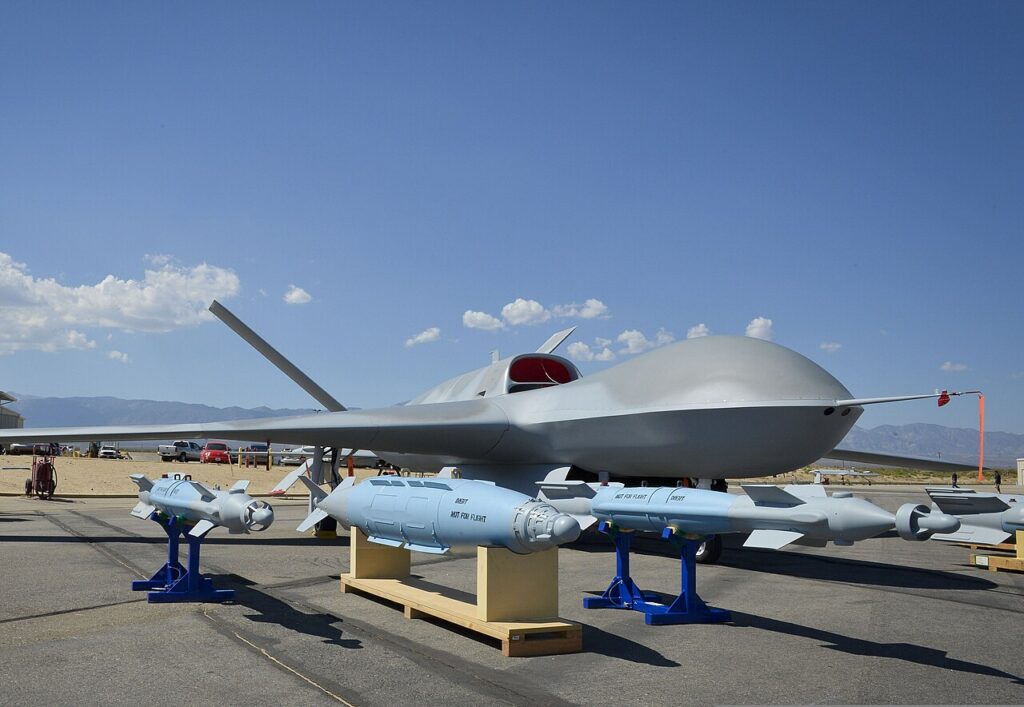
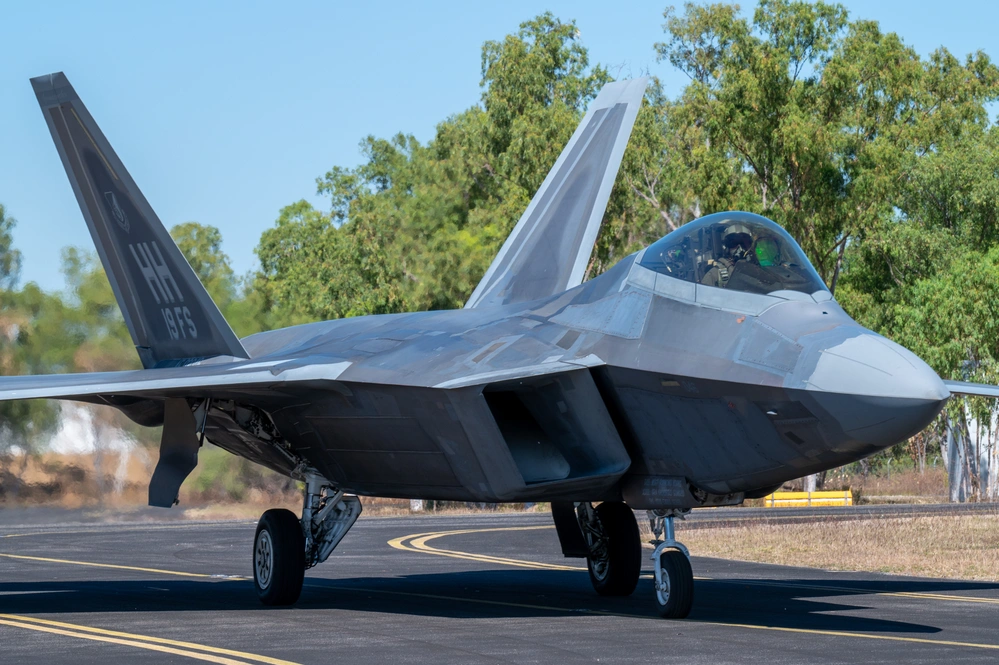
The future of aerial warfare arrived quietly but unmistakably over the Nevada Test and Training Range on October 21, 2025, when an F-22 Raptor, the world’s premier air-superiority fighter, successfully took command of an MQ-20 Avenger, a stealthy unmanned combat drone designed as a “loyal wingman.” In a single flight, a human pilot sitting alone inside a fifth-generation fighter managed, through a secure tablet and advanced data links, to direct an autonomous companion aircraft—marking one of the most consequential breakthroughs in modern military aviation.
This was not a simulation, nor a laboratory experiment. It was a fully operational, in-flight demonstration that validated years of research by the U.S. Air Force and American defence industry. Most importantly, it showcased that the era of manned fighters leading teams of robotic wingmen is no longer theoretical. It has begun.
Inside the Breakthrough — How the F-22 Controlled the MQ-20
For decades, the F-22 has been revered for its unmatched stealth, super-cruise capabilities, and air-dominance pedigree. But the October 21 mission introduced a capability never imagined when the aircraft first entered service: the ability for a lone pilot to manage another aircraft mid-air, not as a passenger or co-pilot, but as a commanding node in a distributed combat network.
Sitting inside the F-22’s single-seat cockpit, the pilot used a ruggedised tablet interface linked to encrypted communication channels to issue commands to the MQ-20 Avenger. The drone, developed by General Atomics, carried software that allowed it to interpret commands, plan sub-tasks autonomously, and execute manoeuvres without constant human input. Lockheed Martin, the developer of the F-22, and L3 Harris, the communications systems integrator, jointly enabled the seamless human–machine interaction that made the demonstration possible.
The result was a coordinated flight between a manned stealth fighter and a robotic wingman—one manoeuvring under the pilot’s direct instruction, the other performing complex autonomous behaviours in concert.
For air forces worldwide, the implications are profound. A single fighter can now expand its battlefield footprint by commanding unmanned partners that gather reconnaissance, carry weapons, and absorb risk in environments too dangerous for human pilots.
The MQ-20 Avenger — Designed for a New Kind of Air War
The MQ-20, while less famous than the Raptor, has emerged as a key platform in America’s push for autonomous air combat. It combines a stealthy airframe with sensor modularity, AI-driven autonomy, and the ability to operate either as a standalone strike drone or as part of a larger network surrounding a manned fighter.
In the test, the MQ-20 carried mission software capable of handling independent navigation, target tracking, and formation flight. This autonomy reduces the pilot’s cognitive burden, ensuring that the F-22 remains focused on combat while the drone executes delegated tasks.
This is the essence of the “loyal wingman” concept: not merely a remote-controlled drone, but a semi-independent aircraft working alongside its human commander.
The Start of the Collaborative Combat Aircraft Era
The demonstration is a crucial step toward the U.S. Air Force’s Collaborative Combat Aircraft (CCA) program, one of the largest future-force initiatives in American airpower. Under the CCA Concept, the service envisions fielding over 1,000 unmanned fighters within the next decade—aircraft designed to accompany stealth jets such as the F-22 and F-35, and even future systems like the sixth-generation F-47.
CCA assets will act as weapons carriers, jammers, scouts, and decoys. They will penetrate contested airspace, saturate enemy radars, and extend the range of a fighter package without exposing human pilots to extreme risk. The October test is one of the first operational validations of this ambitious strategy.
With the F-22 successfully taking command of a CCA-class platform, the Air Force has crossed a threshold that many believed was still years away.
F-22 vs. F-35 — Two Fifth-Generation Fighters, Different Strengths
As attention grows around the demonstration, comparisons naturally arise between the F-22 and the F-35—both fifth-generation fighters, but with distinctly different philosophies.
The F-22 Raptor
The F-22 was built for one overriding mission: air dominance.
Its twin-engine power allows it to reach Mach 2+, while thrust vectoring grants unmatched manoeuvrability. Its stealth shaping is optimised for air-to-air combat, and its avionics are fine-tuned for high-speed threat detection and engagement. When the U.S. military needs to control the skies, the Raptor is the aircraft it sends first.
The F-35 Lightning II
The F-35, by contrast, is built around versatility and information superiority.
While slower at Mach 1.6, it brings exceptional sensor fusion, long-range strike capability, and the ability to plug into a vast network of allied aircraft, ground stations, and satellites. It is a battlefield information hub—linking shooters, sensors, and commanders across domains.
Both aircraft benefit from stealth, but the F-35’s emphasis on data sharing makes it indispensable in modern, networked warfare.
It is important to note that F-22 Raptor is exclusively for the US Air Force; it is not available for sale to India or any country due to legal bans, production has shutdown, and strategic concerns.
Whereas, F-35 Lightning II is the stealth fighter the U.S. is willing to offer India as part of defence cooperation and modernisation efforts. It used by many NATO countries and currently agreement is being signed for its sale to Saudi Arabia.
Does the F-35 Have Robotic Wingman Capability?
While the October 21 test centred on the F-22, the F-35 is equally—perhaps even better—suited to commanding loyal wingman drones. The aircraft was engineered from the ground up as a digital platform, with architectures designed to incorporate autonomous systems.
Already, multiple ongoing USAF and joint-industry efforts involve pairing the F-35 with unmanned systems for coordinated missions. Its onboard computing power, advanced sensors, and multi-node communications give it the ability to manage swarms, control missile-carrying drones, and direct autonomous strike packages deep inside defended airspace.
The Air Force views both the F-22 and F-35 as central to the future CCA fleet. The Raptor may have taken the first historic step, but in operational terms, the F-35 is expected to become the primary command aircraft for robotic wingmen over the next decade.
Strategic Consequences — A Fundamental Shift in Airpower
The test flight is more than a technological achievement; it signals a deep transformation in how wars will be fought.
The integration of unmanned systems with stealth fighters enhances strike capacity dramatically. It allows a single pilot to deliver effects that might previously have required multiple aircraft. It creates layers of survivability by sending autonomous drones into dangerous environments first. And it provides unmatched situational awareness through distributed sensors feeding real-time data to the manned fighter.
For adversaries relying on dense air defence networks, the rise of loyal wingman architecture complicates targeting priorities and overwhelms detection systems. For the U.S. and its allies, it opens the door to unprecedented operational flexibility.
In contested environments, where air superiority is uncertain, manned-unmanned teaming offers a decisive advantage.
The Future of Aerial Combat Has Already Taken Flight
The F-22’s successful command of the MQ-20 Avenger is a watershed moment, not just for the U.S. Air Force but for global airpower strategy. It demonstrates that manned stealth fighters can now operate as the central node in a web of autonomous systems. It confirms the viability of the CCA vision. And it signals that both the F-22 and F-35 are positioned to dominate future conflicts—not alone, but accompanied by robotic partners designed to extend their reach, multiply their firepower, and safeguard their pilots.
What took place on October 21, 2025, was not just a test. It was the first real glimpse of the next generation of air warfare—and it will shape military aviation for decades to come.