EU-India Trade Deal 2026: Exports Set to Double
EU and India Seal Landmark Free Trade Agreement, Redefining Global Trade Ties
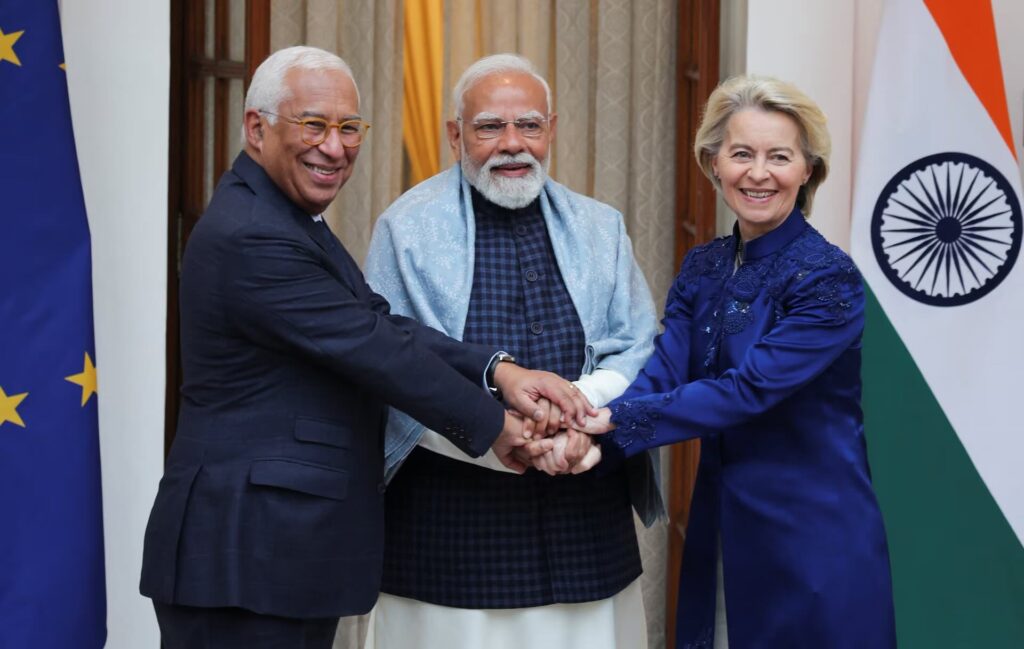
Brussels / New Delhi, 27 January 2026 — The EU-India Free Trade Agreement reached this week marks a decisive moment in the economic relationship between the European Union and India. After years of stalled negotiations, both sides have agreed on a framework that reshapes market access, lowers tariffs, and signals renewed commitment to rules-based global trade.
Under the agreement, the European Union will gain tariff reductions or full elimination on 96.6 per cent of its goods exports to India by 2032. EU officials expect the EU-India Free Trade Agreement to nearly double European goods exports to India within a decade, driven by improved access and reduced cost barriers.
Scope and Trade Commitments
The EU-India Free Trade Agreement focuses strongly on industrial and manufactured goods. Machinery, transport equipment, chemicals, and high-value intermediate products will benefit from phased tariff reductions. The agreement also simplifies customs procedures and clarifies rules of origin, which exporters often cite as major obstacles in the Indian market.
Indian negotiators have positioned the agreement as a long-term growth instrument rather than a short-term concession. Greater access to European markets is expected to support domestic manufacturing, encourage technology transfer, and attract foreign investment. The deal aligns with India’s broader strategy of integrating into global value chains while protecting sensitive sectors through gradual implementation.
Trade officials on both sides emphasised predictability as a core outcome. Clearer regulatory frameworks and dispute-resolution mechanisms aim to reduce uncertainty for businesses operating across borders.
Economic Impact on Both Sides
Trade between the EU and India already ranks among the largest bilateral economic relationships worldwide. It supports hundreds of thousands of jobs across manufacturing, logistics, and services. The EU-India Free Trade Agreement strengthens this base by removing long-standing tariff distortions that limited growth.
European manufacturers stand to gain immediate advantages in price competitiveness. Indian exporters, in turn, will benefit from expanded access to one of the world’s largest consumer markets. Analysts expect investment flows to rise as companies adjust supply chains to reflect the new trade environment.
While formal impact assessments will follow, early projections suggest sustained gains rather than short-term trade spikes. Both sides have deliberately designed the agreement to avoid sudden shocks to domestic industries.
Geopolitical and Strategic Context
The EU-India Free Trade Agreement carries strategic weight beyond trade figures. It arrives at a time when global commerce faces fragmentation, supply-chain stress, and geopolitical rivalry. By finalising this deal, Brussels and New Delhi send a clear signal in favour of economic openness and multilateral cooperation.
For the European Union, deeper engagement with India reduces dependence on limited trade corridors and strengthens partnerships in the Indo-Pacific. For India, the agreement reinforces its position as a key economic partner outside traditional power blocs.
Officials from both sides have framed the agreement as a foundation for broader cooperation. Areas such as clean technology, digital standards, and resilient supply chains are expected to feature prominently in future engagements.
Implementation and Next Steps
The success of the EU-India Free Trade Agreement will depend on execution. Regulatory coordination, sector-specific timelines, and effective monitoring mechanisms will shape outcomes on the ground. Sensitive sectors such as automobiles, agriculture, and digital trade will follow calibrated transition periods.
Ratification procedures will now move forward in both jurisdictions. Business groups have welcomed the agreement but stress the need for clarity and speed during implementation.
As the agreement enters its operational phase, it positions the EU and India as long-term economic partners rather than transactional traders. In an uncertain global order, the EU-India Free Trade Agreement stands as a rare example of strategic alignment backed by economic substance.
Also Read:
India–EU Security and Defence Partnership: Strategic Depth Beyond Symbolism